Customer Payment Terms: Compare Deposits, Milestones and Borrowing
Compare payment schedules for a fictional photography job, redesign an offer around a customer cash cap, and calculate a financing-only concession limit.

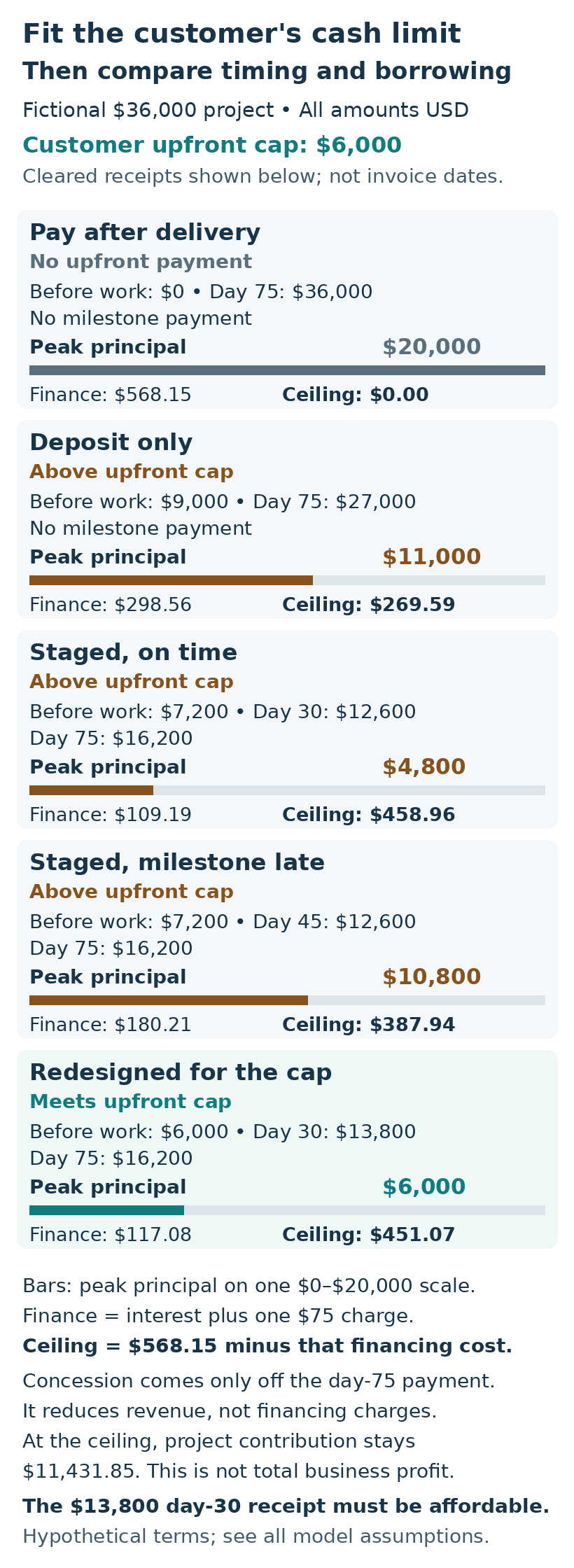
For the fictional $36,000 catalog-photography job below, propose staged payments if the customer can meet the dates. With a $6,000 upfront limit, the starting proposal is $6,000 before work begins, $13,800 clearing on day 30 and $16,200 clearing on day 75. Under this model, that needs $6,000 of peak borrowing and costs $117.08 to finance.
The recommendation depends on the customer’s ability to fund the larger second payment. Moving money to an earlier invoice helps only if the agreed work can be accepted and the payment becomes usable in time.
The job and the dates being negotiated
This is an invented business-to-business catalog-photography and image-editing project. Every amount, rate, facility condition, payment schedule and acceptance date below is hypothetical. All amounts are USD; the example makes no legal or tax conclusions for any country.
- Price: $36,000 before any negotiated concession.
- Project costs: $9,000 on day 0, $7,000 on day 15, $6,000 on day 30 and $2,000 on day 45, totaling $24,000.
- Cash committed by the business: $4,000. Other business cash is excluded.
- Work: a sample catalog-image set meeting agreed file and visual requirements is delivered on day 25. In the on-time scenario, acceptance and invoice processing allow milestone funds to clear on day 30. The project finishes on day 45; the final payment clears on day 75.
Work starts only after any agreed initial payment clears. Same-day customer receipts are assumed usable before that day’s costs. Customer agreement is a condition of each proposal, never a guaranteed outcome.
The hypothetical borrowing facility allows up to $22,000 of principal at 16% annual simple interest, calculated using 365 days, plus one $75 facility charge. Draws and reborrowing are assumed available when needed. Receipts repay outstanding principal first; surplus stays with the project. Interest and the charge are paid on day 75 after the final receipt, when the loan also matures. There are no interim charge payments, other fees, rate changes, minimum interest, restrictions or compounding. This is neither an available lender quote nor an APR.
Compare three opening proposals
- Pay after delivery: the entire $36,000 clears on day 75.
- Deposit only: $9,000 clears before starting and $27,000 on day 75.
- Staged payments: $7,200 clears before starting, $12,600 on day 30 and $16,200 on day 75.
Full-price outcomes for the same project. Financing cost includes interest and the single $75 charge. Contribution percentage uses the $36,000 price.
| Customer proposal | Peak principal | Financing cost | Project contribution | Contribution % |
|---|---|---|---|---|
| Pay after delivery | $20,000 | $568.15 | $11,431.85 | 31.76% |
| $9,000 deposit only | $11,000 | $298.56 | $11,701.44 | 32.50% |
| $7,200 plus day-30 milestone | $4,800 | $109.19 | $11,890.81 | 33.03% |
The larger $9,000 deposit produces more borrowing than the $7,200 staged proposal because it leaves all remaining receipts until day 75. The timing of the second payment matters more here than maximizing the first one.
Project contribution means customer revenue minus the $24,000 of specified costs and financing charges. It is not total business profit. The model excludes taxes, added overhead, refunds, disputes, cancellations, scope changes, collection losses, overruns and other cash flows. Any such obligations need a separate allowance before customer receipts are treated as spendable.
The $4,000 opening cash is a funding contribution, not another project expense. For example, the staged route ends with $15,890.81 cash after repayment and charges: $4,000 of opening funds plus $11,890.81 of project contribution. Neither ending cash nor returned opening funds should be mistaken for business profit. For a wider forecast, see the whole-business cash-gap sizing guide.
Staged payments still leave two borrowing needs
The $7,200 initial receipt plus $4,000 of committed cash covers day 0’s $9,000 cost and leaves $2,200. The day-15 cost is $7,000, so the business must borrow $4,800.
On day 30, the $12,600 milestone clears. Repaying $4,800 of principal and paying the $6,000 cost leaves $1,800. That is $200 short of day 45’s $2,000 cost, so the business borrows again and carries $200 until day 75.
Interest is each outstanding balance multiplied by its elapsed days and 16%, divided by 365. Sum the unrounded intervals, then round total interest once to cents. Here, $4,800 for 15 days plus $200 for 30 days produces $34.19 interest. Adding the $75 charge gives $109.19. The same method gives $493.15 interest for pay-after-delivery and $223.56 for deposit-only.
What if the milestone payment clears on day 45?
Keep the $7,200 initial receipt and every cost unchanged, but move the $12,600 receipt from day 30 to day 45. The unpaid $4,800 remains outstanding on day 30, when the business must borrow another $6,000. Peak principal becomes $10,800.
When the milestone finally clears on day 45, repaying $10,800 leaves $1,800. The same $200 final cost shortfall still needs borrowing. Interest rises to $105.21 and total financing cost to $180.21, an increase of $71.02. Full-price project contribution falls to $11,819.79, or 32.83% of revenue.
This delay still fits the assumed $22,000 principal limit, but it changes the funding commitment substantially. An invoice issued on day 30 cannot support a cost due that day if acceptance or processing keeps the money unavailable. A different clearance date needs a new calculation.
Redesign the offer for a $6,000 upfront cap
A customer with only $6,000 available before work starts cannot meet either the $9,000 deposit or the $7,200 initial staged payment. The lower modeled cost of those proposals does not make them feasible for that customer.
Move $1,200 from the initial staged payment to the day-30 milestone:
- Before starting: $6,000 clears.
- Day 30: $13,800 clears after the agreed sample-set acceptance and processing.
- Day 75: $16,200 clears.
This leaves $1,000 after day 0’s cost, requiring $6,000 borrowing on day 15. The day-30 receipt repays that principal, covers the $6,000 cost and leaves $1,800. The $200 day-45 borrowing need remains.
Financing costs $117.08, comprising $42.08 interest and the $75 charge. Full-price project contribution is $11,882.92, or 33.01%. Accommodating the upfront cap therefore costs $7.89 more than the original on-time staged proposal.
This version assumes the customer can fund $13,800 on day 30. If that larger payment is also unaffordable, negotiate and calculate another schedule before relying on it. The earlier delay test used the $7,200 initial payment; its figures do not automatically apply to this redesigned offer.
Set a financing-only ceiling on any price concession
Use the full-price pay-after-delivery contribution of $11,431.85 as the comparison point. The maximum concession that preserves that amount is:
$568.15 baseline financing cost minus the chosen proposal’s financing cost.
This test deducts a concession only from the final day-75 payment. Earlier receipts and all costs stay fixed, so the borrowing intervals and financing charges stay unchanged for the amounts tested below. A concession sacrifices revenue; it is not an extra financing fee.
How much earlier receipts can justify on financing savings alone. The $360 test reduces total customer revenue to $35,640.
| Proposal | Maximum concession | Contribution with $360 concession | Difference from baseline contribution |
|---|---|---|---|
| $9,000 deposit only | $269.59 | $11,341.44 | $90.41 lower |
| $7,200; milestone on day 30 | $458.96 | $11,530.81 | $98.96 higher |
| $7,200; milestone on day 45 | $387.94 | $11,459.79 | $27.94 higher |
| $6,000 upfront cap; milestone on day 30 | $451.07 | $11,522.92 | $91.07 higher |
For the capped proposal, a $360 concession makes the final receipt $15,840. Contribution is $35,640 minus $24,000 minus $117.08, or $11,522.92. Its contribution percentage is $11,522.92 divided by the actual $35,640 revenue: 32.33%. Using the original $36,000 price would give the wrong denominator.
The $451.07 ceiling preserves baseline contribution exactly under these assumptions. Offering all of it leaves no extra contribution above that baseline to absorb an omitted cost. A $360 concession leaves only $91.07. Start without a concession if the customer accepts the schedule; use the ceiling to evaluate a request, not as an automatic discount.
Checks that could change this proposal
- What exact sample-set files and visual requirements will be delivered on day 25, and who can confirm acceptance?
- Can acceptance and the customer’s processing actually produce usable funds before the day-30 cost?
- Can the customer pay the proposed initial amount, the larger milestone and the final balance on those dates?
- Are the business’s $4,000 and the required borrowing capacity available when needed, including the delayed-receipt case being considered?
- What unresolved obligations or extra costs would prevent treating these receipts as available project cash?
Decision: with the stated $6,000 upfront cap, propose the redesigned schedule only if the $13,800 milestone is affordable and can clear on day 30. Keep the required borrowing available. If a $360 final-price concession is needed to secure those terms, it passes this narrow financing comparison; the deposit-only proposal does not. Rework the offer if the customer cannot meet its payment dates or the excluded obligations change the economics.
Reference
Australia’s business.gov.au lists payment timing options including upfront payment and instalments.
Export Payment Documents: A Two-Packet Review
A worked export-packet review follows an unresolved instruction proposal, an incomplete selected inventory and an unknown carrier arrangement, without inventing the missing evidence.
Profitable Business, Falling Cash: Reconcile the Difference
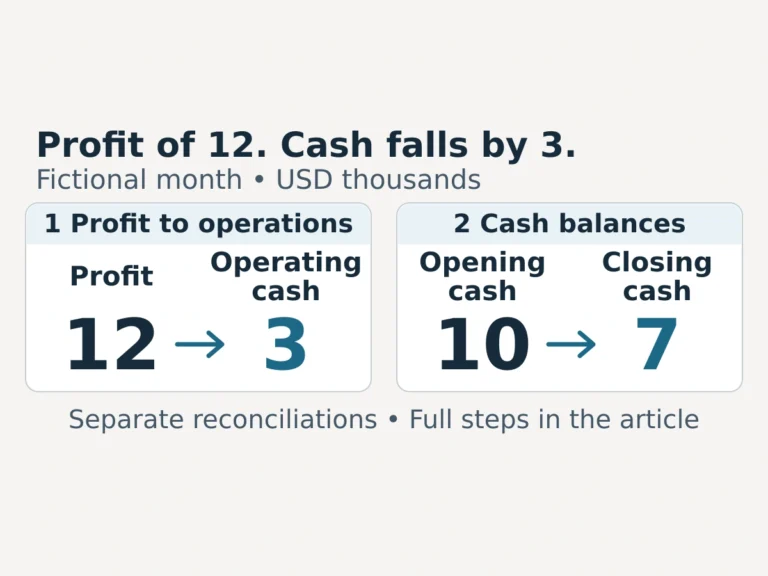
An invented one-month example reconciles net income, customer receipts, supplier payments, equipment, debt and an owner distribution to the closing cash balance.
One Customer Pays Late: Stress-Test Cash and Credit Availability Together
A fictional 13-week test shows how one late customer payment can reduce cash and credit capacity together, leaving a $6,000 gap before added financing…