Debt Collection Notice: What to Check Before Responding
Organize the sender, account, balance calculation, response details, and deadlines on a collection notice with a private six-part worksheet.

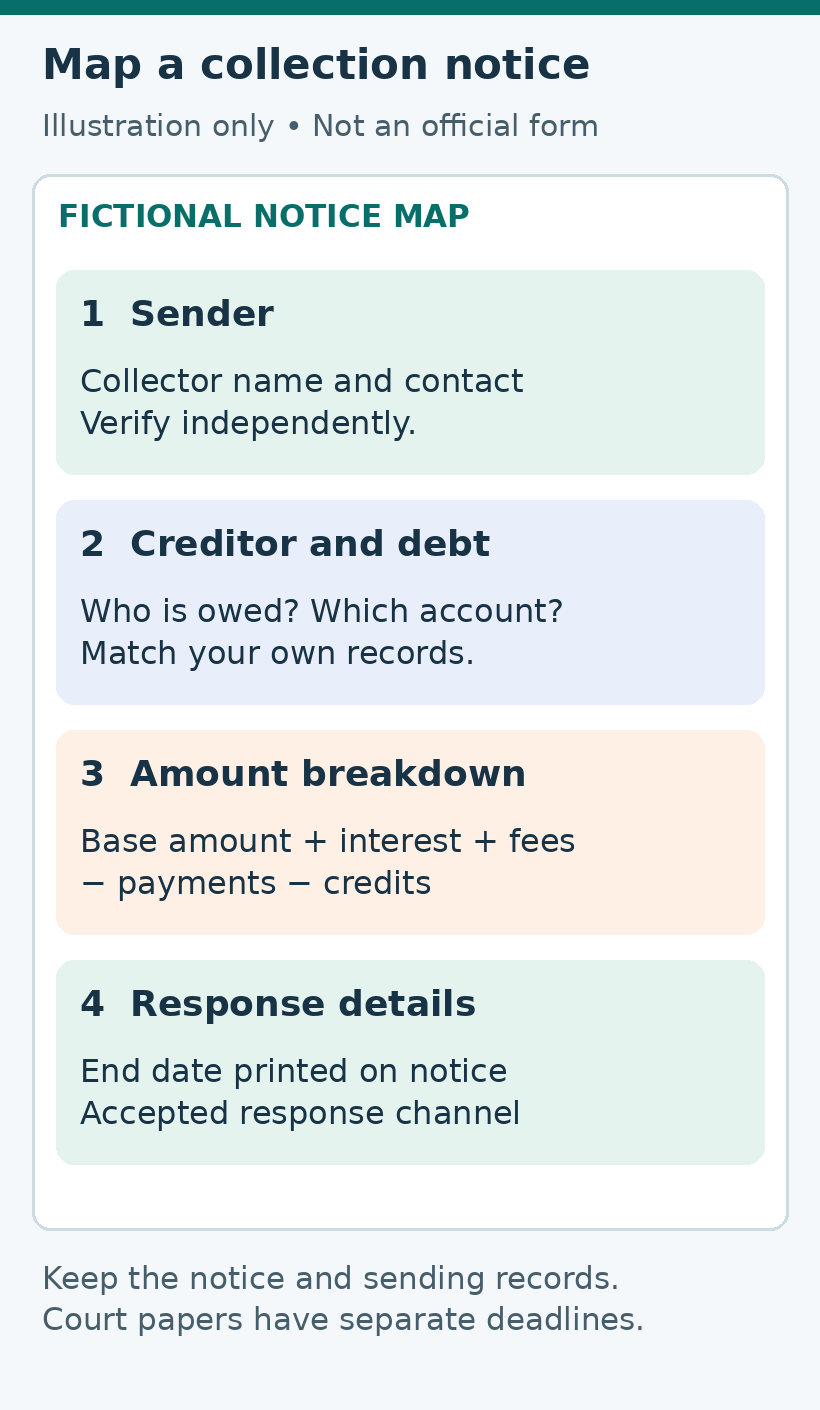
Before responding to a debt collection notice, identify five things: the sender, the debt, the balance calculation, the response channel, and the validation-period end date. Save the entire notice and its envelope or electronic delivery record. If the document is a court summons, treat the court response deadline as a separate urgent matter.
You do not have to solve every question at once. Start by making one private record for this notice, then mark what matches your records and what remains unexplained.
1. Identify who sent the notice
Separate the company seeking payment from the name you remember doing business with. The CFPB explains that debts can be assigned for collection or sold. An unfamiliar company name alone does not prove fraud.
- Original creditor: the business associated with the original debt.
- Current creditor: the party identified as presently owed the money.
- Collector: the person or company trying to collect it. The collector may be working for another party.
For verification, the CFPB recommends obtaining the collector’s name, company, address, telephone number, and license number where relevant. State regulators or your attorney general can help check those details. Avoid sharing personal financial information until you establish legitimacy. Threats and refusal to explain the debt are warning signs.
A polished letter or familiar logo is not independent authentication. Record where you checked the information, rather than simply noting “looked official.” If you suspect impersonation, do not use a payment link as your verification method.
2. Match the notice to a specific account
The CFPB’s validation-information guide says this information is generally provided in the initial communication or within five days. It includes collector and creditor details, an account number if any, an itemized balance, response information, and the end date of the 30-day dispute period.
Use your own statements, payment receipts, and prior correspondence to check the connection. Write “not recognized” where that is accurate. Do not fill a gap by assuming the debt belongs to you simply because the notice reached your address.
For each mismatch, describe the issue narrowly. “The account ending does not match my statement” gives you a specific point to investigate. “Everything must be wrong” is harder to evaluate and may overlook a genuine match elsewhere.
3. Reconcile the amount without assuming it is valid
Read the balance as a calculation: the stated starting amount, additions, subtractions, and current total. Compare the dates as well as the dollars. A payment made after the itemization date may require a different explanation from a payment that should already appear.
A fictional balance check
Illustration only; these are not real charges or a recommendation to pay.
- Starting amount: $480
- Interest added: $18
- Fees added: $7
- Payment credited: $100
- Stated current balance: $405
The arithmetic is $480 + $18 + $7 − $100 = $405. Suppose you also have a $40 payment receipt that is not reflected. Your question becomes: “Was this payment applied, to which account, and on what date?” If it belongs in this calculation, the resulting amount would be $365, but the records need to establish that first.
Correct arithmetic does not prove that you owe the debt, that the fees are authorized, or that a lawsuit would be enforceable. Keep those questions separate from the addition and subtraction.
4. Understand the response period
Find the printed validation-period end date and copy it exactly. This is not a payment grace period or a promise that the debt disappears afterward.
Under Regulation F, section 1006.38, a timely written dispute generally requires collection of the disputed debt or portion to stop until the collector sends verification or a copy of a judgment. Special rules apply to duplicative disputes. A timely written request for original-creditor information also triggers a collection pause until the required response.
An accepted electronic channel can satisfy the writing requirement. Keep the message and evidence of submission. Do not assume a telephone conversation alone triggers these written-dispute protections. Certified mail is not the only permitted route.
The same regulation says failure to dispute is not a legal admission of liability. It does not require a collector to answer within 30 days. Missing the validation period can affect these particular protections, so get help promptly if the dates are unclear.
5. Decide what question you need answered
Your response should match your actual concern. These prompts organize the issue; they are not a universal legal letter.
- Unrecognized account: Which details would connect this account to my records?
- Disputed amount: Which payment, fee, credit, or other line is unexplained?
- Unfamiliar creditor: Do I need the original creditor’s name and address?
- Suspected impersonation: How can I verify the sender independently before sharing information?
Do not combine several notices into one unlabeled folder. A response about one account can become difficult to track when correspondence about another account is mixed into the same record.
One notice, one private worksheet
Copy these fields into a private note or print them. Do not post full account numbers, Social Security numbers, or documents containing personal information in public comments.
Document received
Date and delivery method: __________
Saved notice, envelope, or delivery-record location: __________
Sender check
Company and mailing address: __________
Independent verification source and result: __________
Debt identity
Original and current creditor, if known: __________
Partial account identifier and matching personal record: __________
Balance review
Starting amount; interest; fees; payments; credits; total: __________
Unexplained difference and supporting record: __________
Dates to keep separate
Printed validation-period end date: __________
Any court response deadline and help requested: __________
Response record
Issue raised, verified destination, and channel: __________
Date sent, submission evidence, and reply received: __________
Old debts need a separate legal check
The CFPB explains that lawsuit limitation periods vary with applicable law and debt type. Partial payment or acknowledgment can restart the period in some circumstances. Do not make a token payment merely to get information about an old account.
Regulation F, section 1006.26 prohibits covered collectors from suing or threatening suit to collect time-barred debt, with a separate bankruptcy proof-of-claim exception. That does not mean every contact about old debt is prohibited or that the balance has vanished.
Ask a lawyer or legal-aid organization to evaluate uncertain limitation questions. A generic checklist cannot calculate your individual deadline.
A dispute letter does not replace a court response
If you receive court papers, seek legal help promptly and identify the court’s response requirements. The CFPB warns that a judgment can still result if you fail to respond and raise an available time-bar defense. Do not assume a letter to the collector answers a summons or suspends court deadlines.
The useful result of this checklist is an organized record: what you received, what you verified, what is disputed, and which date needs attention. It cannot determine liability, fee legality, or enforceability on its own.
Sources checked October 19, 2026. U.S. educational information, not individualized legal or financial advice.
Featured photo: Photo by Angela Roma on Pexels. Used under the Pexels license. Stock photograph illustrating received correspondence; not an actual collection notice.

Credit-Builder Loan vs. Secured Card: A Cash-Access Checklist
Work through three fictional situations and four private questions before deciding whether a new account fits your needs.

Hotel Card Hold: Compare Two Checkout Payment Paths
Compare two fictional hotel checkout choices while keeping the original card’s capacity and the actual payment in separate records.
Overdraft Fee? Look Beyond the Online Bill Label
Compare three fictional document packets behind the same $60 ONLINE BILL entry, then identify what the records still leave unexplained.