Earnest Money: Track Your Deposit and Release
Keep a private four-part deposit record, reconcile two fictional receipts with a closing credit and identify missing evidence when a purchase stalls.

Estimated reading time: 8 minutes
An earnest-money record should answer three separate questions: what did you agree to pay, what happened to the payment, and how was the money finally applied or released? A receipt helps with the second question. It doesn’t settle every question about who is entitled to the money.
Chase describes earnest money as a good-faith home-purchase deposit, commonly held by a third party and applied toward the purchase at closing. Keep receipts and review the actual agreement’s conditions with the appropriate professional.
Your contract and applicable law determine obligations and rights. Get unclear terms explained before signing or sending funds, especially when money could be lost. This guide organizes evidence; it doesn’t determine whether you can terminate, obtain a refund or owe more than the deposit.
Earnest money: verify the holder and destination
Find the named holder in your transaction documents and ask how it acknowledges deposits. Don’t infer the correct recipient from a familiar company logo or a message appearing in an existing email chain.
As a precaution for deposit payments, apply the CFPB’s closing-funds verification advice: confirm instructions in person or through a previously established trusted phone number. Don’t use the number supplied in a changed-instructions email as your independent check.
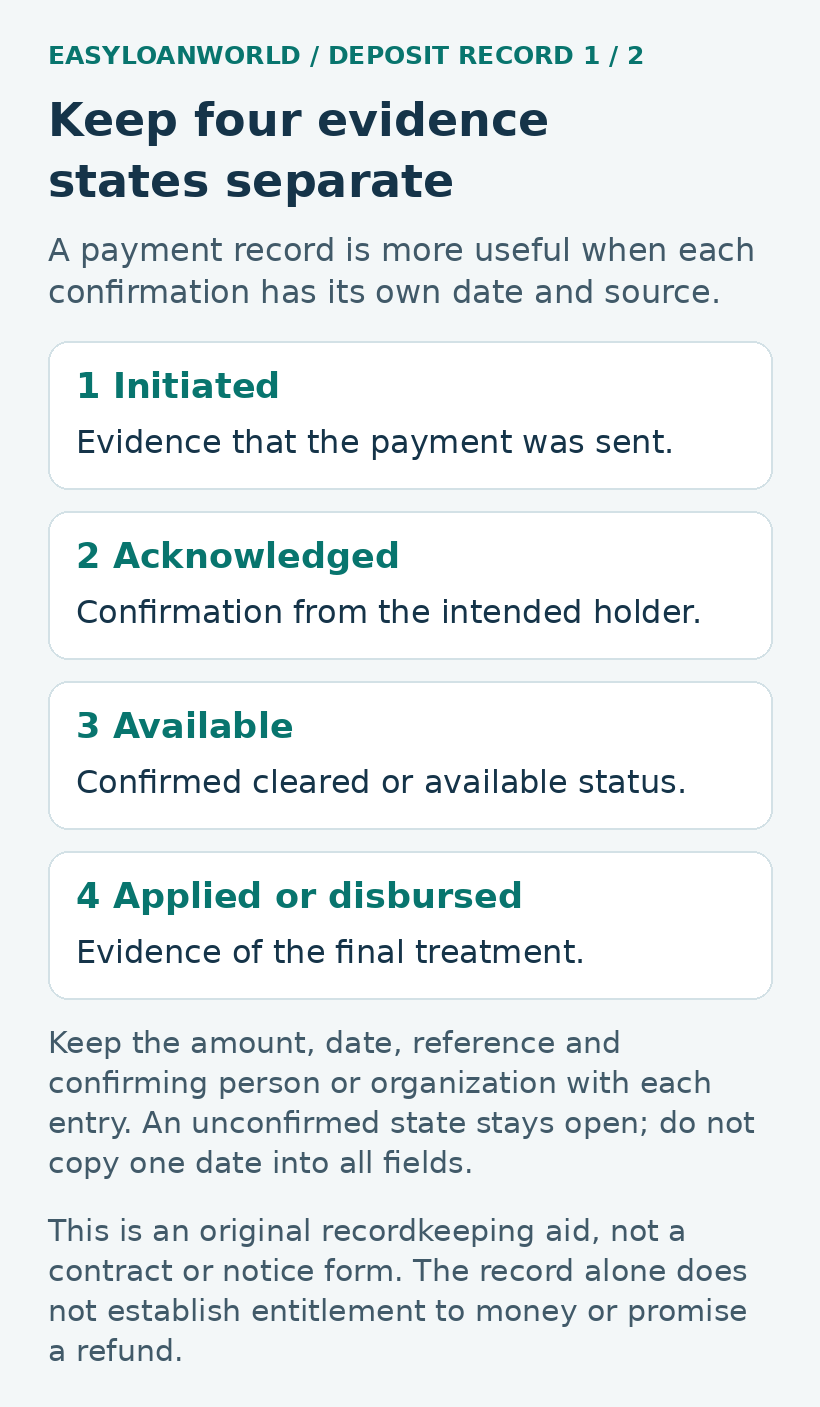
Keep these milestones distinct in your record:
- Initiated: you have evidence that a payment was sent
- Acknowledged: the intended holder confirms receipt
- Available: cleared or available status has been confirmed
- Applied or disbursed: the final treatment has supporting evidence
Date each confirmation. A screenshot saying “sent” doesn’t, by itself, establish every later milestone. Leave unconfirmed fields open rather than copying the same date into all four.
A Texas illustration
The Texas Real Estate Commission’s Form 20-19, effective July 1, 2026, separates deposits and option fees, with distinct payment, notice and release provisions. This Texas illustration excludes condominiums and builder-new-home transactions.
Record separate fees individually, even when included in a combined payment.
Build four private records for one transaction
Keep these records with your documents; don’t upload private contracts or payment details to EasyLoanWorld. Use a document name and page or clause reference beside each important entry. The records below are an organizing method, not a substitute contract or notice form.
1. The obligation record
Record the property or transaction identifier, governing state, signed agreement version and amendments. List initial and additional deposits, any separate fee, the named holder and the supporting clause. Check the signed terms before treating an amount as agreed. A blank amount remains unresolved.
2. The date-and-notice record
Record each event’s date, time, time zone, recipient, delivery requirements and clause reference, with the interpretation confirmed.
Keep your calendar reminder in a separate field. For example, “review documents Tuesday” is your private task; it doesn’t establish a contractual deadline. Likewise, keep an extension request separate from evidence that an extension was agreed.
3. The payment-evidence record
Give every installment its own entry: amount, initiation date and reference, verified destination, acknowledgment, confirmed funds status and receipt location. Identify the person or organization supplying each confirmation. Ask your lender which evidence it needs for your particular file.
4. The outcome record
For a closing, compare the receipt total with the proposed deposit credit and save the final explanation of any difference. For an ended transaction, record notice evidence, the holder’s instructions, and release or dispute status.
Use separate entries for requested, authorized and received. Ending a transaction and obtaining a disbursement need separate verification. A hoped-for return shouldn’t fund a new commitment before you can establish that the money is available.
Example: two receipts, one incomplete credit
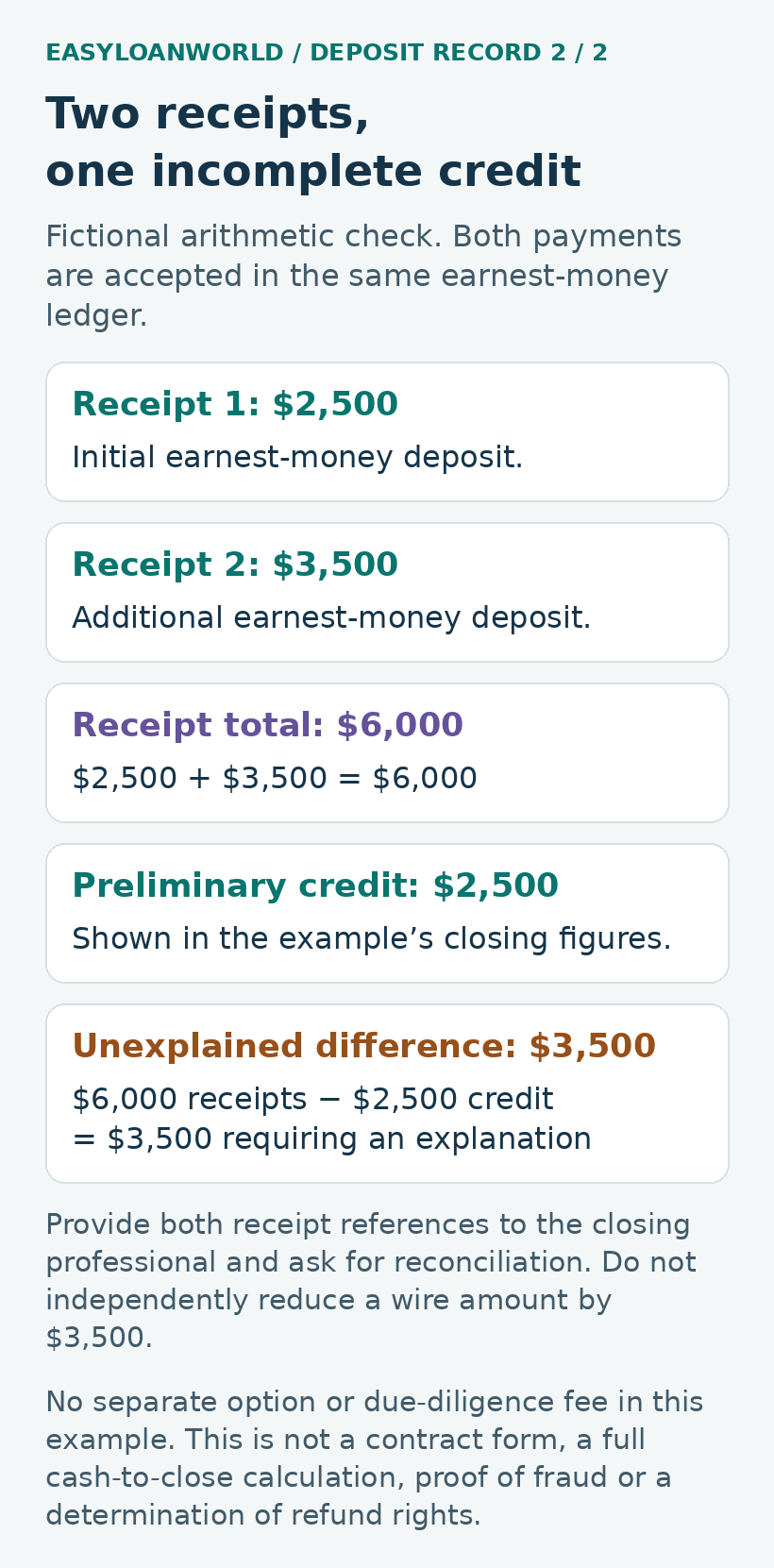
A fictional transaction calls for $2,500 initially and an additional $3,500 in earnest money. Assume both amounts were correctly delivered, accepted and credited to the same transaction’s earnest-money ledger. There’s no separate option or due-diligence fee. These are invented amounts, not suggested deposits or market norms.
- Initial receipt: $2,500
- Additional receipt: $3,500
- Combined receipts: $6,000
- Preliminary closing credit shown: $2,500
- Difference requiring an explanation: $6,000 − $2,500 = $3,500
Give both receipt references to the closing professional and request a corrected reconciliation or an explanation of different treatment. Don’t independently reduce a wire amount by $3,500. The mismatch also doesn’t, by itself, establish fraud.
This calculation checks one credit against two receipts. It doesn’t calculate the full amount due at closing or determine refund rights if the purchase fails.
Earnest money: test how an accepted deposit changes cash still needed
Use a separate fictional purchase worksheet to connect a confirmed deposit with closing cash. Assume a $200,000 purchase price, $180,000 of loan funds applied to that price and $5,000 of closing costs. For this exercise, prepaids, initial escrow deposits and other included costs already paid are all zero.
The buyer has already delivered a confirmed $6,000 deposit that will be credited toward these uses. Seller and lender credits are initially zero. These are supplied calculation inputs, not a quote for any actual property or an estimate that taxes and insurance will really be zero.
Enter the price, purchase loan and closing costs in their named fields. Enter zero for prepaids and escrow, seller credits, lender credits and included costs already paid. Put $6,000 in “Earnest money or deposit already paid.” Expected modeled cash still needed is $19,000.
The arithmetic is $20,000 down payment plus $5,000 closing costs minus $6,000 already paid. The calculator should also show a $20,000 down payment and $6,000 of deposit and included costs already paid. Expected excess to reconcile is zero.
The $19,000 is additional cash for this stated worksheet. Combined with the $6,000 already paid, buyer cash applied to the modeled uses totals $25,000. Don’t add another $6,000 refund or another deposit credit; the accepted deposit has already reduced the remaining requirement once.
Earnest money: change one confirmed credit and reconcile the difference
For an independent variation, suppose the documents confirm a permitted $2,000 seller credit applied to eligible closing costs already included in the $5,000. Keep every other input unchanged and enter $2,000 in the seller-credit field.
Modeled cash still needed falls to $17,000. The $2,000 reduction matches the newly assumed credit. The down payment remains $20,000, and the buyer’s deposit already paid remains $6,000. Neither changed merely because the seller credit was added.
Buyer cash applied to these modeled uses is now $23,000: $6,000 already delivered plus $17,000 still needed. The remaining $2,000 of the original $25,000 uses is covered by the stipulated seller credit. This balances the worksheet without inventing an extra cash receipt.
Actual permission, eligible costs and final treatment must come from the transaction’s documents. A calculator entry can’t authorize a seller credit or turn an unused allowance into a refund. Keep the resulting cash figure conditional if a credit is proposed rather than confirmed.
Keep this calculation separate from the earlier incomplete receipt example. There, only $2,500 appeared on a preliminary record despite $6,000 of receipts. Here, the entire $6,000 is expressly confirmed as credited. Using the calculator can’t resolve a missing receipt or establish that the holder accepted a disputed payment.
Before relying on a real closing figure, compare the latest itemized statement, actual deposit credit and independently verified payment instructions. Ask the responsible closing professional to explain any difference. Don’t unilaterally reduce a requested transfer using a worksheet result.
This tool addresses remaining modeled cash, not entitlement to release a deposit if a transaction fails. The contract, notices and applicable law still govern that separate question. Save each calculation with its document date so a later revision can be traced.
If financing fails, collect evidence before assuming a refund
Consider a separate branch of that fictional transaction: before closing, the lender declines the loan. The buyer has the denial message, the signed agreement with a financing provision, and an email to their own agent saying they want to withdraw.
The buyer hasn’t established whether that email satisfied the agreement’s notice requirements or what is needed for release. The record should read: “Contract/legal review needed; funds not yet confirmed available.”
Use the four records to identify missing evidence. An attorney in the property’s jurisdiction should assess uncertain rights before you act on an interpretation.
A financing denial, inspection concern or wish to withdraw alone doesn’t prove an immediate refund right. Nor does this example establish forfeiture, effective termination or breach. Keep the unresolved question visible until the evidence and qualified advice support the next step.
U.S. educational information, not legal advice. Contract terms and applicable state and local law require individual review.
When the purchase proceeds, reconcile the deposit with the cash-to-close worksheet so the same money is credited only once.
Featured photo: Photo by Filip Szalbot on Unsplash. Used under the Unsplash license. Illustrative house keys. Photo by Filip Szalbot on Unsplash.

Down-Payment Savings: Can Waiting Require a Bigger Monthly Deposit?
Compare fictional down-payment savings deadlines when the target changes with the assumed price. Separate exact deposits, cent rounding and fixed-deposit gaps.

Down-Payment Assistance: Is Your Paperwork Enough to Decide?
Use three invented teaching cards to identify missing evidence, resolve version questions and prepare a clearer request for assistance paperwork.
California Supplemental Property Tax: Check the Bill, Payment and Cash
Organize one California supplemental property tax bill, its payment evidence and the cash earmarked for it. A fictional example shows why a funding gap…