Energy Overlap
Equal electricity use and generation do not necessarily imply equal bill reductions. This fictional comparison separates gross imports, exports and…
Estimated reading time: 5 minutes
Equal electricity use and generation do not necessarily imply equal bill reductions. This fictional comparison separates gross imports, exports and same-slot consumption.
Specify the settlement rule
Assume two time slots. Each imported energy unit costs 0.30 monetary units; each exported unit earns a 0.05 credit against the same period’s bill. These prices stay constant across both slots. There are no fixed charges, taxes, storage, losses, export limits, credit caps or carryovers. All unused generation is exported, and all unmet consumption is imported.
The model prices imports and exports separately rather than charging only for their difference. Generation consumed in the same slot avoids an import; generation exceeding that slot’s use receives the export credit. This is a stipulated settlement rule, not a statement about a household’s actual tariff.
Both profiles use 20 energy units in total and generate 10, all in the first slot. Without generation, either profile would cost 20×0.30 = 6. That shared baseline is possible because the import price is identical across slots; we are not mixing a timing change with a different purchase price.
Compare the two complete profiles
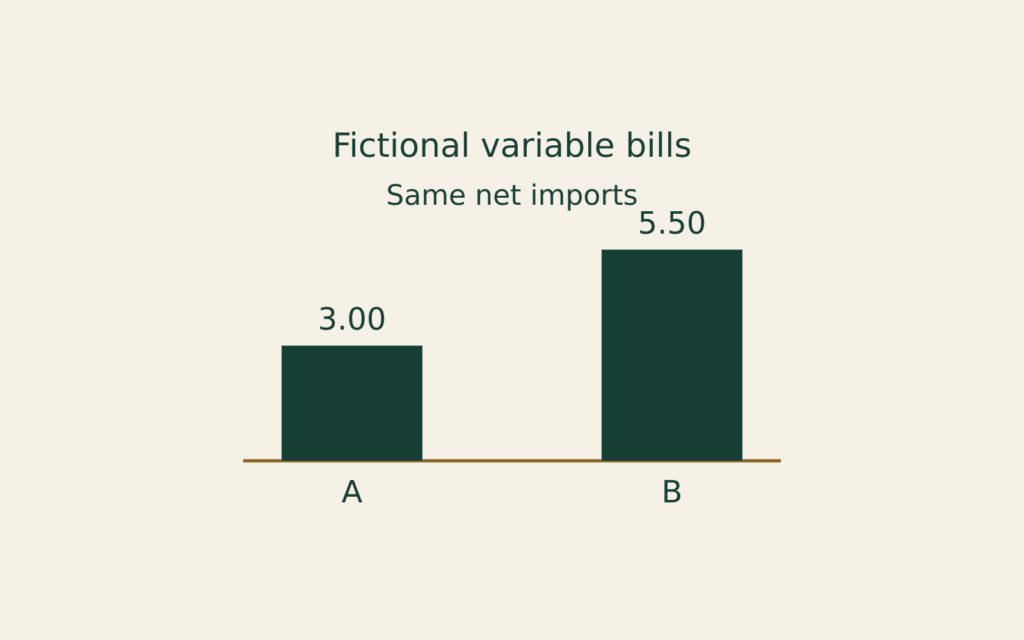
Profile A uses 10 units in the first slot and 10 in the second. Its first-slot generation covers all first-slot use. It imports nothing then and exports nothing. In the second slot it has no generation, so it imports 10. Its variable bill is 10×0.30 = 3, a reduction of 3 from the baseline.
Profile B uses nothing in the first slot and 20 in the second. It exports all 10 generated units, earning a credit of 10×0.05 = 0.50. It later imports 20 units at a cost of 6. Its variable bill is 6−0.50 = 5.50, a reduction of only 0.50.
Both profiles have net imports of 10: A imports 10 and exports zero; B imports 20 and exports 10. Their identical net figure conceals different gross transactions. Multiplying that net figure by 0.30 would return 3 for both, understating B’s modeled bill by 2.50. No energy disappeared, and neither household used more energy in total.
Keep the overlap term
Let total use be U, generation G and same-slot consumption of that generation S. Imports equal U−S and exports equal G−S. With import price a and export credit b, the bill is a(U−S)−b(G−S), or aU−bG−(a−b)S. Relative to the no-generation baseline aU, the reduction is bG+(a−b)S.
In our case, this becomes 0.50+0.25S. The 0.50 term is the credit that all 10 generated units would receive if exported. Each unit instead consumed in its generation slot replaces a 0.05 export credit with an avoided 0.30 import, adding 0.25 to the reduction. At S=0 the result is B’s 0.50; at S=10 it is A’s 3.
Show that the intermediate cases exist
The algebra alone does not prove that an arbitrary overlap is physically possible. For this fictional example, however, an explicit family supplies every value from zero through 10. Put s units of use in the first slot and 20−s in the second, with 0≤s≤10. Keep generation at 10 in the first slot and zero in the second.
First-slot use is then entirely covered, so same-slot consumption is exactly s and exports are 10−s. Second-slot imports are 20−s. Total consumption remains 20 and net imports remain 10 for every member of the family. This constructs feasible examples within the assumptions; it does not claim a real household can shift its usage in this way.
Test one stated payment amount
Suppose a proposal compares the modeled reduction with a fixed payment of 1.50 for this same period. The calculation requires 0.50+0.25S≥1.50, hence S≥4. The total generation of 10 alone cannot determine whether that test passes.
At the boundary, use 4 units in the first slot and 16 in the second. Six generated units are exported for a credit of 0.30, while 16 imports cost 4.80. The resulting bill is 4.50; subtracting it from the baseline of 6 gives exactly 1.50. This is a comparison of stipulated period amounts, not a full project cost or loan-affordability test.
More generally, let M≥0 be a fixed payment for this same period. Every profile in this family meets the comparison if M≤0.50. None meets it if M>3. For 0.50<M≤3, only profiles with S≥4M−2 meet it. At M=3, that requires S=10; at M=0.50, even S=0 qualifies. These endpoints follow from the attainable interval, not from assuming a typical household.
Remove the price difference as a control
If both prices instead equal 0.30, the overlap coefficient becomes zero. The variable bill is 0.30(U−G)=3 for every profile, and the reduction is always 3. Equal total use and generation suffice under that changed rule, but not under the original unequal prices.
The National Laboratory of the Rockies separates metering arrangements, sell rates and retail rates. It distinguishes on-site consumption from exports. These assumptions are neither a tariff nor performance forecast.
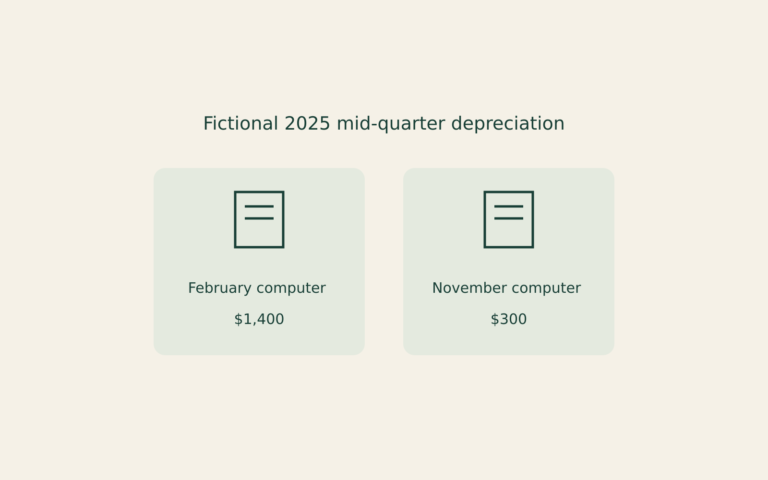
Mid-Quarter Depreciation Across Purchases
Check the entire acquisition pool.
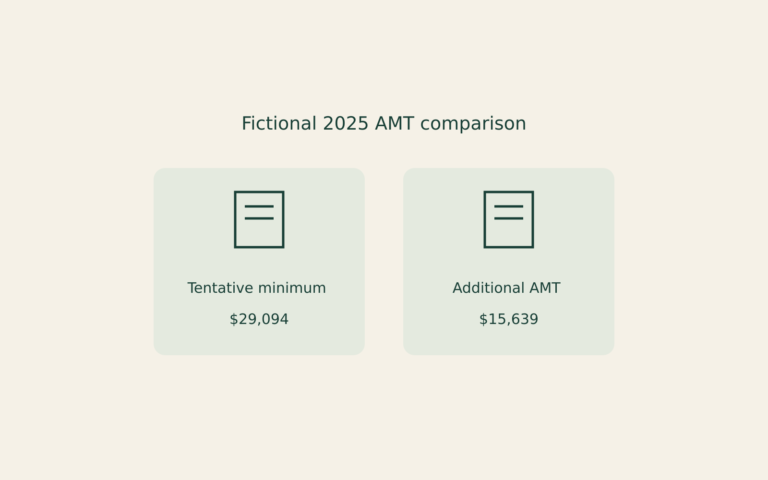
Alternative Minimum Tax Reconciliation
Separate tentative and additional tax.
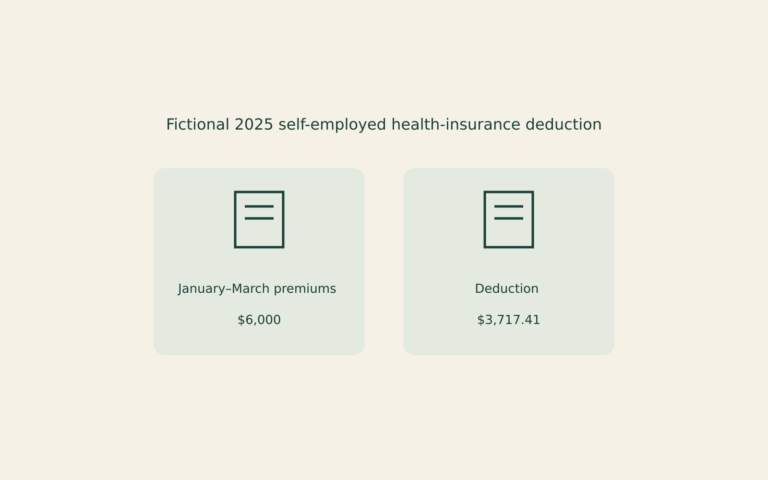
Self-Employed Health Insurance Limits
Check coverage eligibility before enrollment.