2026–27 FAFSA: Family Business and Farm Assets
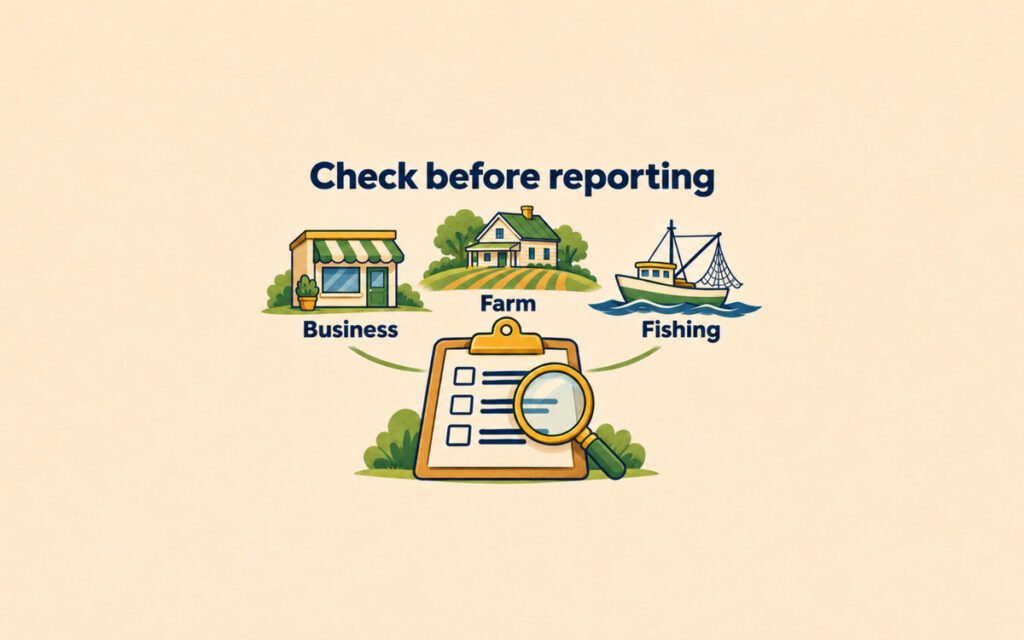
Check business size, farm residence and related debt before reporting assets.
Estimated reading time: 5 minutes
Before using an older FAFSA asset figure in a college funding plan, check the award year’s rules. For 2026–27, changes to business and farm reporting can affect what belongs in the asset questions.
Three exclusions to check for 2026–27
Federal Student Aid identifies these exclusions from business and farm net worth:
- A business owned and controlled by the family with 100 or fewer full-time or full-time-equivalent employees.
- A farm on which the family resides.
- A commercial fishing business and related expenses owned and controlled by the family.
Use the instructions for the named award year. Do not assume an earlier application’s asset answer should be copied unchanged.
Separate the business-size and farm-residence tests
The current handbook describes the small-business exclusion for businesses owned and controlled by the family. The farm exclusion turns on where the family resides. They are separate categories. Value assets as of the day the FAFSA is signed.
Consider these independent fictional cases, assuming the stated ownership and employee classifications have been confirmed:
- A family-owned and controlled shop has exactly 100 full-time-equivalent employees. It is within the business-size exclusion.
- A different family shop has 101. It is outside that particular exclusion; other applicable asset-reporting instructions still matter.
- A family lives on its farm. The farm’s value falls within the residence-based farm exclusion.
- A family owns an income-producing farm elsewhere. A small workforce alone does not establish the residence-based exclusion.
Do not replace full-time-equivalent staffing with a count that simply ignores part-time workers. If the classification, ownership or residence is unclear, ask the financial aid office before deciding the entry. These examples do not determine an aid award.
If an asset is reportable, match its value and debt
The official form defines net worth using current value and debts related to that same asset. When calculating net worth, use zero for an investment or property with a negative value. Follow the form’s applicable skip instructions before answering asset questions.
Fictional reportable farm, with no exclusion: $240,000 current value minus $150,000 related debt gives $90,000 net worth.
An assumed unrelated $17,000 personal car loan does not reduce this to $73,000; check actual debt classifications separately.
The form separately asks for 2024 tax information and current assets. An asset exclusion is not an instruction to remove business income from the required income answers.
Keep supporting records together; ask the school about uncertain classifications.
Resolve the entry before revising the borrowing plan
A useful school question identifies the award year, asset category, ownership, residence or staffing issue, and the answer that remains unclear. Provide private records only through the school’s verified route, not public comments or EasyLoanWorld.
This guide does not calculate an SAI, promise a grant or replace the school’s review. If income changed after the relevant tax year, read how to ask about a separate aid adjustment.
Build a classification worksheet before entering numbers
Give each business or farm its own row in your working notes. Use columns for its name, who owns it, the category you are considering, the facts supporting that category, and the question you still need answered. A separate row prevents the answer for one property from being carried over to another without checking.
For example, imagine a family has a repair shop and a parcel of agricultural land. The shop’s staffing records are complete, but the land’s ownership documents are still being gathered. Mark the shop’s review as complete only if its relevant facts have been resolved. Mark the land as unresolved. Do not use the shop’s conclusion as a shortcut for the land, and do not invent an answer simply to finish both rows together.
Keep supporting files clearly named and leave the originals unchanged. A note such as “ownership document requested from accountant” is more useful than an unexplained zero. In your worksheet, distinguish a confirmed exclusion from a calculation that produces zero and from a question you have not resolved. Those labels are for organizing your research, not substitutes for the FAFSA’s actual instructions.
Send the school a question it can answer
Instead of asking “Do we count our business?”, describe the specific uncertainty. For example: “We are completing the 2026–27 FAFSA. Our records include several owners and part-time staff. Which documents would help you confirm the ownership and staffing classification?” This does not presume that the business qualifies or ask the school to accept an unsupported total.
Keep the response with your worksheet and note which facts the answer depended on. If the response assumes something different from your situation, clarify it before relying on the answer. For an already submitted application, identify the entry you believe may be wrong and ask the school about the appropriate correction process rather than making several speculative changes.
Official sources checked November 4, 2026. This page addresses the 2026–27 FAFSA only; it does not provide a personalized reporting determination.

Parent Pays Student Loan Interest: Who Deducts?
Separate payment and obligation.

Returned Loan Debit: Two Fees?
Trace the payment and fees.

Rehabilitation Payment Too High?
Check an alternative request.