Hospital Financial Assistance: How to Apply and Track Your Request
Find the correct hospital assistance policy, organize the requested documents, and track your application through the final adjusted bill.

A hospital financial assistance application is easier to manage when you treat it as a sequence of checkpoints: find the right policy, submit the requested information, confirm completeness, and reconcile the decision with each bill. Start with the hospital’s assistance office before replacing a medical balance with consumer borrowing.
This guide focuses on applying for help and tracking the result. It assumes you have identified the bill you need help paying; checking insurance processing or correcting a billing error is a separate task.
Find the policy for the facility that treated you
Federal Section 501(r) requirements apply to tax-exempt 501(c)(3) hospital organizations, not every medical provider. For a covered facility, its financial assistance policy, or FAP, describes eligibility and how to apply for free or discounted eligible care. It covers emergency and other medically necessary hospital care, but separately billing clinicians may be excluded. Check the policy’s provider list rather than assuming every bill from the visit qualifies. Eligibility is policy-specific; there is no single income cutoff to use for every hospital. IRS: Financial assistance policies.
Ask for the policy, application, plain-language summary, and any separate billing and collection policy. Covered facilities must make the assistance documents available online and provide free paper copies on request. IRS: Policy availability requirements.
Write down the facility’s exact name and your service dates beside the policy link. A system logo is a useful starting point, but it is not your confirmation that a particular account is included.
Ask four questions before filling out the form
- Does this policy apply to my facility, service dates, and account?
- Which information is required for my circumstances, including if I have insurance?
- What deadline applies, and how can I document that the application arrived?
- Who should I contact if I cannot provide one of the requested documents?
CMS recommends obtaining the hospital policy, reviewing its requirements, and applying through its process. Other providers may offer assistance too. Ask how long review normally takes and what happens to the bill during that time. If a collector is involved, explain the application and request a pause; a request alone does not guarantee one. CMS: Apply for financial assistance.
Build a small application file
Create one folder for the application and a short list of every related bill. Use masked account numbers in your working notes. Keep full account identifiers only where they are needed for the actual application.
Possible documents to ask the office about include recent income records, household information, or unemployment and benefits records. These are examples, not a universal document checklist. Follow the policy’s instructions and ask about alternatives if a requested record does not exist in your situation.
Before sending anything, confirm the portal or mailing address through the hospital’s official website or a verified phone number. Do not send identity documents or medical records to an unverified email address. Save the exact version of the application you submitted, a list of attachments, and the receipt or tracking confirmation.
Know what the 120-day and 240-day periods actually mean
For facilities subject to Section 501(r), the general framework includes a 120-day notification period before extraordinary collection actions and an application period extending at least 240 days from the first post-discharge bill. The starting point is not the treatment date. Longer periods can apply, and hospitals may accept later applications.
A timely complete application requires suspension of extraordinary collection actions, an eligibility determination, and written notice explaining the decision. An incomplete application submitted within the application period must receive an opportunity to be completed. These protections concern extraordinary collection actions; they do not mean every statement or phone call automatically stops. Do not wait until day 240 to ask for help. IRS: Billing and collection rules.
Record the first post-discharge statement date, but also ask the office to confirm the deadline for your account. If a lawsuit or other urgent legal deadline is involved, contact legal aid promptly rather than relying on an application to resolve it.
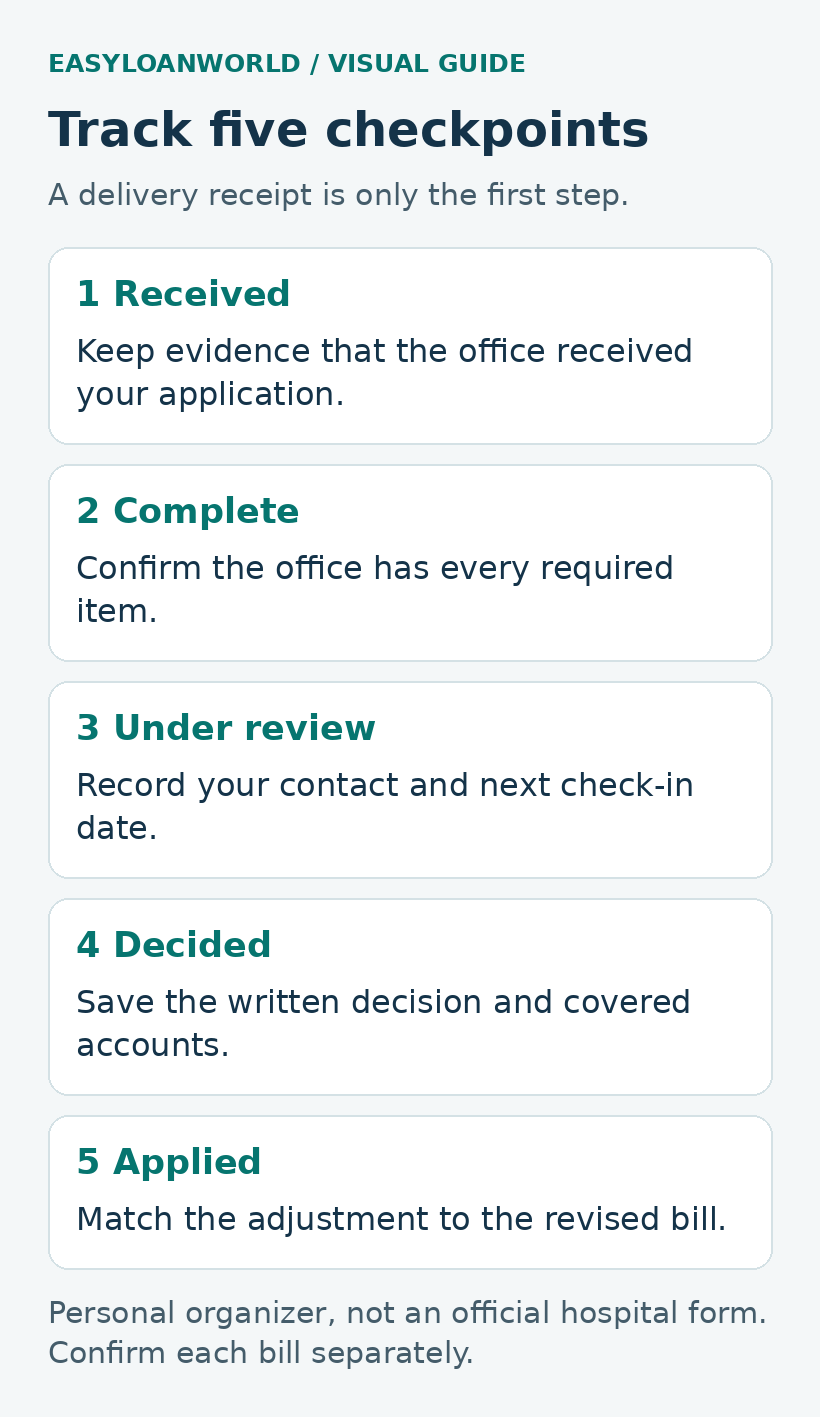
Track five separate milestones
- Received: You have evidence the office got the application.
- Complete: The office confirms it has what it needs, or identifies missing items.
- Under review: You know the contact and the next check-in date.
- Decided: You have the written result and understand which accounts it addresses.
- Applied: The billing record reflects the adjustment and shows the remaining balance.
A delivery receipt proves delivery, not completeness. An approval letter describes a decision, but you should still compare it with the revised statement. Keeping these milestones separate makes a follow-up call more precise.
A copyable assistance tracker
This is a personal organizer, not an official hospital form. Make one copy for each biller and use initials or masked account identifiers.
- Biller and account ending: ____
- Service date and exact facility: ____
- Policy link, version or date saved: ____
- Account/provider coverage confirmed by: ____
- First post-discharge statement date: ____
- Application deadline confirmed by office: ____
- Requested documents and outstanding items: ____
- Submission date, method, and receipt/reference: ____
- Completeness confirmed on/by: ____
- Staff contact and most recent conversation date: ____
- Expected response date and next follow-up: ____
- Collection status confirmed in writing: ____
- Decision, covered accounts, and revised balance: ____
- Separate-biller action or reconsideration deadline: ____
Example: one approval, two bills
Jordan has a $2,400 hospital bill and a $350 bill from a separate clinician. In this fictional example, the hospital approves a 75% reduction on its eligible bill. Jordan’s remaining hospital balance is $600: $2,400 multiplied by 25%.
The decision does not establish that the clinician’s $350 bill is included. Jordan checks the provider list and contacts that office separately. Until another adjustment is confirmed, $950 still needs resolution: $600 plus $350. The amounts and reduction are invented to illustrate account tracking, not typical savings or a promise of eligibility.
Use a focused follow-up script
Finding the application: “Please tell me where to get the financial assistance policy, application, and covered-provider list for my facility. Which of my accounts can be included?”
Checking completeness: “Did you receive every required item? What is still missing, what deadline applies, and what happens to billing and collections during review?”
Closing the file: “My decision covers the account ending ____. Please confirm its revised balance and whether any other accounts need a separate application.”
If the result is a denial or partial approval
Read the reason before deciding what to do next. Ask whether the issue is missing information, eligibility, service coverage, or a different account. Request any reconsideration instructions and deadline. Do not assume every hospital has the same appeal process or response timetable.
If you still need help, ask whether a patient advocate can explain the options. Once the balance is settled, you can evaluate an affordable payment arrangement for the remainder. Keep the decision and revised statement together so you are negotiating from a confirmed amount.
Educational information for U.S. readers, checked October 19, 2026. Hospital policies and state protections vary. This is not individualized financial or legal advice.
Featured photo: Photo by Fernando Lacerda Branco on Pexels. Used under the Pexels license. Illustrative stock photograph of medical equipment; no hospital or assistance program is depicted or endorsed.

Credit-Builder Loan vs. Secured Card: A Cash-Access Checklist
Work through three fictional situations and four private questions before deciding whether a new account fits your needs.

Hotel Card Hold: Compare Two Checkout Payment Paths
Compare two fictional hotel checkout choices while keeping the original card’s capacity and the actual payment in separate records.
Overdraft Fee? Look Beyond the Online Bill Label
Compare three fictional document packets behind the same $60 ONLINE BILL entry, then identify what the records still leave unexplained.