Institutional Property Records
Identify the seller and sale stage before interpreting institutional property records. The guide compares examples from named programs.
Estimated reading time: 5 minutes
For institutional property purchases, identify the seller’s role and sale-stage document. These examples describe named programs.
Distinguish a marketed REO from a pending foreclosure
Chase’s real estate owned (REO) FAQ describes property acquired through foreclosure or a deed in lieu of foreclosure. Its explanation places marketing after the process is complete, title has transferred and the property is ready for sale. It doesn’t provide lists of properties still in foreclosure, citing privacy concerns.
For a property offered by its owner before foreclosure, Chase directs a pre-foreclosure offer to that owner’s listing agent, not the bank. That’s a different seller situation from a marketed Chase REO.
The FAQ also says Chase lists and sells at fair market value. The word “foreclosure” therefore doesn’t establish a particular discount. Chase says financing may be available for certain properties.
A trustee name may not identify the sales contact
U.S. Bank’s property guidance distinguishes its role from other arrangements. When U.S. Bank is listed as trustee for a trust owning the property, it has no involvement in marketing or selling that property. A bank name on a record doesn’t answer the role question.
The bank also describes conveying a property to the original investor, which then uses its own disposition method. Where a property has no local listing or sale sign, it may be unavailable for sale or undergoing that conveyance.
Its published purchase exclusions cover bank employees and immediate family, along with specified agent-related purchasers. A bank’s identification as seller and a buyer’s relationship to that bank therefore raise separate questions under this provider’s policy.
Read HUD’s sale period and repair boundary
HUD’s sales introduction describes evaluating properties for special programs before public listing. Properties not sold through those programs are offered first on an exclusive basis to owner-occupants buying a primary residence. Unsold properties subsequently enter an extended period available to other interested buyers, including investors.
The same guidance states that HUD homes are sold as-is, without a condition warranty, and HUD doesn’t pay to correct defects or make repairs. The asking price reflects current as-is appraised value unless otherwise specified.
HUD also distinguishes its sale from rehabilitation financing: it doesn’t provide direct rehabilitation financing for these properties, although FHA has a separate rehabilitation-loan program. A HUD listing shouldn’t be read as a commitment to repair the home or directly lend the repair money.
Read HomePath’s conditions before assuming acceptance
HomePath’s published FAQ says Fannie Mae doesn’t accept offers contingent on selling the buyer’s existing home. This seller-specific condition doesn’t establish that every institutional seller uses the same contract.
The FAQ distinguishes negotiating an offer from final acceptance. For a financed purchase, the lender’s prequalification letter is required before final acceptance, rather than before negotiations begin. For an all-cash purchase, proof of funds is required before final acceptance.
It also says prequalification isn’t loan approval and that the loan application is separate. The buyer may obtain prequalification from a lender of their choice. Fannie Mae uses its own purchase contract; unclear provisions need explanation from the appropriate transaction professional rather than assumptions based on a standard form used elsewhere.
Receipt and an executed HomeSteps contract are different
HomeSteps’ offer description lists a sales contract, preapproval letter, proof of funds for cash sales, earnest money and necessary HomeSteps addenda. It specifies certified funds for earnest money at contract execution, excluding personal checks and money orders. This describes its required package, not a payment instruction for an actual transaction.
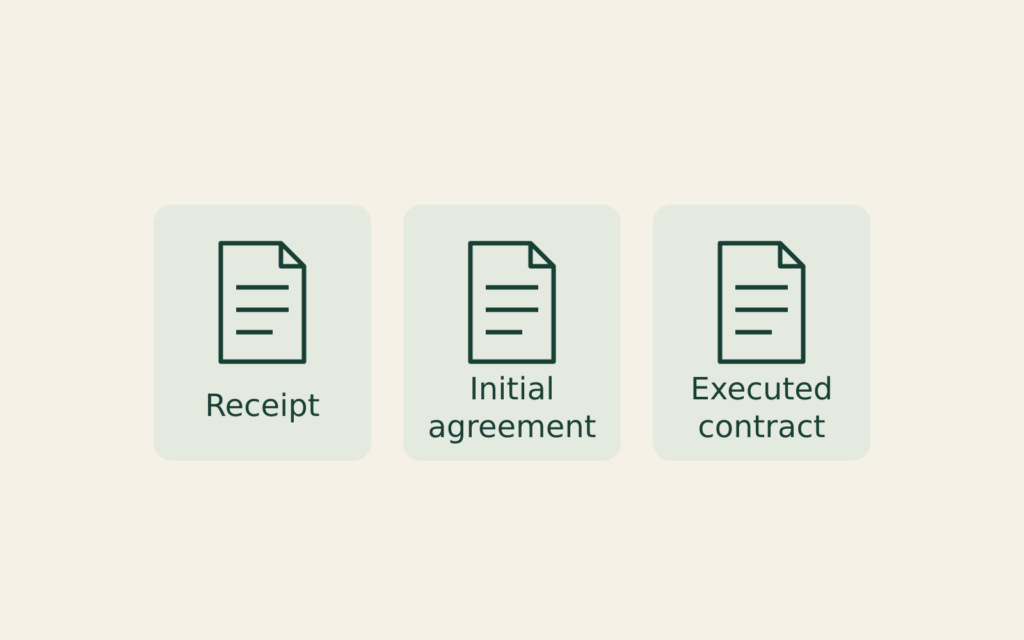
When a complete offer enters its system, the buyer’s agent receives an acknowledgement email. An incomplete offer may be rejected by the listing agent and never entered or considered. The acknowledgement therefore confirms a different stage from acceptance.
HomeSteps expressly distinguishes initial agreement from legal acceptance, which it says occurs only when all parties have fully executed the contract. Its multiple-offer description retains that distinction. Neither a receipt email nor an initial response should be relabeled as the fully executed agreement.
FDIC evaluates more than the offered price
The FDIC’s published property-sales FAQ, updated June 7, 2024, lists several offer-evaluation factors: appraised value, purchase price, earnest money, cash or financing, due-diligence and inspection periods, closing period, net proceeds and complete executed documents. A comparison limited to the headline price omits other inputs in that stated evaluation.
The FAQ also says list prices can reflect appraisals, broker opinions, condition, time on market and market conditions, and can change without notice. An old advertised price is therefore not a commitment to accept a later offer at that amount.
The FDIC reserves the ability to accept, reject or counter and to continue marketing while evaluating offers. It specifically states that it doesn’t provide seller financing for real-estate purchases. Its ownership of a listed property doesn’t make it the buyer’s prospective seller-financier.

One Mortgage Form, Two Borrowers
Match each person’s share.