Personal Loan Late Payments: Verify the Catch-Up Amount
Organize a dated payment record, separate the next installment, and check a fictional catch-up calculation against the lender’s response.

Estimated reading time: 8 minutes
Personal loan late payments need a dated catch-up calculation, not just a balance from an account screen. Identify what is unpaid, what has been credited and what will be due after any proposed arrangement.
A missed personal-loan payment leaves several questions: which installment remains unpaid, what the lender says will bring payments current, and what comes due afterward. Build a dated catch-up record before treating a balance on a screen as the answer.
Contact the lender promptly if you can’t make a payment. Available arrangements depend on your situation and the lender; missed payments can lead to collection activity or credit reporting. The CFPB explains payment trouble. Don’t delay contact while waiting for an assumed reporting threshold.
Personal loan late payments: identify the missing installment
Start with the payment schedule and the lender’s recent transaction record. For each questioned installment, note its due date and amount. Beside it, record any attempted payment, the attempt date, and whether the lender shows it as credited, returned or still unresolved.
A bank transaction and a lender entry are two records to reconcile. If they disagree, retain both rather than marking the installment paid from the payment attempt alone. Use the actual labels in each record; don’t silently change “pending” into “posted.”
Ask the lender for the amount needed to bring payments current, an itemized explanation, and the date through which that amount applies. Also ask whether it includes the next scheduled installment. A total remaining loan balance answers a different question from a catch-up amount.
Personal loan late payments: separate the quote and next bill
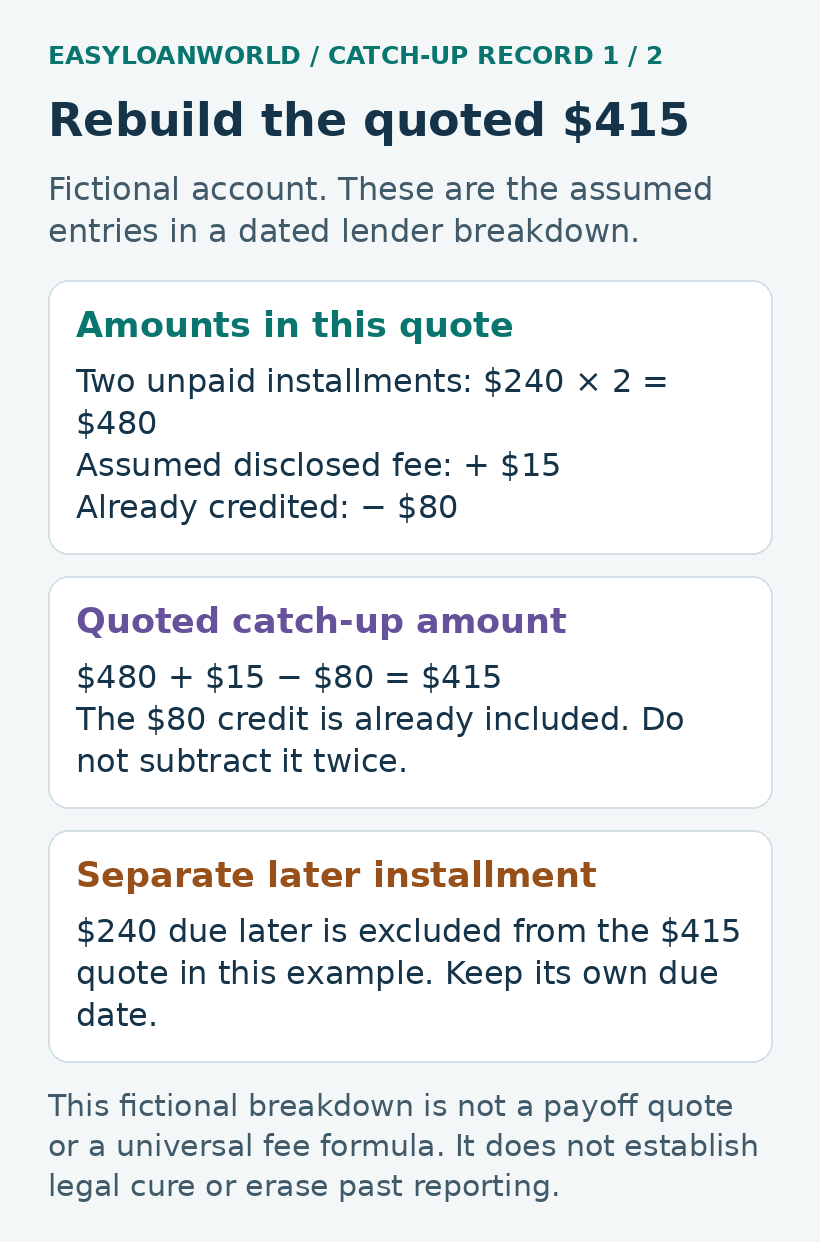
The following figures are fictional. Assume the lender has supplied a dated breakdown with exactly these entries, including a disclosed fee. This is a record-checking exercise, not a rule for calculating every lender’s charges.
- Two unpaid installments: $240 each, totaling $480.
- One assumed disclosed fee: $15.
- Payment already credited against these amounts: $80.
- Lender’s dated catch-up amount: $480 + $15 − $80 = $415.
The next $240 installment is due later and, by assumption, is expressly excluded from that $415. Write it on a separate line with its own due date. Don’t subtract the $80 again: the quoted $415 already reflects it.
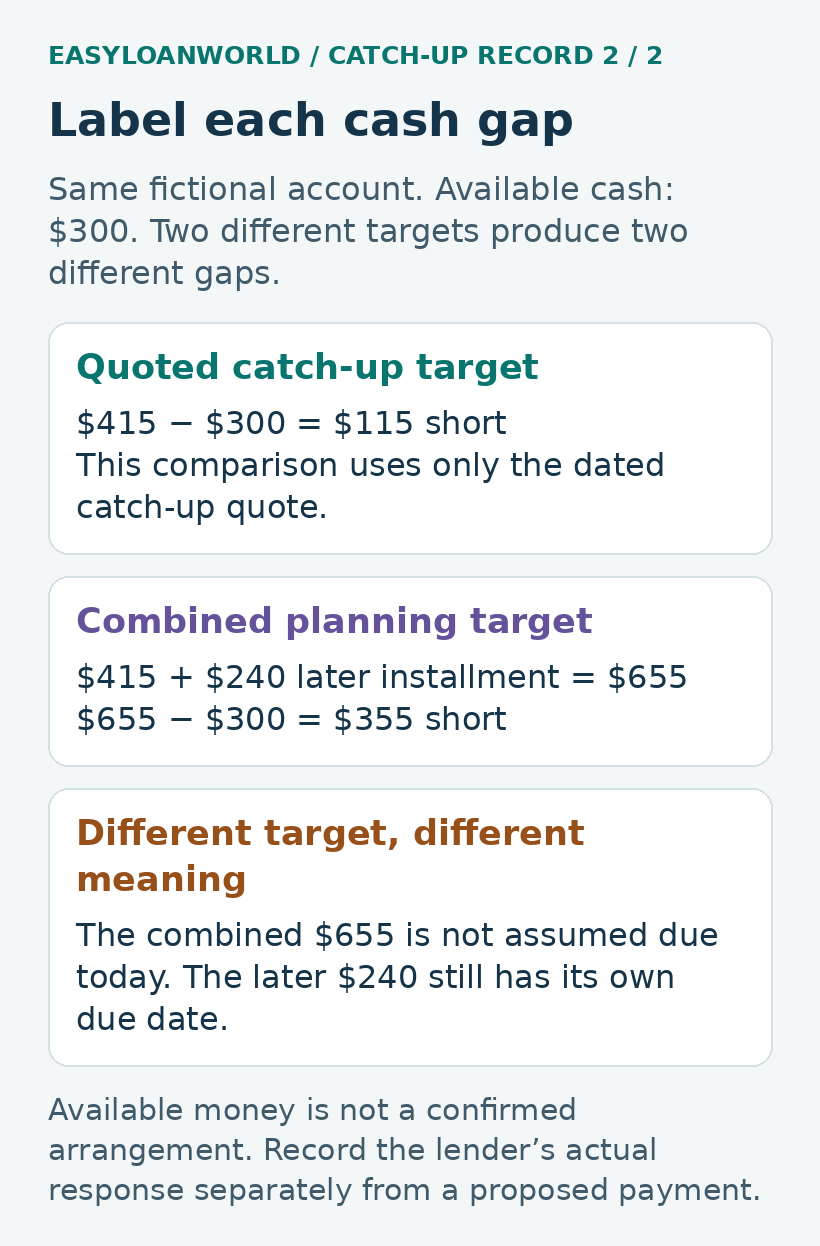
For planning, the two separate targets total $415 + $240 = $655. That doesn’t mean $655 is all due today. If $300 is available, it falls $115 short of the quoted catch-up amount, or $355 short of the combined planning target. Label the target beside each shortfall so the smaller figure doesn’t hide the later bill.
None of these figures is a full payoff quote. The example doesn’t establish legal cure, erase past reporting, or calculate later interest and fees. Your actual account needs its own current breakdown and terms.
Make the unresolved amount explicit
For the fictional account, a useful question is: “Your breakdown shows $415 through the stated date, excluding the later $240 installment. I can offer $300 on my proposed date. What would remain unresolved, and what arrangement, if any, would you accept?” Replace every example amount with verified information before using that wording.
A proposed payment isn’t a confirmed arrangement. Record the lender’s actual response, including a refusal or a request for more information. If the answer changes the schedule, request written amounts and dates, treatment of the missed balance, interest and fees, the arrangement’s end date, and what happens to subsequent installments. Ask how the lender will describe the account in any reporting; don’t infer the answer from a reassuring phrase.
Keep your own offer realistic. An amount you hope to have is different from cash you can identify for a stated date. If the lender’s proposed schedule remains unworkable, leave that issue marked unresolved instead of recording a commitment you can’t support.
Personal loan late payments: follow a partial payment through the dated quote
Return to the original $415 catch-up quote, which already includes the earlier $80 credit. Suppose the lender confirms a new $300 payment posted entirely against that quoted amount, with no intervening charge or other change. The unresolved quoted remainder becomes $115.
The arithmetic is $415 minus $300. Don’t subtract the original $80 again; it was already used to produce $415. Nor should the new payment be subtracted once when sent and again when posted. Those are two statuses of one payment.
The separate later $240 installment remains outside the original quote. After the stipulated $300 credit, the combined planning target is $115 plus $240, or $355. This describes the two remaining targets without asserting that both are due at the same moment.
A $300 payment also doesn’t establish that the lender accepted a new schedule or that the account is legally cured. Those questions need the actual arrangement and updated record. The example expressly confirms only the allocation and the unchanged arithmetic inputs.
Personal loan late payments: test the next available receipt
Continue that fictional branch. Suppose only $200 of additional usable cash will arrive before both remaining targets must be funded, with no other source. Against the $355 combined requirement, the shortfall is $155.
If the $200 were applied first to the $115 quoted remainder under a confirmed arrangement, $85 would remain for the later $240 installment. That would leave $155 of the later installment unfunded. The same shortfall appears in a different part of the ledger.
This isn’t advice to select that payment order or assume the lender accepts it. Ask how the actual payment would be allocated and what obligations would remain. A useful proposed arrangement must identify every relevant amount and date, rather than moving the gap out of view.
If the receipt is uncertain, label the $200 conditional. A hopeful income figure isn’t confirmed payment capacity. Also check whether that cash is already needed for essential bills before calling it available for the loan.
Personal loan late payments: reconcile a changed quote instead of reusing the old one
Suppose a later lender breakdown lists a different catch-up amount. Keep the old $415 version and compare individual lines: newly due installments, additional credited payments, fees and any interest item the lender identifies.
Don’t assume the difference is another copy of the original $15 fee. Ask for its date, description and basis. A changed total needs an explanation; the worksheet can’t establish that an unfamiliar charge is permitted or forbidden.
Check whether the later $240 installment is now included. If it has moved into the updated catch-up figure, keeping it again as a separate addition would duplicate it. Label the covered-through date and inclusion status on every quote.
If the lender says a previous payment was returned, match that statement with the payment and bank records. A returned payment and a new required installment change the ledger for different reasons. Preserve the exact entries instead of adjusting the total with an unexplained balancing amount.
Personal loan late payments: close each evidence gap separately
After a written arrangement, verify the required amount, its due date, actual receipt and lender posting. Then check the next required payment. Completing one promised payment doesn’t establish that the entire remaining schedule is affordable.
Keep reporting questions separate from balance arithmetic. A smaller past-due amount doesn’t by itself prove that prior reporting was removed or changed. Ask for a specific explanation of the account treatment and retain the response.
The useful result is a dated, itemized record that reconciles and a realistic plan for what follows. If the proposed dates still can’t be funded, identify the unresolved gap promptly rather than recording an unsupported commitment as agreed.
If the expected $200 arrives after the later installment’s due date, it can’t fund that earlier date merely because the month’s final total includes it. Put the receipt and required payment on the same dated timeline before proposing a commitment.
Check the payment against the agreement
After an agreed payment, compare the lender’s updated record with the written arrangement. Look for the amount actually credited, its allocation, the remaining past-due amount, and the next installment’s date and amount. Save the version you checked and the date you checked it.
Use four separate status labels in your private notes: requested, agreed, paid and posted. Move an item only when the corresponding evidence exists. If the credited amount or schedule differs, point to the specific entry and ask for an explanation; retain the unresolved difference beside the original agreement.
If the notice says “charge-off”
The OCC’s bank-loan guidance explains that charge-off alone doesn’t cancel repayment. Its guidance principally concerns OCC-regulated banks. Forgiveness, disputed liability and other legal issues require their own review.
This worksheet isn’t advice about paying an old or disputed debt or responding to a lawsuit. Obtain qualified help for those questions. Keep account records private; this guide requires no upload or public account details.
General U.S. education, not individualized financial or legal advice. Sources checked October 19, 2026. All example amounts are fictional.
Before offering a payment date, use a cash-timing worksheet to check when the promised cash will actually be available.
Featured photo: A blank notebook and pen for organizing notes. Photo: Adrian Regeci / Unsplash. Used under the Unsplash license.
Changing Loan Autopay: Check the Notice
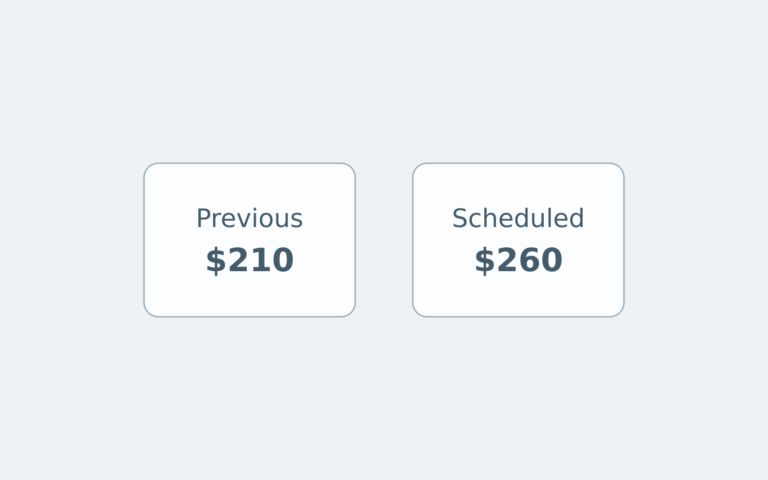
Compare the debit and notice.
Approved for a Loan, but Received a Risk-Based Pricing Notice?
Identify the document and separate report-review questions from the actual loan offer.