Lease Mileage: When Does a Higher Allowance Pay Off?
Compare two fictional lease mileage quotes before signing. Calculate the break-even mileage, see why savings level off, and adjust for upfront costs and taxes.

Estimated reading time: 7 minutes
Compare lease mileage allowances by putting the extra price beside the driving you expect. The worked example below identifies a break-even mileage total and shows why a higher allowance has limits to its value.
A higher mileage allowance can be worth paying for before you sign a car lease. Ask how much extra driving would recover the higher price. Compare two matching written quotes, then test several realistic mileage totals.
The Consumer Financial Protection Bureau identifies mileage limits as negotiable lease terms and explains that exceeding the allowance can trigger charges.
Timing can matter: Toyota Financial Services says extra miles may be arranged before signing, but the allowance becomes fixed after signing and taking possession. That’s Toyota’s process; check the rules for your own lessor.
Lease mileage: start with two matching fictional quotes
This U.S. consumer example compares a scheduled return after the full 36-month term. Both quotes cover the same vehicle and have identical non-mileage costs. All figures are invented, exclude tax and aren’t advertised offers from Toyota or any other provider.
- Lower allowance: 36,000 total miles; $0.25 for each mile above that limit.
- Higher allowance: 45,000 total miles; $25 more on each of 36 payments, plus $0.25 for each mile above its own limit.
- Extra premium: 36 × $25 = $900 for 9,000 additional allowed miles.
There are no unused-mile refunds, credits, bonuses or waivers in this exercise. This assumption doesn’t describe any provider’s refund policy. We compare undiscounted extra dollars, not the full lease price or the value of paying money earlier versus later. Early termination, buyout and extensions are outside this comparison.
Lease mileage: the tie is 39,600 total miles
Let M mean the miles you drive during the entire lease. It isn’t necessarily the ending odometer reading: check the starting odometer and the contract’s allowance basis.
- Lower extra cost: $0.25 × the miles above 36,000, or zero if you stay within that allowance.
- Higher extra cost: $900 + $0.25 × the miles above 45,000, with no overage charge below that allowance.
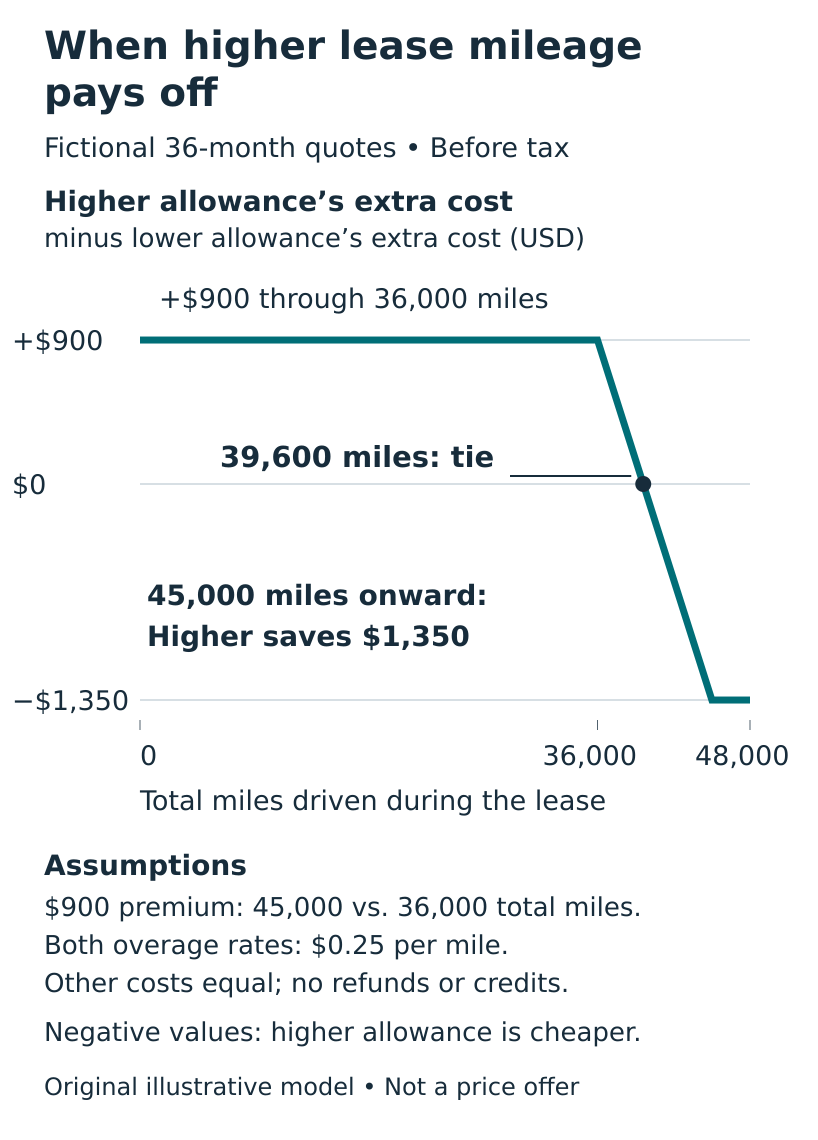
While driving remains between the two limits, the higher quote avoids $0.25 of overage for each mile beyond 36,000. Recovering the $900 premium takes $900 ÷ $0.25 = 3,600 miles above the lower allowance. Add those to 36,000: the offers tie at 39,600 total miles.
That isn’t 3,600 total miles or 3,600 extra miles each year. Over three years, the tie averages 13,200 miles annually; this conversion doesn’t create an annual allowance reset.
Test your likely driving against both quotes
| Total miles driven | Lower allowance: extra cost | Higher allowance: extra cost | Cheaper option |
|---|---|---|---|
| 33,000 | $0 | $900 | Lower by $900 |
| 39,000 | $750 | $900 | Lower by $150 |
| 39,600 | $900 | $900 | Tie |
| 42,000 | $1,500 | $900 | Higher by $600 |
| 45,000 | $2,250 | $900 | Higher by $1,350 |
| 48,000 | $3,000 | $1,650 | Higher by $1,350 |
For example, at 48,000 miles the lower quote adds (48,000 − 36,000) × $0.25 = $3,000. The higher quote adds $900 + (48,000 − 45,000) × $0.25 = $1,650. Neither number is the full cost of the lease.
Why the saving stops growing
Subtract the lower quote’s extra cost from the higher quote’s extra cost:
- Up to 36,000 miles: the higher quote costs $900 more.
- Above 36,000 through 45,000 miles: the difference is $900 − $0.25 × (M − 36,000).
- Above 45,000 miles: the higher quote costs $1,350 less, because both quotes now charge the same rate for every further mile.
Under these assumptions, lower wins below 39,600 total miles, the quotes tie there, and higher wins above it. The higher allowance’s saving reaches its $1,350 ceiling at 45,000 miles and stays there. Driving beyond 45,000 still costs money.
Adjust the calculation for your actual quote
Upfront differences: If the higher quote also requires a genuine extra $300 nonrefundable charge, its premium becomes $1,200. The tie becomes 36,000 + ($1,200 ÷ $0.25) = 40,800 total miles, before tax. Count the first installment once: if it’s already in the signing amount, include only 35 later installments for this 36-payment example. Keep refundable deposits separate from nonrefundable costs and consider when that cash is returned.
A premium too large to recover: The extra 9,000 allowed miles avoid at most 9,000 × $0.25 = $2,250 in lower-tier overage. With equal overage rates, a premium above $2,250 never pays for itself through mileage alone. At exactly $2,250, the quotes tie at and beyond 45,000 miles. Dividing any premium by $0.25 without checking the allowance gap can give a misleading answer.
Different overage rates: The flat $1,350 saving depends on equal rates. With different rates, recalculate each quote at every mileage scenario, including above both limits; the difference can keep changing.
Refunds or credits: Use only a documented provision that applies to your quote and scenario. Subtract a qualifying credit once from the relevant option. Don’t assume an allowance tier works like a separately purchased prepaid-mile product.
Taxes: Toyota’s lease-end FAQ says invoice items may be taxable. Obtain the applicable tax treatment for your actual quotes rather than assuming the pre-tax example gives your final result.
Lease mileage: build a driving estimate from its components
For an invented planning case, assume a 40-mile round-trip commute on 220 days each year, 3,000 miles of annual errands and 1,000 miles of annual travel. The annual estimate is 8,800 plus 3,000 plus 1,000, or 12,800 miles. Over the full three-year lease, that becomes 38,400 miles.
At 38,400 miles, the lower allowance’s extra cost is $600: 2,400 overage miles at $0.25. The higher allowance still costs its $900 premium with no overage. The lower quote is therefore $300 cheaper in this specific driving scenario, before tax and other matched costs.
Now change only the commute frequency to 240 days annually. Commute miles become 9,600, annual total becomes 13,600 and three-year driving becomes 40,800. Lower-allowance overage is $1,200; the higher premium remains $900. The higher quote is $300 cheaper in this alternative.
The difference between those plans is 20 additional commute days per year, or 800 annual miles and 2,400 miles over the term. No forecast of actual commuting is supplied. Use the exercise to identify which input matters rather than treating the present work schedule as fixed.
Lease mileage: keep the allowance basis separate from the odometer
Suppose the vehicle starts at an invented 150-mile odometer reading, and the contract explicitly measures the modeled allowance from that starting reading. The first plan’s 38,400 miles driven would end at 38,550 on the odometer. Subtract the confirmed starting reading before comparing driven miles with that contract’s allowance.
This is a stated contract assumption for the illustration, not a rule that every lessor uses the same basis. If the written quote defines the limit differently, follow that definition and obtain clarification. A raw ending odometer value alone may not answer the full-term-driving question.
Keep a dated projection with its commute days, round-trip distance, errands and travel assumptions. Avoid counting a work trip again inside the general-travel estimate. If moving, remote work or another driver could change usage, create a labeled alternative instead of averaging incompatible plans without explanation.
Finally, run each plausible full-term total against both written quotes. A range spanning 39,600 miles exposes the consequence of uncertainty: each option can win under different driving totals. The arithmetic can’t choose the future mileage or establish that a higher recurring payment fits the household budget.
Make low, middle and high lease mileage estimates
Build each full-term estimate from commute round trips × expected workdays, errands and planned travel. Add likely changes such as moving farther from work. Use three plausible totals rather than treating today’s commute as certain for three years.
- Record each quote’s full-term allowance, overage rate and installment count.
- Itemize cash due at signing, nonrefundable extras, refundable deposits, taxes, return charges and any written credits.
- Calculate each option at your low, middle and high mileage totals using its own allowance and rate.
- Compare both the dollar difference and the payment timing. A higher monthly commitment must fit your budget even if it wins in a high-mileage scenario.
Ask the lessor to clarify any missing term in writing before deciding. If your realistic mileage range straddles the tie, the calculation shows the cost of each outcome; it can’t tell you which future driving pattern will occur.
If your plans extend beyond the mileage allowance, review car lease exit calculations and the separate lease-end buyout comparison.

Parent Pays Student Loan Interest: Who Deducts?
Separate payment and obligation.

Returned Loan Debit: Two Fees?
Trace the payment and fees.

Rehabilitation Payment Too High?
Check an alternative request.