Medical Bill vs EOB: How to Check What You Owe
Compare the same services, current EOB and credited payments before deciding whether a provider balance matches your records.
Estimated reading time: 7 minutes
An Explanation of Benefits, or EOB, shows how your health plan processed a claim; the provider’s bill requests payment. When checking a medical bill vs EOB, compare the same services and add your receipts. The patient share on an EOB may include money you have already paid. CMS guide to reading an EOB
A difference between the documents deserves a question. It does not immediately establish an error. You might be comparing different visits, an older claim decision or a statement that has not credited a payment.
Medical bill vs EOB: match the claim before the totals
Set out the current EOB, a detailed provider statement and your payment records. CMS recommends requesting an itemized bill and asking the insurer for an EOB and help checking errors. CMS bill-error checklist
Start with the patient and provider, then compare the service date and claim reference. Ask which services the provider’s account total includes. In a hypothetical comparison, a $150 statement and a $90 patient share cannot be reconciled by subtraction alone if the statement also covers another visit that is missing from the EOB you are reviewing.
Check the dates on the documents, but distinguish a statement’s printing date from the date care was provided. CMS identifies both as separate fields. It also notes that different providers, services or treatment days can produce separate EOBs. CMS guide to reading your bill
If two EOBs appear to concern the same claim, ask the insurer which decision is current. Keep the earlier copy as history until the relationship is clear. A newer date does not prove that a document replaces every earlier amount on the account.
Find the patient share, then trace what you paid
The largest number on the EOB may be the original charge, rather than the amount you need to pay. CMS distinguishes the billed charge from the allowed amount, the insurer payment and the patient balance. Remark codes explain processing details; check their descriptions and ask the plan about anything unclear. CMS EOB field guide
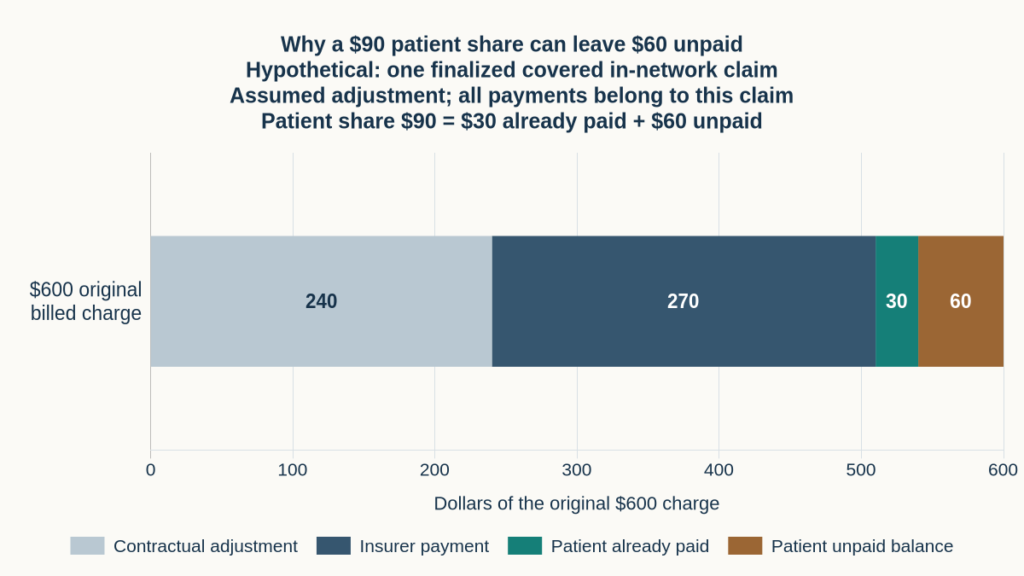
The following hypothetical example assumes one finalized, covered in-network claim, a contractual adjustment and no unrelated services or balances. All payments belong to this claim.
| Amount in the example | Value | What to check |
|---|---|---|
| Provider’s billed charge | $600 | The starting charge for these services |
| Allowed amount after the assumed $240 adjustment | $360 | The amount split between the insurer and patient |
| Insurer payment | $270 | The plan’s share for this claim |
| EOB patient responsibility | $90 | The patient’s share before accounting for the receipt below |
The first calculation is $600 − $240 = $360. Next, $270 + $90 = $360. These figures reconcile the assumed adjustment and the shares of the allowed amount.
Now add a receipt showing that you already paid $30 toward these services. The unpaid amount in this example is $90 − $30 = $60. The EOB’s $90 patient share and a $60 provider balance can therefore agree once the prior payment is included.
Subtracting only the insurer payment from the original charge gives $600 − $270 = $330. That shortcut overlooks the adjustment and your receipt. It would overstate the unpaid amount in this particular example.
If the provider instead asks for $90, ask where the $30 went and confirm that it belongs to these services, rather than another account, before requesting a corrected statement. Do not subtract a receipt from an unrelated account merely because the amounts look convenient.
This arithmetic describes the stated assumptions. Denied claims, out-of-network charges, multiple insurers and reprocessed claims need their own explanations; the example is not a universal billing formula.
A revised EOB changes the comparison
Consider a second hypothetical stage of the same example. The insurer confirms that a replacement decision changes patient responsibility from $90 to $50, and the provider confirms that the same $30 payment remains credited, with no other balances or adjustments.
- Earlier EOB
- Patient responsibility was $90. A confirmed $30 payment left $60 unpaid under that version.
- Confirmed replacement EOB
- Patient responsibility is $50. The same $30 payment leaves $20 unpaid under the revised assumptions.
- Statement to request
- An updated statement reflecting the replacement decision and the payment allocation, with any remaining difference explained.
The revised calculation is $50 − $30 = $20. Do not add the old $90 and new $50 decisions as if they were separate services, or count the receipt twice. The $40 decrease in patient responsibility is not automatically a $40 cash refund: the $30 already paid remains below the new $50 share.
Ask the billing office which claim decision its current statement reflects. Save its answer with the replacement EOB and updated statement. Mark the earlier version as superseded for this comparison only after that relationship is confirmed.
When comparing a medical bill vs EOB after reprocessing, carry forward the question about the $30 receipt until someone identifies its allocation. A replacement decision about coverage does not itself tell you where that payment went.
Put the question to the office that can answer it
A receipt is missing from the statement
Ask the provider’s billing office to trace the payment reference to the account and service dates. For the hypothetical $30 receipt, the useful request is to show its allocation and the remaining balance for those services. Keep the answer and any corrected statement together.
The plan’s decision is unclear
Ask the insurer what the remark code means and whether this is the current claim decision. If you disagree with a denial, read the appeal instructions promptly.
HealthCare.gov describes an internal appeal process and recommends retaining the EOB, appeal request, supporting documents and conversation notes. Follow the requirements and deadlines for your coverage; a billing-office inquiry does not necessarily file a plan appeal. HealthCare.gov internal-appeal guidance
A service looks duplicated or unfamiliar
CMS recommends checking detailed charges and contacting billing departments about possible double billing or codes that do not match the care received. Ask for a line-by-line explanation. A repeated code alone is not enough to decide that two charges represent the same service. CMS bill-error checklist
If you need medical records to compare with the bill, ask about any access fee first. CMS also points readers to Consumer Assistance Programs and patient advocates for help with billing issues.
If one document is missing
An EOB does not request payment, and the provider’s bill may arrive later. The Texas Department of Insurance explains that timing can vary and that you might not receive a bill if you owe nothing. TDI explanation of bills and EOBs
If a bill arrives before you can find an EOB, ask the insurer whether it received the claim and whether an EOB is available. Tell the billing office which document you are trying to obtain and clarify the bill’s due date. CMS recommends checking with the plan when an EOB is missing. CMS medical-bill guidance
A reconciled balance can still need another route
An unexpected out-of-network charge may require a complaint or plan appeal. CMS distinguishes those insured situations from patient-provider dispute resolution tied to a good faith estimate, which has separate eligibility conditions for people who did not use insurance.
That estimate-based process is not a universal remedy for an insured claim. Owing a deductible alone is not a No Surprises Act violation. CMS guide to medical-bill disputes
If the amount is correct but unaffordable, ask the provider about assistance before replacing the bill with consumer borrowing. Our hospital financial-assistance guide explains how to organize that request.
While an ordinary billing question is under review, ask whether the provider will hold billing or collection activity and get any agreement in writing. Keep the provider due date separate from an insurance appeal deadline. A call about a missing payment does not, by itself, establish that either deadline has changed.
For a reader holding both an EOB and a payment receipt, check the receipt’s allocation first. Ask the billing office to identify the services it paid for and show that credit on the statement you are being asked to pay.