Minimum Credit Card Payments: What They Do and What They Cost
Understand what the required minimum covers, compare a simple payment example, and build an affordable plan using your actual statement.
Paying your credit card’s required minimum on time can satisfy that month’s payment requirement. It does not usually clear the balance or prevent purchase interest. The useful question is what you can sustainably pay above that minimum while still covering essentials.
This guide covers U.S. consumer credit cards. Your statement and card agreement control your actual payment amount, deadline and interest terms.
Start with three numbers on your statement
- Minimum payment due: the required payment for this bill. Use the current statement, especially if the account has overdue amounts.
- Payment due date: check the receipt deadline and payment instructions, not just the calendar date.
- Statement balance: the balance when that billing cycle closed.
The current balance in your app can differ from the statement balance because later purchases, payments and other posted activity change it. Neither figure is interchangeable with the minimum payment. Capital One explains the statement/current balance distinction.
Also find the APR for each balance category and any repayment warning. Keep those beside your payment plan so you are using the account’s actual terms.
Why the minimum changes
There is no universal minimum-payment percentage you can safely use for every card. Your agreement sets the formula, which may treat different account features differently. The balance and activity on the account can therefore change the amount due. The federal repayment-disclosure calculation rules use the issuer’s actual minimum-payment formula.
If this month’s required amount is unexpectedly high, compare the new statement with the previous one. List changes in balances, interest, fees or past-due amounts, then ask the issuer to explain how it calculated the minimum. Do not assume last month’s automatic payment is still sufficient.
What a payment actually does: a simple example
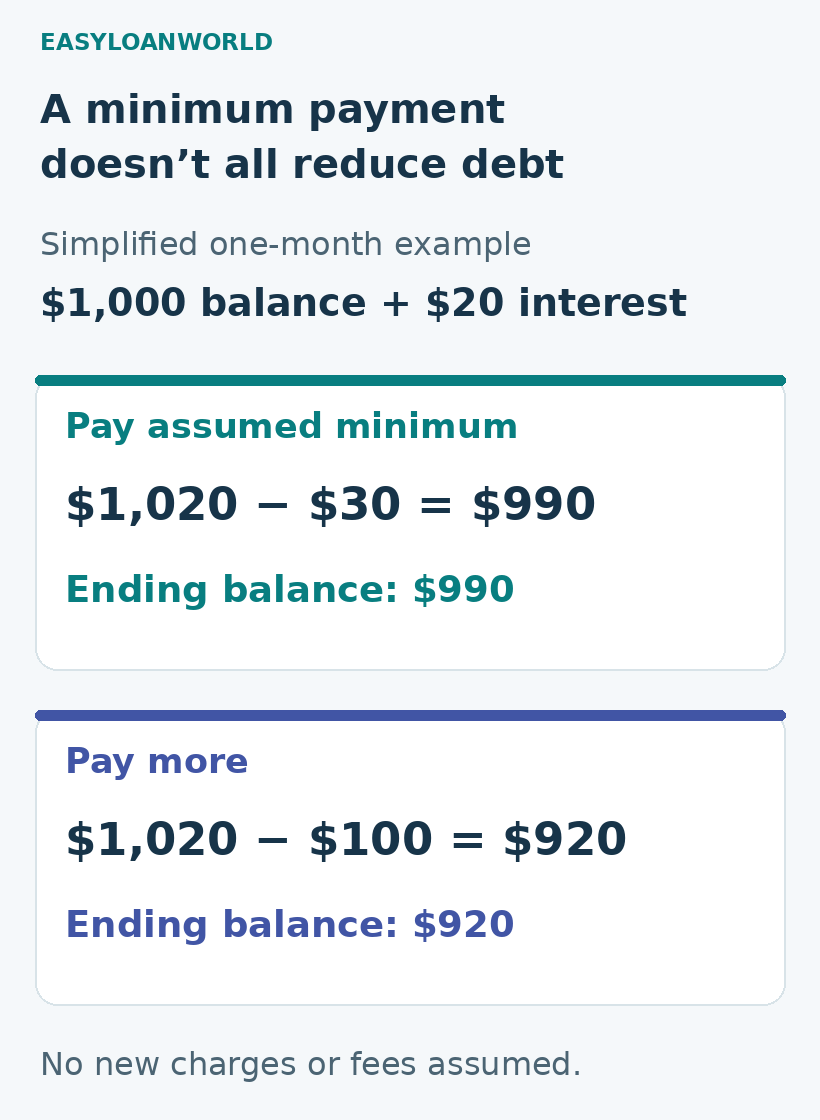
Suppose an account begins with a $1,000 balance and a 24% APR. For this illustration only, divide the APR by 12 to get a 2% monthly rate. Assume $20 of interest is added before payment, no new charges or fees, and a required minimum of $30.
Pay the assumed $30 minimum
Starting balance: $1,000
Interest added: +$20
Payment: −$30
Ending balance: $990
The balance falls by $10.
Pay $100 instead
Starting balance: $1,000
Interest added: +$20
Payment: −$100
Ending balance: $920
The balance falls by $80.
Simplified illustration; actual cards commonly calculate interest daily. The $30 minimum is assumed, not an issuer formula. This is a one-period comparison, not a payoff forecast.
The extra $70 payment produces a $70 lower ending balance under these assumptions. Notice that paying $30 does not reduce the starting balance by $30: the added interest absorbs part of the payment.
Read the repayment warning without mistaking it for a bill
Look for the statement’s minimum-payment repayment estimate. Many statements also show a payment designed to repay the displayed balance in three years. That alternative is information, not a replacement for the required minimum.
The estimates assume you make no additional charges. Continuing to use the card means you cannot rely on the displayed payment to clear everything within the illustrated period. The CFPB explains these repayment examples.
Not every statement must show a separate three-year amount. The rules include exceptions, such as when the minimum-payment repayment estimate is already three years or less. See Regulation Z’s periodic-statement requirements.
Choose a payment you can repeat
- Write down the required minimum. Start with this statement’s amount, rather than an old estimate.
- Protect essential expenses. Review what must remain in your bank account for housing, utilities, food and other necessary commitments.
- Choose a sustainable extra amount. Add an amount you can actually fund. An ambitious payment that forces fresh borrowing may be difficult to maintain.
- Review the next bill. Check whether the balance fell, whether new spending offset the payment, and whether the required minimum changed.
When interest accrues daily, making an extra payment earlier can reduce interest compared with waiting. Within one card account, payments above the minimum generally go first toward the highest-APR balance; the issuer generally decides how to allocate the minimum portion. Special rules can apply. This is different from deciding which of several cards to prioritize. Read the CFPB’s interest and payment-allocation explanation.
Check autopay before relying on it
Use this quick review each time a new statement arrives:
- Is autopay set to the minimum, statement balance or a fixed amount?
- Does a fixed amount cover this month’s required minimum?
- What amount and date does the issuer show for the next debit?
- Will the bank account have enough available funds?
- If you make a manual payment, will the scheduled debit change? Check the issuer’s rules rather than assuming it will be canceled.
- Afterward, did the payment successfully post?
If the minimum is already unaffordable
Contact the issuer promptly. Prepare four details: why payment is difficult, the amount you can afford, when you expect your situation to change, and what temporary adjustment you want to request. Ask what any offered arrangement would change, including interest, payment dates and account use, and request the terms in writing.
The issuer may have assistance options, but an offer is not guaranteed. A credit counselor may also help you review the budget; check the organization’s services and fees. The CFPB’s guidance for unaffordable credit card bills outlines practical first steps.
Common questions
Does paying the minimum avoid interest?
Usually not. Purchase-interest relief depends on your card’s grace-period terms and eligibility, commonly including full payment by the due date. A minimum-only payment is a different requirement.
Is the three-year payment mandatory?
No. When shown, it is a repayment illustration. Your required minimum is separately identified on the statement.
Can I keep spending and still use the statement’s payoff estimate?
The estimate assumes no additional charges. New spending changes the balance you need to repay.
Why did my minimum increase even though I paid last month?
Look at the formula and the new statement’s activity. A payment does not freeze the next bill’s balance, interest, fees or required amount.
Next step: Open your latest statement, write down the required minimum and due date, then choose an extra amount that fits your cash flow. Recheck the plan when the next bill arrives.
General educational information for U.S. readers. Sources checked October 19, 2026.
Featured photo: Photo by Kindel Media on Pexels. Used under the Pexels license.

Credit-Builder Loan vs. Secured Card: A Cash-Access Checklist
Work through three fictional situations and four private questions before deciding whether a new account fits your needs.
Hotel Card Hold: Compare Two Checkout Payment Paths
Compare two fictional hotel checkout choices while keeping the original card’s capacity and the actual payment in separate records.
Overdraft Fee? Look Beyond the Online Bill Label
Compare three fictional document packets behind the same $60 ONLINE BILL entry, then identify what the records still leave unexplained.