Mortgage Owner or Servicer? Read the Notice
A new company name on mortgage paperwork is a reason to identify what the document says changed, not to guess from its logo.
Estimated reading time: 5 minutes
A new company name on mortgage paperwork is a reason to identify what the document says changed, not to guess from its logo. This guide compares the questions answered by different notices. It doesn’t determine legal title, enforceability, whether a particular notice complies with law, or where you should send money.
Keep account numbers, signatures and addresses private. Don’t change payment or autopay instructions based on this illustration. For an actual conflict, obtain clarification through a verified contact rather than treating an unfamiliar message as sufficient authority.
Start with the job, not the brand
The CFPB distinguishes the original lender from the servicer. The lender supplied the money when the mortgage was made. The servicer handles the account day to day: statements, payment processing, questions and, when applicable, escrow administration. Those jobs may be performed by the same company, but need not be.
A monthly statement or payment coupon can identify the servicer. Read role labels alongside company names.
A sale can leave servicing unchanged
The CFPB explains that selling a mortgage does not necessarily change its servicer. Lenders may sell loans in the secondary market, freeing money for additional lending. A sale is therefore different from a borrower applying for a new loan.
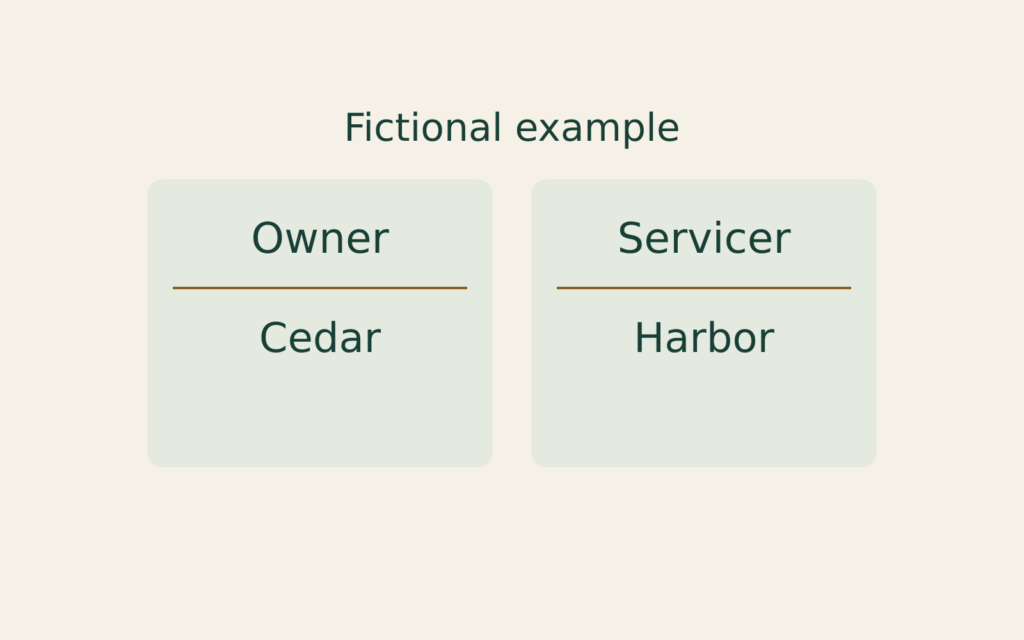
Consider a fictional letter saying that Cedar acquired the loan while Harbor continues servicing it. The two names aren’t inherently contradictory: the letter describes one change and one continuing role. This illustration isn’t evidence that either company exists or owns anyone’s loan. Its practical lesson is to read the statement about what remains unchanged as carefully as the announcement of a new name.
| Owner | Cedar |
|---|---|
| Servicer | Harbor |
What an ownership notice identifies
Regulation Z’s ownership-transfer disclosure rule concerns covered acquisitions of legal ownership and includes exceptions. Don’t infer from an absent letter that a debt disappeared.
The required disclosure identifies the loan and new covered owner, the transfer date, and relevant contact information. It also addresses where ownership is or may be recorded, or that it hasn’t been recorded when disclosed. A separate authorized contact may be identified for specified matters; read that role rather than treating every listed address as interchangeable.
The rule allows ownership information to be combined with a servicing-transfer notice if applicable requirements are met. One envelope can therefore contain more than one kind of disclosure. Its page count doesn’t establish how many functions changed. This overview isn’t a complete notice-compliance checklist.
What a servicing notice adds
Under Regulation X’s servicing-transfer provisions, the notice identifies the servicing effective date, contacts for the outgoing and incoming servicers, and when each stops or starts accepting payments. It also addresses effects on optional insurance and states that servicing transfer doesn’t change loan terms except those directly related to servicing. Certain transfers are excluded.
Compare the date labels, not just the dates. A letter’s printing date isn’t the same description as the effective date stated inside it. Nor should a reader silently rename every date “transfer date.” Keep the printed label with its value when asking about an apparent mismatch. This article doesn’t calculate notice deadlines or direct a payment rerouting.
Use an ownership question for an ownership gap
The CFPB’s owner-identification guidance says you can call or write your servicer to ask who owns the mortgage. The servicer must, to the best of its knowledge, provide the owner’s name, address and telephone number.
The guidance also links Fannie Mae and Freddie Mac loan-lookup tools and a MERS servicer-identification tool. Notice the different question in each tool’s name. A servicer search and an ownership inquiry aren’t interchangeable descriptions of the same task. Don’t paste private loan details into a public discussion while trying to sort them out. Use the official guidance to identify the intended route; this article doesn’t run a lookup or interpret a search result for an individual borrower.
Why an owner response may name a trust
Regulation X’s information-request commentary explains responses involving loans held in trusts. Depending on the arrangement, the response identifies the trust and trustee’s contact information. Special provisions address Fannie Mae and Freddie Mac, including whether the request expressly asks for the trust or pool name or number. A trustee label shouldn’t simply be erased when copying a response into notes.
Follow any required designated address or designated online intake, if offered. The rule has response requirements and exceptions; a broad demand for every securitization document isn’t equivalent to a focused owner-identity question. These procedures don’t establish that every requested document must be supplied.
This discussion assumes a covered U.S. consumer mortgage; Regulation X’s scope provisions and incorporated definitions govern applicability. It isn’t a universal procedure for every product secured by property.
Keep the unresolved question visible
Before calling, choose one sentence you can’t yet complete: “The document identifies ___, but I still need clarification of ___.” Read the relevant passage in full rather than supplying your own missing words. If an answer arrives, preserve the answer alongside the original question. Don’t rewrite an earlier uncertainty as though you had known the answer all along.


Roth Conversion and Account Clocks
Separate five-year tests.

ABLE Distributions Across Month-End
Separate retained purposes.