One Collector, Several Debts: Check Where a Payment Went
A fictional three-account record shows why a matching payment total does not resolve a destination mismatch.
Estimated reading time: 5 minutes
When one collector handles several accounts, a receipt for the correct total doesn’t establish that the money reached the correct debt. Compare the payment instruction with the account-level entries, not just the combined balance.
This guide uses a fictional three-account record to separate two questions: how much money was recorded, and where it went. It isn’t a recommendation to pay a disputed or old debt, choose a repayment priority, or accept a settlement.
First check whether this rule fits the situation
The CFPB explains that the federal Fair Debt Collection Practices Act covers collection of personal, family and household debts, not business debts. It generally doesn’t cover collection by the original creditor. State laws can provide additional protections. This article concerns covered debt collectors, not every lender’s ordinary payment system.
For a single payment involving multiple debts, Regulation F section 1006.30(c) says the collector must not apply it to a debt the consumer disputes and, where applicable, must follow the consumer’s directions. The FTC’s repayment guidance also explains the consumer’s ability to choose which debt receives a payment when a collector is collecting several debts.
Don’t confuse an instruction identifying the destination with an agreement changing the amount owed. The CFPB recommends obtaining repayment or settlement terms and the collector’s promises in writing before paying. A payment reference alone doesn’t supply those terms.
Start with three records, not one total
For an existing payment you’re checking, put these records beside one another:
- The instruction: the exact account reference, intended amount, date and message you sent.
- The payment record: the amount, transaction reference and completed status, rather than merely a scheduled debit.
- The collector’s entries: the amount credited to each account and the dates shown.
Use a private nickname in your worksheet, but preserve the actual reference in secure supporting records. Two accounts from the same original creditor can still be separate debts. If a reference changed, ask what connects the old and new identifiers; don’t merge them because their balances look similar.
A $300 receipt can conceal a $100 destination problem
Everything below is invented. Assume a covered collector handles three consumer accounts. For this exercise, A and B are verified debts, C is disputed, and the collector received an unambiguous direction assigning a completed $300 payment entirely to A. No settlement, new charges, reversals or other transactions occur during the comparison. The starting figures are amounts shown in the collector’s records, not findings that every claimed debt is valid.
| Account | Before | Recorded credit | After |
|---|---|---|---|
| A | $800 | $200 | $600 |
| B | $500 | $0 | $500 |
| C, disputed | $400 | $100 | $300 |
| Total | $1,700 | $300 | $1,400 |
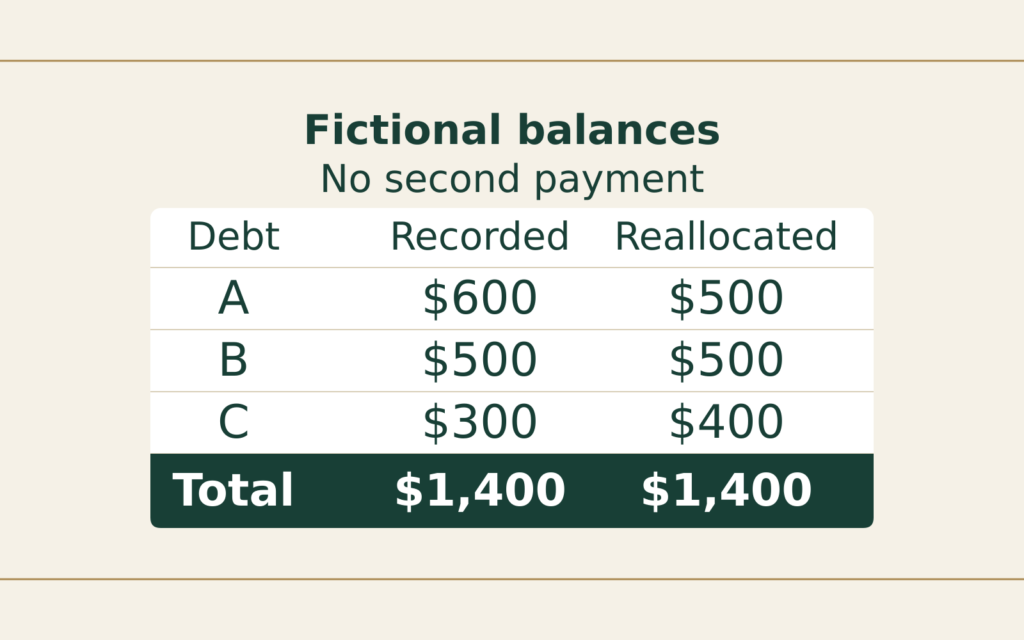
The collector’s figures add correctly: $200 + $0 + $100 = $300, and $1,700 − $300 = $1,400. There is no missing cash in this stipulated record. Nevertheless, the destination does not match the direction, and $100 was credited to disputed C. Those are the issues to raise under the rule above; a matching grand total does not answer them.
Under the stipulated instruction, the comparison amounts would instead be A $500, B $500 and C $400. They still total $1,400. The two sets of ending figures differ account by account even though neither the payment total nor the combined ending figure changes.
Describe the mismatch without sending a second payment
A useful inquiry identifies the original transaction and asks for its account-level explanation. For the invented file, the question is why A received $200 and C received $100 when the saved direction specified $300 to A. Attach or reference the instruction and relevant entries through a verified, secure channel. Don’t send full account records in public comments.
This comparison doesn’t establish that another $100 must be paid. If the collector corrects the original allocation, the arithmetic is a $100 increase in A’s credited amount and a $100 decrease in C’s credited amount. That’s a redistribution of the original $300, not a second $100 payment or another $100 reduction in the combined figure.
Keep the original entries and the correction record. Check which transaction was reversed or adjusted and whether the revised account totals reconcile. An acknowledgement that your message arrived isn’t yet evidence that the allocation changed. If the answer remains unclear, state the unresolved difference rather than marking the file complete.
Keep the legal and payment questions separate
For an unrecognized debt or disputed amount, use the collection-notice checklist to organize the notice and response questions. The example here doesn’t determine whether your dispute was sufficient, calculate a response deadline, or decide liability.
Old debts need particular care. The CFPB warns that a payment or acknowledgement can affect lawsuit time limits in some circumstances. Seek legal guidance before making a commitment about an uncertain old account; don’t make a token payment simply to test the collector’s posting system.
If court papers arrive, respond by the required court deadline, personally or through a lawyer. A payment inquiry isn’t a court response. For unresolved collection problems, the CFPB also accepts complaints; preserve the original documents and the specific question that remains unanswered.
U.S. consumer education, not individual legal or financial advice. Primary sources checked October 29, 2026. The arithmetic illustrates record checking, not a real account outcome.


