Temporary Debit Credit: Reconcile What Stays and What Reverses
Follow a fictional $800 checking-account snapshot through three separate outcomes, then compare a $50 removal with reversing $300 and rebooking $250.

Start with the temporary credit that has actually posted to your checking account. When a later decision arrives, ask two separate questions: how much of that credit stays, and which new entries change the account?
This guide follows one already-posted provisional debit-dispute credit in a fictional U.S. personal checking account. It is a reconciliation exercise, not an assessment of your claim, a refund promise or a spending recommendation.
Report suspected unauthorized activity to your bank promptly. Do not postpone reporting while organizing records. See the CFPB’s reporting guidance.
Build the balance that already includes the credit
All amounts below are invented U.S. dollars. Assume a $300 disputed debit and a full $300 provisional credit have posted, followed by $200 of ordinary spending. There are no other transactions, merchant refunds, fees, interest, holds, overdraft effects or initial withholding. The debit is alleged to be unauthorized; the example does not decide that question.
A plus sign increases this checking-account ledger; a minus sign reduces it. The running balance is the model’s posted total. It does not reproduce a particular bank app’s available-balance calculation.
| Record | Change | Running balance |
|---|---|---|
| Opening balance | Starting amount | $1,000 |
| Disputed debit | −$300 | $700 |
| Provisional credit | +$300 | $1,000 |
| Ordinary spending | −$200 | $800 |
The check is $1,000 − $300 + $300 − $200 = $800. That $800 already includes the temporary credit. Keep this snapshot fixed while comparing the following alternatives.
Three outcomes from the same $800 snapshot
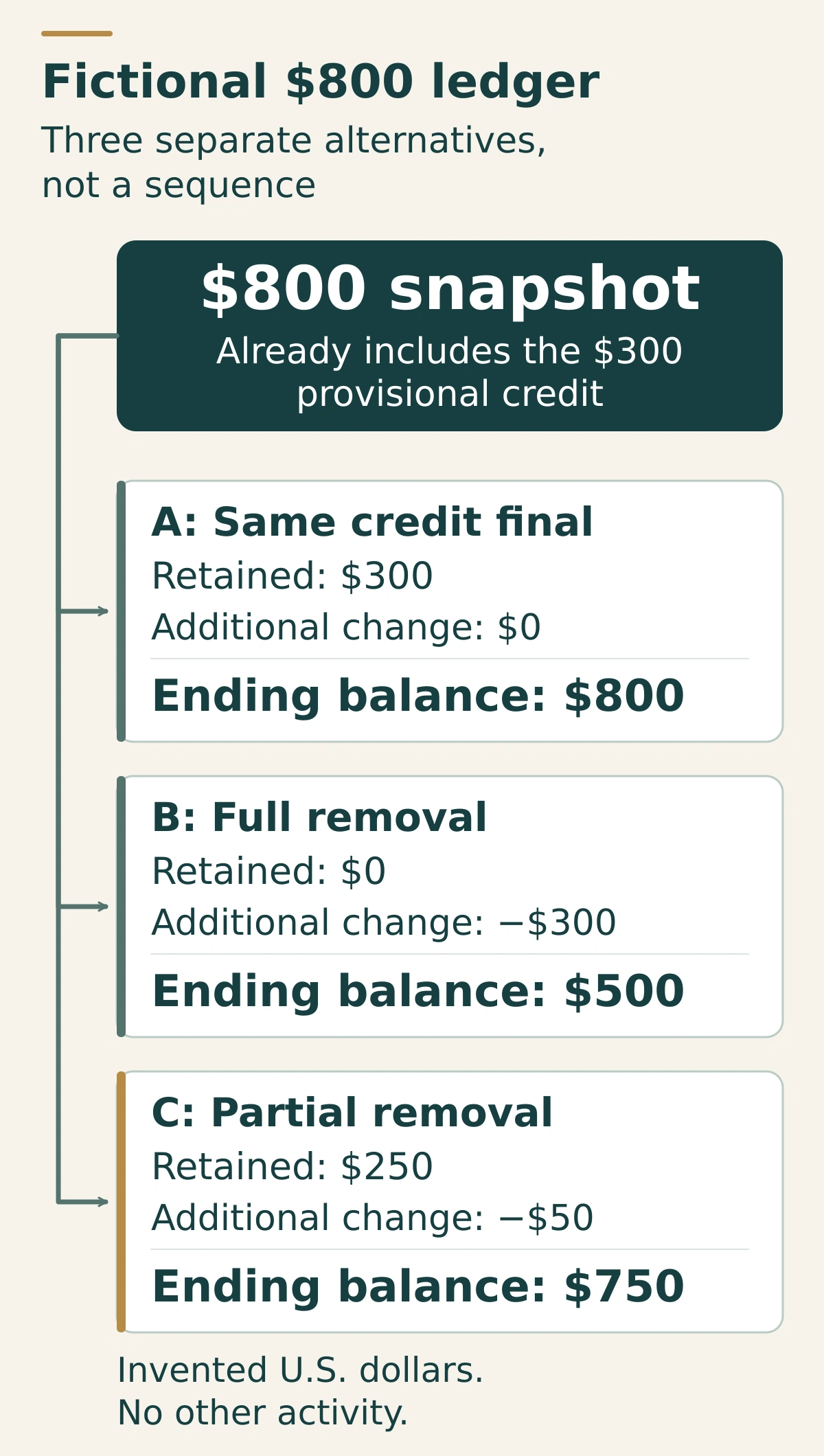
Each row is a separate invented outcome with no other activity. The first assumes a status change only; the other two assume that the stated removal actually posts. These rows are alternatives, never a sequence.
| Assumed outcome | Final credit retained | Change from $800 | Ending balance |
|---|---|---|---|
| Same credit becomes final; no new posting | $300 | $0 | $800 |
| Full provisional credit removed | $0 | −$300 | $500 |
| $250 retained; $50 removed | $250 | −$50 | $750 |
A bank’s investigation result can confirm that an existing provisional credit has become final. Regulation E §1005.11(c)(2)(iv).
In the first fictional row, adding another $300 would produce $1,100 and count the same credit twice. The decision changes the assumed status; the model contains no additional inflow.
In the third row, $250 describes what remains from the original $300. The amount removed is $300 − $250 = $50, leaving $800 − $50 = $750. Adding $250 to $800 would incorrectly produce $1,050. Subtracting the retained $250 would incorrectly produce $550.
This example’s $50 is solely the difference between two invented amounts. It is not a legal deductible or a liability calculation, and the model assumes no initial withholding.
If the entries reverse and rebook the credit
Here is a different illustrative presentation of the same $250 retained-credit outcome. Assume the record actually contains both entries below. This is an accounting comparison, not a prediction of your bank’s display.
| New posted entry | Change | Running balance |
|---|---|---|
| Reverse the original provisional credit | −$300 | $500 |
| Post replacement final credit | +$250 | $750 |
Together, −$300 + $250 equals −$50. Count either the single $50 removal from the earlier scenario or these two actual entries, according to the records. Do not enter all three adjustments. Likewise, reversing $300 and replacing it with $300 would have a net effect of zero.
Preserve the original +$300 entry in the historical ledger. Add each later reversal or replacement as its own linked entry. A new snapshot that already includes those adjustments must not receive them again.
Match the decision to four record questions
- Which original credit does the notice address? Match the case reference and transaction description to the posted provisional credit. Equal amounts alone are insufficient for your reconciliation.
- What amount does the decision say stays? Record the final retained amount separately from the signed adjustment. In the partial example, these fields are $250 and −$50.
- What actually posted? List the debit and credit references, amounts and posting dates. Keep the notice date and status wording in separate fields. Leave a missing posting unconfirmed.
- What remains unexplained? Identify the specific difference between the decision and the activity record. Ask the bank which entries implement its result, rather than filling the gap with a guessed adjustment.
Keep the record private. Use a short account label in a general worksheet, without full account numbers, passwords or authentication codes. If you compare snapshots from different times, list the intervening transactions before calling the balances inconsistent.
Keep the bank’s explanation with the calculation
For covered accounts, unauthorized electronic transfers are among Regulation E’s covered errors. If the bank finds no error, or a different error from the one alleged, it must provide written findings and explain your right to request the documents it relied on; requested copies must be provided promptly. When debiting a provisional credit under those procedures, it must notify you of the debit’s date and amount. Use of credited funds during an investigation does not itself establish the final outcome. See Regulation E §1005.11.
Finish with a posted balance you can explain and a clearly identified unresolved amount or missing document. In the fictional case, the matching result is $800, $500 or $750 depending on the chosen outcome. Your calculation can reconcile the entries; it does not close the investigation or establish entitlement.
General U.S. financial education. Primary sources checked October 21, 2026. No personal reporting, investigation or reversal deadline is calculated here.

Hotel Card Hold: Compare Two Checkout Payment Paths
Compare two fictional hotel checkout choices while keeping the original card’s capacity and the actual payment in separate records.
Overdraft Fee? Look Beyond the Online Bill Label
Compare three fictional document packets behind the same $60 ONLINE BILL entry, then identify what the records still leave unexplained.
Identity-Theft Records: A Report-by-Report Matrix
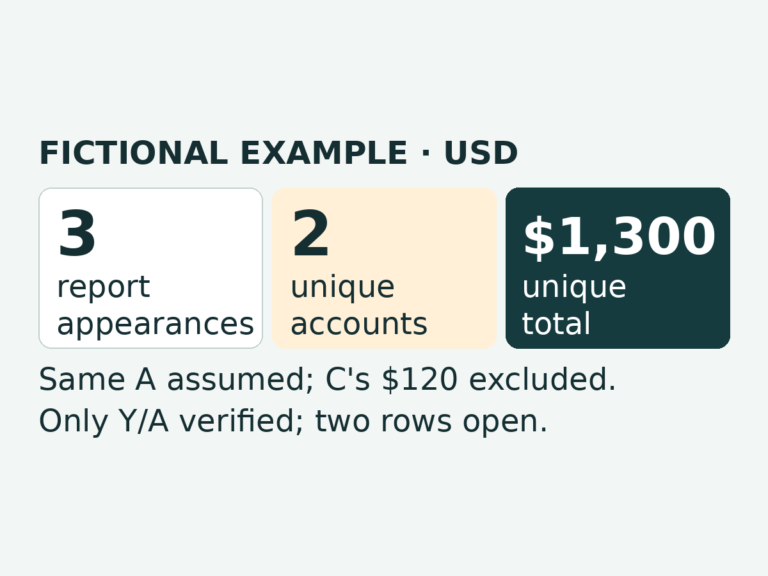
Use a fictional account-by-bureau matrix to separate three report appearances from two accounts and track which responses still need checking.