Power Factor Billing Adjustment
Check the threshold.
Estimated reading time: 1 minute
Oklahoma State Extension illustrates a power-factor adjustment in a fictional commercial rate schedule. It is not your utility’s tariff.
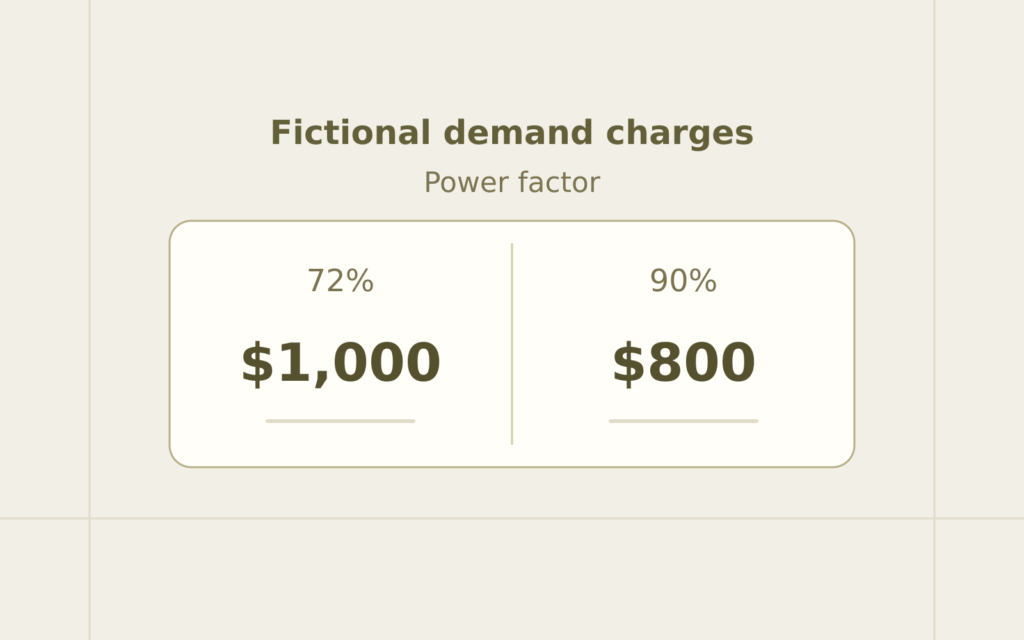
Use that example’s 90% threshold with invented inputs: 80 kW measured demand, 72% power factor and a $10 monthly charge per billing kW. Below the threshold, adjusted demand is measured demand × 90% ÷ measured power factor.
Thus 80 × 0.90 ÷ 0.72 = 100 billing kW, producing a $1,000 demand charge.
At 90% power factor, the unadjusted 80 kW produces $800. At 95%, this rule still produces $800: its below-threshold adjustment no longer applies. Using 80 × 0.90 ÷ 0.95 would wrongly reduce billing demand below measured demand.
The modeled $200 difference is a demand-charge reduction, not proof of lower kWh consumption or a $200 reduction in every bill.
Energy charges, taxes, fees and historical demand floors are excluded. Before financing corrective equipment, ask the utility to verify the account’s actual rule and measurements. Obtain qualified technical advice; this arithmetic establishes neither equipment suitability nor project payback.