Personal Loan Payoff Quote vs. Statement Balance: What to Verify
Check a personal-loan payoff quote, its effective date and pending-payment assumptions, then reconcile the final payment and completion record.

For a planned final personal-loan payment, request a payoff amount for the date and payment method you intend to use. Check what that amount includes and which payments it already assumes. A balance on an older statement or account screen may not answer the same question.
The aim is a confirmed payment instruction and a completed payoff record. Keep the worksheet below privately; EasyLoanWorld does not need your account numbers, statements or payment details.
Read the label and date before using the balance
Identify what the number actually represents: remaining principal, total account balance, the current installment due, or a separately labeled payoff figure. Record its as-of date. Do not assume every lender uses the same statement labels or that a payoff figure must always be higher.
Upstart’s servicing guidance, for example, says its displayed payoff includes accrued interest or unpaid fees and assumes scheduled payments succeed. A canceled or failed payment changes the amount. That is a reason to ask your own servicer which payment assumptions its quote uses.
Check the agreement and ask about any charge you do not recognize. Adding the remaining installments or copying an unexplained screen total is not a substitute for confirming the amount the servicer requires for full payoff.
Match the quote to your intended payment
Upgrade’s payoff-quote workflow, for example, lets borrowers select their intended payoff date.
Use this request with your own servicer: “Please provide the full payoff amount for my planned payment date and method. When must funds be received or credited, how long is the quote usable, and which pending payments are already included?”
Record the answers in a payoff worksheet:
- Account: Servicer and a private loan reference.
- Dates: Quote issue date, intended effective payoff date and any stated valid-through date.
- Amount: Total plus any itemized principal, interest, charges and credits.
- Assumptions: Payments already reflected, including any still pending.
- Delivery: Accepted method, receiving deadline and required reference.
- Changes: What would require an updated quote?
- Evidence: Quote copy and clarification reference saved.
These are questions to resolve, not a claim that every quote must contain the same fields. If a date or component is unclear, ask before sending money. Confirm whether a deadline concerns sending, receipt or crediting; record the servicer’s answer rather than choosing the most convenient interpretation.
Do not subtract the same payment twice
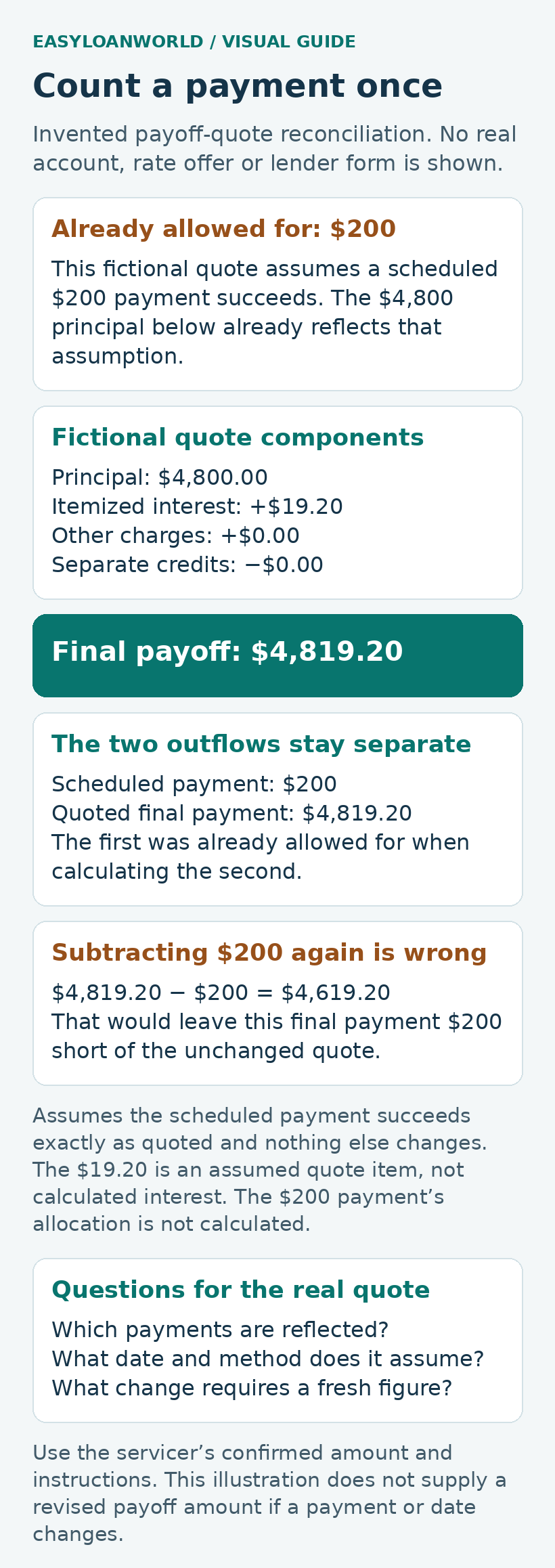
Here is a fictional quote for an agreed payoff date. It is an arithmetic illustration, not an actual account or interest-rate offer.
- Remaining principal shown in the quote: $4,800.
- Itemized interest: $19.20.
- Other charges: $0.
- Separate credits: $0.
- Total payoff quoted: $4,819.20.
In this example, the quote expressly says it already accounts for a scheduled $200 payment and assumes it succeeds. The $4,800 principal is the figure after that assumption. It is not the principal before the scheduled payment.
The reconciliation is $4,800 + $19.20 + $0 − $0 = $4,819.20. If the $200 payment succeeds exactly as assumed and nothing else changes, the payoff figure remains $4,819.20.
Subtracting $200 again would produce $4,619.20, leaving the final payment $200 short of the still-applicable quote. The scheduled payment and the quoted final payment are separate outflows in this example; the first has already been allowed for in calculating the second.
The $19.20 is an assumed quote item, not interest calculated from an APR. The example does not calculate how the $200 was allocated or assume that all of it reduced principal.
If the scheduled payment fails, is canceled, posts differently or the intended payoff date changes, request a fresh figure. Do not simply add $200 back: the revised amount could also reflect changed timing or other adjustments.
Coordinate payoff with existing payment instructions
SoFi’s payment guidance says a scheduled automatic debit may still occur while a payoff payment is processing, with an overpayment refunded under its process. It also provides access to a paid-in-full letter after completion. Those are provider-specific procedures; confirm your servicer’s instructions and timetable.
Before the final payment, ask:
- Is the next automatic debit already included in this quote?
- Is a debit already queued, and what will happen while payoff processes?
- Should I change any payment instruction, and at what confirmed point?
- How would an excess payment be returned?
- What payment remains due if the planned payoff does not complete?
Keep following the agreement and verified instructions until payoff is confirmed. Do not skip a required installment simply because you requested a quote, or cancel every automatic payment without checking the consequences.
For unexpected changed instructions, apply the FTC’s verification advice: contact the company through a website or number you know is genuine.
Save the verified instructions beside the quote. Keep distinct records for payment scheduled, payment sent, payment received or credited, and paid-in-full confirmation. Treat these as your tracking labels, not interchangeable proof that everything is finished.
Close the record after the payment finishes
Match the completed payment to the intended loan and the servicer’s response. Keep the quote and transaction confirmation together. If a remaining amount or excess payment appears, ask for a reconciliation rather than assuming it is an error or ignoring it.
Obtain or locate paid-in-full confirmation and retain it privately. Verify recurring-payment instructions after completion, including whether a previously queued transaction still needs attention.
For a secured personal loan, ask what separate document or step establishes release of the specific collateral or hold. Keep that question open until the required evidence is available.
Two quick checks before calling it finished
Can I estimate the payoff myself? An estimate can help you spot a question, but use the servicer’s dated amount and verified instructions for the final payment. Do not send a guessed extra amount as a substitute for clarification.
Does receiving a quote mean the loan is closed? No. A quote supplies information; the payment and final account status still need to be confirmed. Keep any unresolved amount, payment or documentation question on your follow-up list.
U.S. consumer education. Loan terms and servicing procedures vary. Sources checked October 19, 2026.
Featured photo: Photo by Tuccera LLC on Unsplash. Used under the Unsplash license. Illustrative stock photograph of calculation tools and coins. It does not depict the example payoff or a lender’s payment method. Photo by Tuccera LLC on Unsplash.

Keep Savings or Pay Extra on a Personal Loan? Compare Cash and Debt
A fictional three-payment comparison shows how extra principal changes cash, debt, and interest, then tests which expenses the remaining cash can cover.
Payday Alternative Loans: Your Options
Screen three cash needs, then compare actual offers.

Stop Loan Autopay: Separate the Debit From the Debt
Review a fictional $210 payment, trace a $420 cash outflow, and compare the supporting records before treating an unexplained difference as resolved.