Personal Loan Refinancing: When Do the New Fees Pay Back?
Compare personal-loan refinancing through the same payoff date, including the remaining balance, to see when new fees are recovered.

A refinancing offer can lower your monthly payment and still cost more if you pay the debt off soon. To find out, compare each loan through the same future date, including the balance you would need to clear on that date.
This guide tests when a new fee is recovered on an existing U.S. personal loan. The example is invented, with no current offers, extra borrowing or promised savings. Its central question is simple: how much would you have paid to be finished with the same debt?
Set the starting line at today’s payoff
Refinancing replaces an existing loan with new borrowing. OneMain’s refinancing guide highlights charges from both lenders and the possibility of spending longer in debt. Read the actual terms before treating a lower payment as a cost reduction.
Start your comparison today. Include future payments, new charges and any applicable payoff adjustment. Money already paid and not refundable is outside this forward-looking decision. However, all remaining principal belongs in the calculation, including principal that originally financed an old fee.
Discover’s refinancing guidance separates the amount needed to clear the existing loan from additional borrowing. Keep those decisions separate here: an offer that also delivers spending money does not replace the same debt on the same basis.
Write down the old loan’s payoff amount for your chosen transaction date. Then reconcile new principal, deducted charges, cash you contribute and net funds available to clear that payoff. A funding gap means the proposed transaction does not fully replace the old debt.
A fictional $9,000 replacement
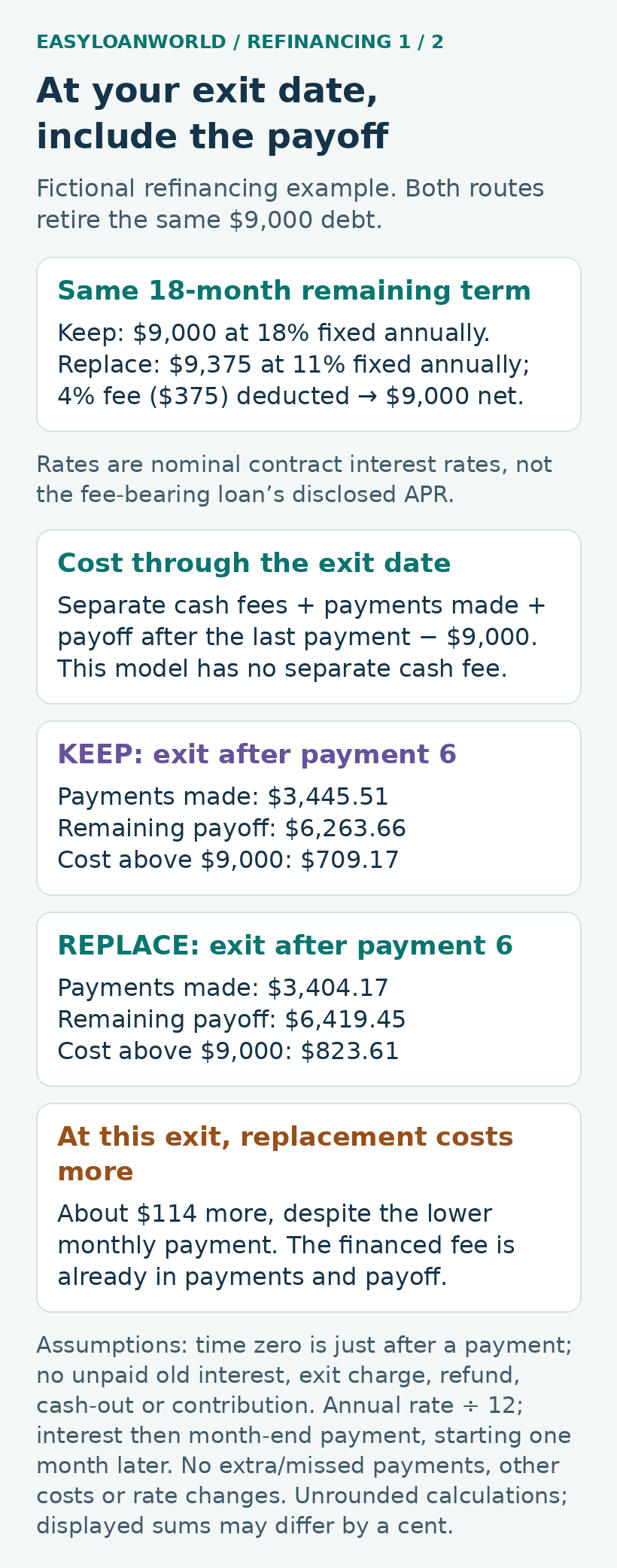
Assume the transaction happens immediately after a scheduled payment. The old principal and valid immediate payoff are both $9,000, with no unpaid interest, exit charge or refund. Eighteen monthly payments remain at a fixed 18% nominal annual interest rate.
The replacement uses a fixed 11% nominal annual interest rate for the same 18 months, with a fee equal to 4% of its principal deducted before funding. These are contract interest rates, not the disclosed APR of the fee-bearing loan.
Discover’s fee explanation describes fees deducted from loan proceeds. Confirm how your particular offer handles its fee.
Under our assumptions, the new principal is $9,375: deducting the $375 fee leaves exactly $9,000 to retire the old debt. No cash is paid separately or taken out.
Both schedules use annual rate divided by 12, interest added before each month-end payment, and the first payment one month after the transaction. Calculations retain unrounded payments internally. There are no missed or extra payments, other costs or rate changes. Actual dates, rounding and contract methods can produce different results.
Following both schedules to month 18
- Keep the old loan: about $574.25 monthly; $10,336.54 in remaining payments; $1,336.54 in future interest.
- Replace it: about $567.36 monthly; $10,212.50 in payments; $837.50 interest on the new principal, plus the $375 fee.
The new payment is about $6.89 lower. Fee plus interest totals $1,212.50, making the modeled full-term reduction about $124. That result depends on completing these assumed schedules.
What if you clear the debt after six months?
Use this same-date test for each option:
Cost through the exit date = separate cash fees + payments made + payoff immediately after the last included payment − the common $9,000 starting debt.
Use the actual payoff applicable to that date, including any contractual exit charge or refund. Here, payoff equals the modeled remaining balance. The financed $375 fee is already inside the replacement balance and payments; adding it again would count it twice.
Keep the old loan, then exit
Six payments total about $3,445.51. The remaining balance is about $6,263.66. Together they are $9,709.17, or about $709.17 above the starting debt.
Refinance, then exit
Six payments total about $3,404.17. The remaining balance is about $6,419.45. Using unrounded figures, the combined outflow is about $9,823.61, or about $823.61 above the starting debt. Displayed components can differ by a cent when added.
The replacement has cost about $114 more at this exit. Its smaller payments have not yet compensated for its larger remaining balance.
Find the crossover using balances
Repeat the calculation at plausible payoff dates. In this monthly model:
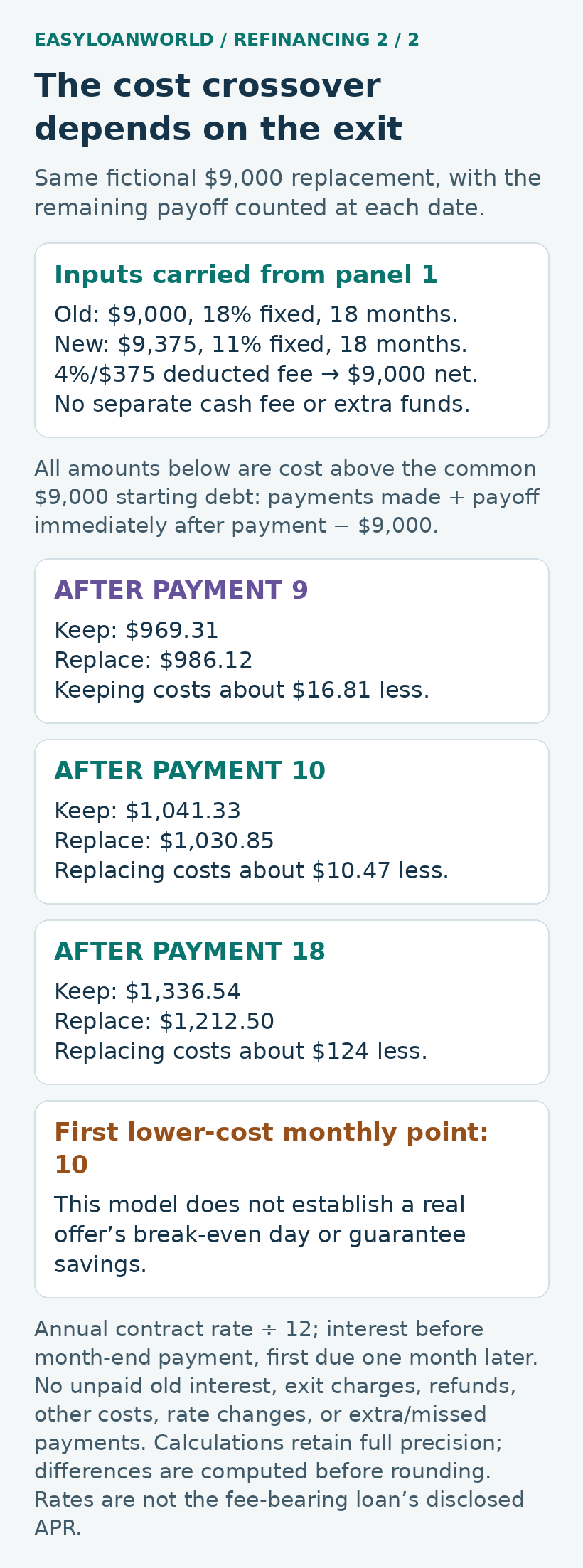
- After month 9: keeping costs about $969.31; refinancing costs about $986.12. Keeping is still ahead by about $16.81.
- After month 10: keeping costs about $1,041.33; refinancing costs about $1,030.85. Refinancing is ahead by about $10.47, calculated before display rounding.
Month 10 is the first modeled monthly checkpoint where the replacement costs less. This is not a promise about a real offer’s break-even day.
Dividing the $375 financed fee by the roughly $6.89 payment reduction produces about 54 months, beyond either loan’s term. That shortcut treats the financed fee like a separate cash outlay and leaves out the different remaining balances. It does not answer the total-cost question in this example.
Keep payment relief separate from fee recovery
Change only the replacement term to 30 months. Its payment drops to about $358.86, but fee plus interest rises to about $1,765.71, approximately $429.17 more than keeping the original schedule. After month 18, about $4,060.31 remains owed, with 12 payment dates still ahead. The cash-flow relief may matter, but record its cost and additional time explicitly.
Make a short decision record
- Starting boundary: transaction date, debt being replaced and payoff funds available, with any funding gap identified.
- Two views: full scheduled repayment and plausible earlier exits, each including its remaining payoff.
- Cash treatment: fees paid separately, charges financed and refunds actually available. Count each once.
- Decision: required payment, cost at your selected exit and time remaining in debt.
- Unconfirmed items: rate conditions, optional products, dates and contractual payoff treatment. Leave unknown amounts unresolved rather than entering zero.
If the current payment is unworkable, ask the existing lender about available assistance as a separate option. Discover notes that help depends on the situation. Neither relief nor a new loan is assured.
A planning exit date is also not an assurance that another refinance will be available. Keep current payment obligations in view while evaluating alternatives. The comparison is useful when it shows both the monthly requirement and the cost of actually being done.
Featured photo: Photo by Sasun Bughdaryan on Unsplash. Used under the Unsplash license. Illustrative calculator. Photo by Sasun Bughdaryan on Unsplash.

Keep Savings or Pay Extra on a Personal Loan? Compare Cash and Debt
A fictional three-payment comparison shows how extra principal changes cash, debt, and interest, then tests which expenses the remaining cash can cover.

Payday Alternative Loans: Your Options
Screen three cash needs, then compare actual offers.

Stop Loan Autopay: Separate the Debit From the Debt
Review a fictional $210 payment, trace a $420 cash outflow, and compare the supporting records before treating an unexplained difference as resolved.