Personal Loan vs. Credit Card for a One-Time Expense
Compare ways to finance the same purchase, separating required installments from payoff targets and checking the time left on a card promotion.

For a one-time expense, start with the invoice and the payment deadline. Then compare the money each borrowing option makes usable, the payments it requires and the date you want the debt gone. An existing card promotion may have far less time remaining than its advertised original length.
This U.S. guide uses one fictional $2,400 purchase to separate a loan installment from a chosen card payoff target. All rates and terms are invented. The examples are not current offers or a recommendation to borrow.
Can the proposed method pay this invoice?
Capital One’s loan-and-card comparison notes that seller acceptance and borrowing terms affect how funds can be used. It also distinguishes ordinary purchases from cash advances, which can have different fees and rates. Confirm the transaction type before applying purchase-rate calculations.
For our example, a merchant accepts either an ordinary card purchase or payment from loan-funded bank cash, charging the same $2,400 all-in price. There is no surcharge, currency conversion, usage restriction or other service fee.
For a real purchase, record the actual accepted method, price and deadline. Confirm net loan proceeds or eligible purchase credit cover that amount when needed. An advertised limit or an unconfirmed funding date does not close an unpaid gap.
If you can pay without borrowing, keep that as a separate baseline. A card purchase paid in full under applicable interest-free terms also differs from the carried-balance case below. Check the account’s conditions before assigning interest to that path.
Three ways to pay the same $2,400
Assume each route pays the invoice at time zero. There are no other balances, purchases, cash advances, annual fees, rewards, late payments, discounts or penalties. The example loan is fixed-rate and unsecured; those are selected terms, not a description of every personal loan.
Interest-bearing calculations use the nominal annual rate divided by 12, with interest before each month-end payment and the first payment one month after the purchase or funding. Calculations keep unrounded values internally. Actual day counts, rates, payment dates and rounding can change results; multiplying displayed payments may differ by cents.
Path 1: a loan with 12 required installments
Discover’s loan FAQ describes origination fees deducted from proceeds. Confirm your own offer’s treatment.
Here, a hypothetical 3% deducted fee means the theoretical principal must be $2,400 ÷ 0.97, or about $2,474.23. The fee is approximately $74.23, leaving $2,400 for the merchant.
At a fixed 12% annual contract interest rate over 12 months, the modeled required installment is about $219.83. This rate is not the fee-bearing loan’s disclosed APR.
Total repayment is about $2,637.98. Cost above the invoice is about $237.98, including the financed fee and interest. Do not add the fee again to total payments.
Path 2: an ordinary card balance, cleared in 12 months
Assume the purchase starts a $2,400 card balance with no transaction fee, a constant hypothetical 24% annual interest rate and no purchase-interest exemption for this carried balance. The monthly rate is 2%.
A payment of about $226.94 clears it in 12 periods under this model. Total repayment is approximately $2,723.32, including about $323.32 interest.
The $226.94 is a voluntarily chosen payoff target, not the issuer’s minimum or a predicted bill. The actual minimum must still be met. A smaller payment would change the planned finish and cost.
Path 3: a purchase promotion with nine periods left
Chase’s introductory-rate guide describes offers whose clock runs from account opening and whose purchase and transfer coverage differ. Check the specific start trigger, eligible transactions and expiration date. Do not assume a new purchase restarts the promotional period.
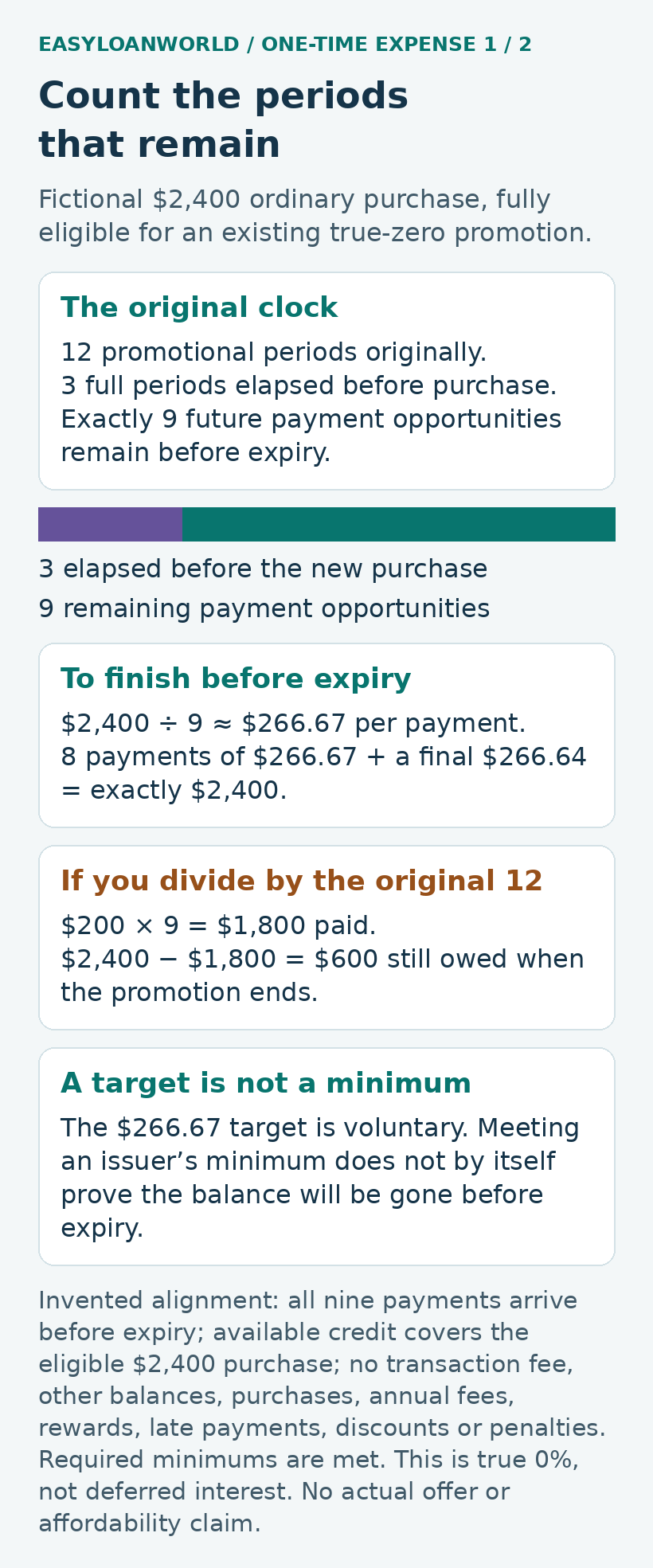
In this fictional case, the card originally had 12 zero-interest periods. Three full periods elapsed before the new purchase. Exactly nine future monthly payment opportunities remain before expiry, the whole purchase qualifies and available credit is sufficient.
To clear $2,400 within those nine opportunities, the target is $2,400 ÷ 9, or approximately $266.67. Eight payments of $266.67 and a final $266.64 total exactly $2,400.
The modeled interest and fees are zero, but the monthly payoff target is higher than either 12-month path. It is not the issuer’s minimum or proof that the purchase fits your budget. This deliberately aligned example assumes required payments are met and all nine arrive before expiry.
The clock error: $200 leaves $600 behind
Suppose instead you divide the $2,400 by the original 12-period promotion and choose $200 monthly. Only nine payments arrive before it ends. You have paid $1,800 and $600 remains at expiry.
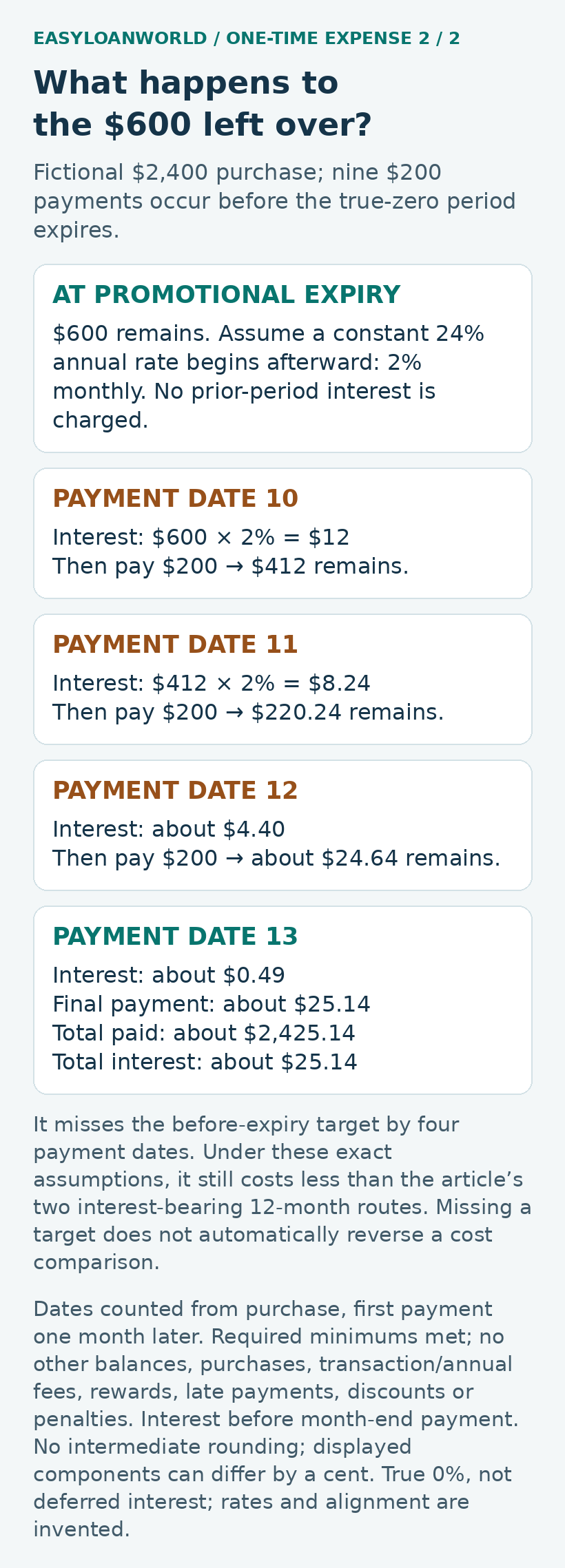
For this alternative, assume required minimums were met and a constant 24% annual rate starts afterward, modeled as 2% monthly. There is no charge for interest during the prior true-zero period.
The first post-promotion interest is $12. After the next $200 payment, $412 remains. Continuing at $200 produces a smaller final payment of about $25.14 on payment date 13, counted from the purchase.
Total repayment becomes about $2,425.14, including $25.14 of interest. Under these exact assumptions, that is still less than either interest-bearing 12-month route. But it misses the intended before-expiry finish and adds four payment dates after the promotion ends. Different terms or payments would change the result.
Keep conditional deferred-interest offers out of this true-zero model. If unpaid balances can make interest from the promotional period become owed, the consequences differ. The CFPB’s official interpretation of Regulation Z, comment 60(b)(1)-9, distinguishes that arrangement from a 0% rate.
Record the route, requirement and intended finish
Before choosing, make a short private record for the actual invoice:
- Purchase: total price, seller’s accepted method, payment deadline and transaction classification.
- Usable funding: net proceeds or eligible purchase credit, confirmed availability and any unfunded amount.
- Contract requirement: installment or minimum, payment dates, rate type, fees and conditions.
- Chosen finish: target date and feasible payment opportunities. For a promotion, use the verified remaining window; expiry and the statement due date need not coincide.
- Cost and balance: total payments, debt remaining at the intended finish and the rate and payment plan afterward.
If the required payment or chosen target cannot be funded, mark that gap. A smaller proposed payment does not establish affordability or preserve the finish date. Other balances, a later posting date, a rate change or insufficient available credit can require rebuilding the calculation.
The example demonstrates three different trade-offs: a required loan schedule, a voluntary card payoff schedule and a shorter remaining promotional clock. Decide using the actual invoice and terms, without relying on a future refinance or another promotion to complete the plan.
Featured photo: Photo by Markus Spiske on Unsplash. Used under the Unsplash license. Illustrative repair tools. Photo by Markus Spiske on Unsplash.

Keep Savings or Pay Extra on a Personal Loan? Compare Cash and Debt
A fictional three-payment comparison shows how extra principal changes cash, debt, and interest, then tests which expenses the remaining cash can cover.
Payday Alternative Loans: Your Options
Screen three cash needs, then compare actual offers.

Stop Loan Autopay: Separate the Debit From the Debt
Review a fictional $210 payment, trace a $420 cash outflow, and compare the supporting records before treating an unexplained difference as resolved.