Private Student Loan Co-Signer Release Checklist
Check your private student loan's release policy, qualifying payment record and required evidence, then verify the written decision for each loan.

Estimated reading time: 8 minutes
Cosigner release requires more than reaching a payment milestone. For a private student loan, distinguish evidence of a requirement, a complete request under review and a written release that names the affected loan.
A private student loan co-signer release file should distinguish three stages: evidence that a requirement may be met, a complete request under review, and a written release with an effective date. Reaching a payment milestone doesn’t establish all three.
The CFPB explains that release is available for some private loans, subject to the lender’s or servicer’s specific criteria. Start with the terms for your actual loan; there’s no single payment-count rule to apply across providers.
The practical goal is a traceable request and a decision whose scope you can verify. Don’t substitute a family understanding, changed account access or a removed payment instruction for lender confirmation.
Cosigner release: check the exact product and policy
These selected examples were checked October 19, 2026. They illustrate differences, not a ranking or complete eligibility test. Follow each provider’s full current instructions for the loan involved.
Sallie Mae’s release policy includes graduation or certificate completion, income and credit review, and twelve qualifying on-time principal-and-interest payments or qualifying prepayment. In-school, separation and grace-period interest-only or fixed payments don’t count. Account-standing and recent-hardship restrictions also apply. Parent Loans originated after May 2026 are excluded. Meeting a payment condition alone is insufficient; requirements may change.
College Ave’s detailed release page requires half the original repayment term to have elapsed, alongside income, residency and credit criteria. Its example is five years of principal-and-interest payments for a ten-year term. Only the primary borrower may submit its request; a request submitted by the co-signer is declined.
Don’t use either example to decide that another loan qualifies. If payments are becoming unaffordable, ask about available assistance and its consequences. Don’t skip needed help or make an unsustainable payment to pursue a possible later release.
Cosigner release: build six small records
Keep sensitive documents privately and use the lender-approved secure channel for submissions. Don’t upload personal records to EasyLoanWorld. In a shared planning sheet, use private file references rather than full account identifiers.
1. Loan map
Give each loan a separate card with its lender or servicer, product, origination date, borrower and co-signer roles, repayment stage, and agreement reference. If you have several yearly loans, avoid collapsing them into one unlabeled account total. Ask which loans a combined request would cover.
2. Policy copy
Save the contractual release provision and current policy or application, including the date checked. Ask about any apparent inconsistency.
Keep the original version alongside a replacement. Otherwise, a later review can leave you unsure which wording you relied on. A website summary is a starting reference, not a personalized decision.
3. Payment reconciliation
Separate interest-only, fixed and principal-and-interest periods. Record each scheduled amount, due date, credited date, returned-payment status and confirmed qualifying classification.
Keep a statement or transaction reference for each entry. Mark disputed classifications unresolved instead of counting them optimistically. An amount leaving a bank account and a payment being credited correctly are different facts to verify.
4. Requirement evidence
List the current form’s requested completion and income evidence, required recency, items supplied and remaining questions.
This isn’t a universal document list. Use a simple evidence status such as located, submitted or acknowledged. A document in your folder hasn’t necessarily reached the reviewer.
5. Submission trail
Verify who must request release, required signatures and the accepted submission method before sending anything.
Save the receipt, reference number, acknowledged missing items and any follow-up date supplied by the lender. Don’t call the file complete solely because an upload finished; look for the lender’s confirmation of what remains needed.
6. Decision record
Identify the loans covered, the stated outcome, reasons or missing evidence, and any next steps. If approved, retain the written release’s effective terms and date for both borrower and co-signer. Keep “received a response” separate from “verified an effective release.”
Worked example: sixteen months don’t mean sixteen qualifying payments
Consider an invented policy requiring twelve qualifying on-time principal-and-interest payments, plus separate credit and other requirements. This isn’t a Sallie Mae or College Ave eligibility calculation.
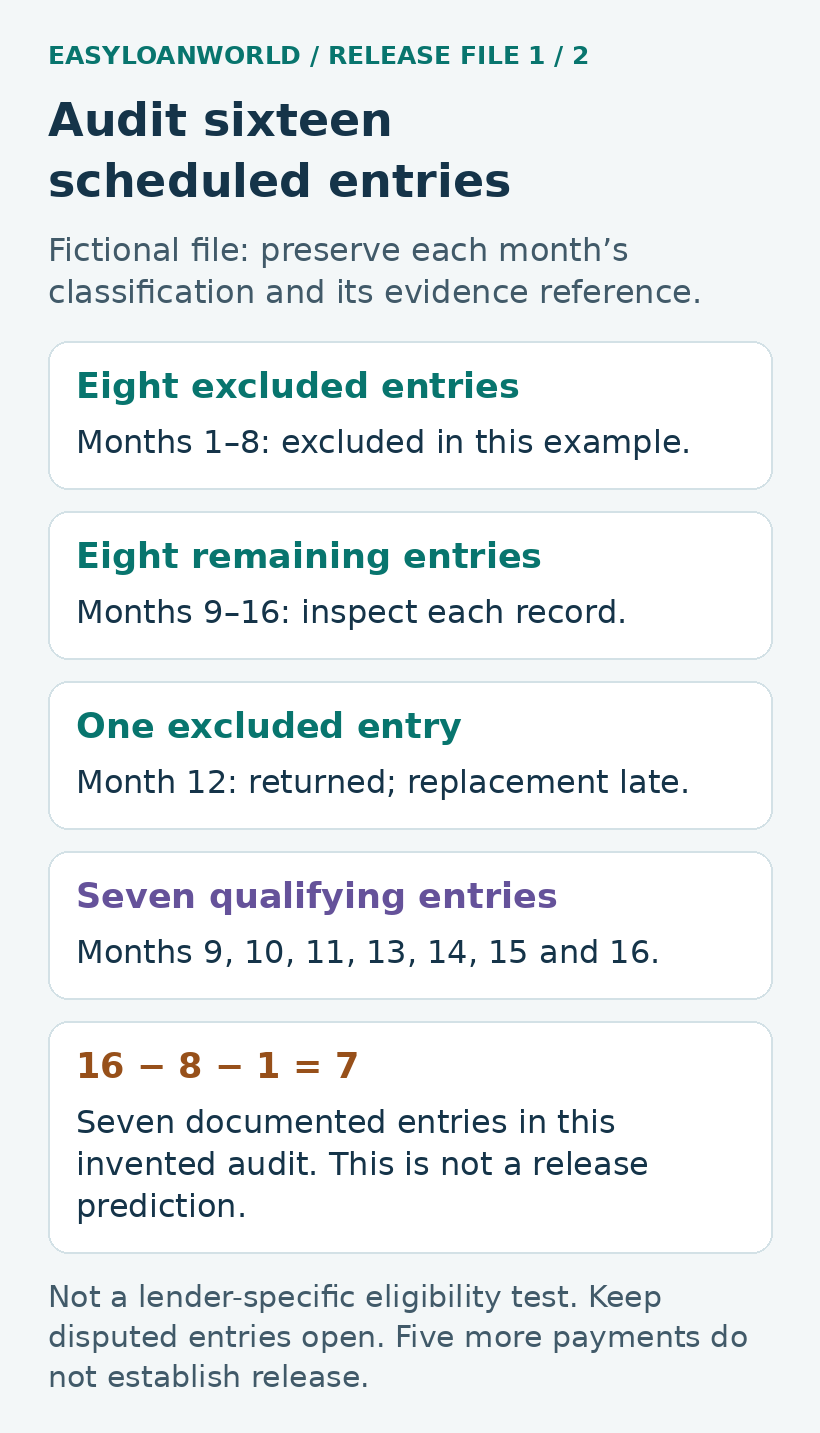
The borrower’s file contains sixteen scheduled payment months:
- The first eight were in-school interest-only months, excluded by this fictional policy.
- The next eight required principal-and-interest payments.
- One of those payments was returned; its replacement arrived after the due date and doesn’t qualify under the invented rule.
- Seven entries are documented as qualifying: 16 − 8 − 1 = 7.
The file therefore supports seven qualifying entries, not sixteen. That doesn’t mean five more payments will secure release. The actual policy may treat sequence, account standing and other conditions differently; the lender still must review the request.
If the returned payment’s classification is disputed, retain its original and replacement references and ask for an account-level explanation. Don’t overwrite the history with a single check mark.
Cosigner release: update the count without rewriting history
Continue the fictional sixteen-month record with five additional scheduled principal-and-interest payments. Suppose all five are documented as qualifying under the invented policy. The supported count rises from seven to twelve. The earlier eight excluded school-period entries and returned-payment history remain in the file.
The new count answers only the payment-condition question. It doesn’t establish current credit, income, account standing or another condition the lender must assess. Keep a separate status for each requirement instead of turning “twelve documented payments” into “release approved.”
Assign the new entries their own dates and transaction references. If a lender asks for a corrected payment history, preserve both versions and identify which entry changed. Don’t delete the original returned transaction merely because later payments succeeded.
Also distinguish scheduled months from payment events. An additional transfer could be a replacement, an extra principal payment or a payment allocated elsewhere. The actual policy and lender classification determine its relevance; another debit in a bank record isn’t automatically another qualifying month.
Cosigner release: audit more than one loan independently
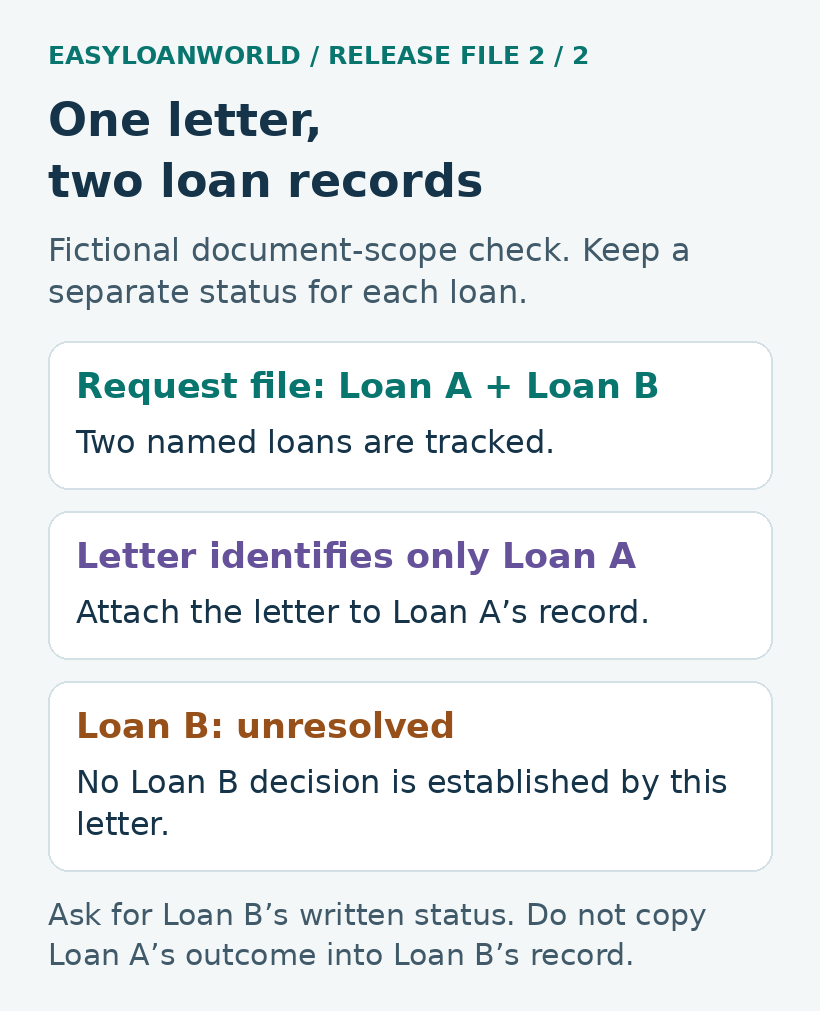
In a separate loan-map exercise, suppose Loan A has twelve documented qualifying entries while Loan B has seven under the same fictional twelve-entry condition. The combined nineteen don’t establish twelve for each loan. Keep each count connected to its own schedule and loan identifier.
Suppose the borrower sends one request naming both loans. A receipt confirming that two loans were listed establishes the submitted scope, not the outcome. If the lender later asks for income evidence, mark that evidence request pending without changing either historical payment count.
When a reply arrives, read the named loans and outcome separately. A letter explicitly releasing the co-signer on A can be stored as A’s decision evidence while B remains under review or otherwise unresolved. Don’t use the account-level portal heading to overwrite that loan-specific distinction.
A useful private summary has one line per loan: policy version, documented payment count, other requested evidence, submission reference and written decision status. Put the release’s actual effective terms beside A’s record rather than using the date the envelope arrived as an assumed effective date.
If a response is unclear, ask which loan and requirement it addresses. For example: “Does this decision cover only Loan A, and what is the written status of Loan B?” Keep the answer with the original request so the scope can be checked later.
The exercise creates no automatic-release right, reconsideration timetable or permission to stop paying. Its practical value is a clean separation of historical evidence, pending review and the lender’s documented outcome for each obligation.
If one of the five later entries lacks a confirmed qualifying classification, record eleven documented qualifying entries and one unresolved entry instead. Twelve scheduled events would then describe the calendar, not twelve verified qualifications. Seek the missing classification without changing the original returned-payment history or counting its replacement twice.
Follow the decision through to the named loans
Suppose an approval letter explicitly identifies Loan A, but Loan B is absent. Save A’s letter and ask for B’s written status. Don’t mark both loans released because they appear in the same account.
The CFPB’s 2014 sample requests offer an older, useful approach to unclear outcomes: ask which policy was applied, the reason for the result and what evidence or next step is needed. They aren’t current lender application instructions.
Don’t assume a particular reconsideration right or response deadline. If the record or contract interpretation remains disputed, seek qualified advice rather than treating this worksheet as a legal demand.
Sallie Mae’s application also confirms that releasing a co-signer doesn’t remove the borrower’s repayment obligation.
Check your own written terms. This record doesn’t forecast a new interest rate, credit-score change or removal of accurate past reporting. Its endpoint is narrower: documented status for each requested loan, with unresolved questions still visible.
Review the co-signer and co-borrower responsibility guide when explaining which responsibilities continue while a release request remains unresolved.
Featured photo: A quiet library study space. Photo: Austin / Unsplash. Used under the Unsplash license.

Parent Pays Student Loan Interest: Who Deducts?
Separate payment and obligation.

Returned Loan Debit: Two Fees?
Trace the payment and fees.

Rehabilitation Payment Too High?
Check an alternative request.