Co-Signer vs. Co-Borrower: Understand the Responsibility Before Signing
Separate repayment liability, access to proceeds, ownership and release conditions before sharing a personal loan with another person.

Estimated reading time: 10 minutes
Cosigner and coborrower roles · U.S. personal loan education • Sources checked October 19, 2026
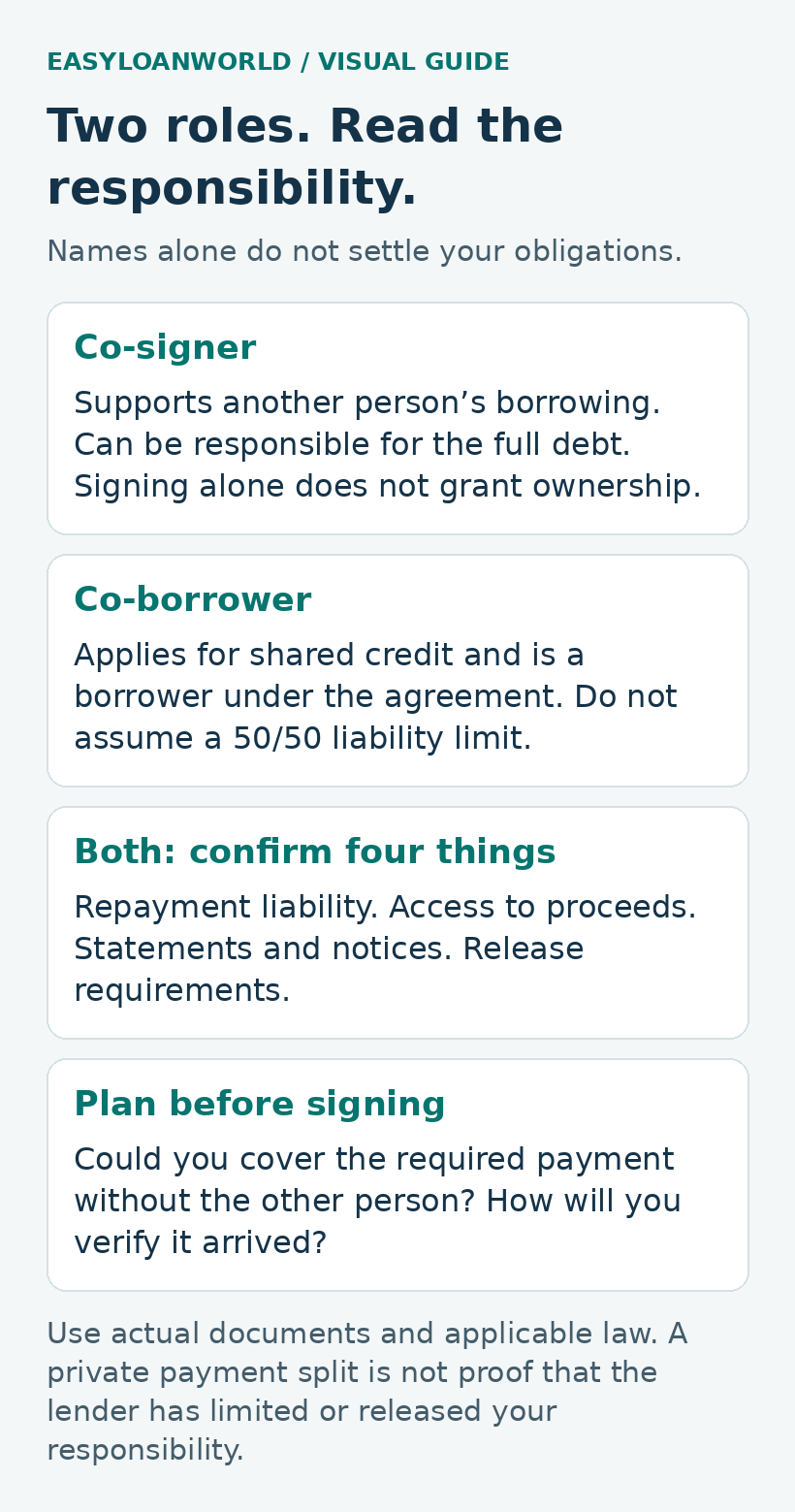
A co-signer supports someone else’s borrowing and can take on repayment responsibility without receiving ownership merely by signing. A co-borrower applies for shared credit and is a borrower under the agreement. Treat these labels as a starting point. Before signing, separate four questions: What can the lender require from me? Who controls the money? What can I verify? What actually ends my responsibility?
Check the proposed documents to understand each signature.
Cosigner and coborrower roles: verify the actual rights
The FTC explains that co-signing can expose you to the debt, additional costs and credit consequences, without giving you title to the financed property. Read its co-signing consumer guidance before accepting the role.
For joint credit, the CFPB’s Regulation B interpretation distinguishes people applying together for shared credit from an additional person required to support an application. A signature making collateral available isn’t necessarily a promise to repay personally. See Regulation B’s interpretation of section 1002.7(d).
Instead of assigning rights from a label, ask the lender to walk through these situations:
- Applying: Which people are requesting the credit, and in what capacity must each sign?
- Receiving money: To whom will proceeds be sent? Who can direct the disbursement?
- Repaying: What amount can the lender require from each signer under this agreement?
- Owning a purchase: What do separate ownership or title documents say?
- Checking progress: What statements, notices and payment history can each person obtain?
- Leaving: Which document would establish that a person’s repayment responsibility has ended?
Don’t assume a co-borrower automatically owns half a purchase or receives half the cash. Ask for the relevant document instead. If you can’t explain your signing capacity in a sentence, request clarification before proceeding.
Cosigner and coborrower: examine the backup promise
A co-signer may face collection without the creditor first exhausting efforts against the main borrower, although some states require a different sequence. Don’t assume a universal order of collection. The FTC’s explanation of co-signer obligations discusses this qualification.
Ask for every relevant notice as well as the agreement itself. The FTC’s Credit Practices Rule includes co-signer notice requirements within its coverage; institution and transaction scope matter. A notice explains risk but isn’t the repayment contract. See FTC guidance on the Credit Practices Rule.
For your decision, replace “I probably won’t have to pay” with a concrete question: “What would I do if the lender required payment from me?” Write the answer independently, before discussing it with the other person. That helps separate your actual capacity from your desire to help.
Cosigner and coborrower: verify any payment split
As one provider-specific example, Prosper’s public borrower guidance, checked October 19, 2026, states that joint applicants are jointly and severally liable. That isn’t a universal rule or a recommendation of the provider.
Consider this original hypothetical: Alex and Morgan are discussing an $8,000 personal loan. Their household plan says each contributes half the monthly installment. Suppose their actual contract validly makes each jointly and severally responsible for repayment. In that scenario, Morgan’s inability to contribute wouldn’t limit the lender’s claim against Alex to Alex’s private 50% share. Enforcement still depends on the agreement and applicable law.
Each person should answer: Could I handle the required payment if the other contributed nothing? What would I need to change? Who receives the money? Would I still choose to sign if our informal payment plan stopped working?
A private arrangement can organize contributions, but shouldn’t be assumed to amend the lender’s rights. If either person is relying on a legal limitation, get advice about the actual documents rather than treating this scenario as a legal conclusion.
A responsibility worksheet for each person
Complete two individual cards separately, then compare them with one shared contract card. Record differences as questions to resolve.
Individual card: complete separately
- My exact role as written in the documents: ___
- Documents I am asked to sign and my capacity on each: ___
- Maximum repayment obligation described, including possible costs: ___
- Money I receive or control, according to the disbursement instructions: ___
- Any ownership rights shown by separate title or purchase documents: ___
- Whether I could cover the required payment without the other’s contribution: ___
- What I need clarified by an independent adviser: ___
Shared card: confirm with the lender
- Payment amount, due date and agreed method: ___
- Whose authorized account makes the payment: ___
- What account access and notices each person can receive: ___
- How both will verify the lender received the payment: ___
- Who contacts the lender if a payment is at risk: ___
- Any release clause, requirements, application process and approvals: ___
- Evidence of release or payoff to retain: ___
- Unanswered question, written response and date: ___
“Sent my share” and “the installment reached the lender” are different milestones. Agree how you’ll verify the second without sharing passwords or assuming access you haven’t been granted. Ask the lender about supported account access and notifications.
Cosigner and coborrower: verify the lender received the payment
Add a payment-evidence check to the fictional Alex and Morgan discussion. Assume a separate illustrative installment of $240 is required on a stated date, with no other amount included in this narrow check. Their private contribution plan assigns $120 to each. That split is an organizational assumption, not a limit on either person’s contractual responsibility.
Suppose Alex transfers $120 to Morgan, but the lender’s record shows no installment received. Alex’s transfer establishes a movement between the two people; it doesn’t establish a $120 lender payment or reduce the confirmed $240 installment requirement in this example. The question is where the funds went next and what the lender actually recorded.
In a separate version, the lender confirms $120 applied to that installment. The remaining amount for this stipulated $240 installment is $120. Record the credited amount and date rather than treating a screenshot of an intended transfer as completed payment. Real accounts can include other charges, arrears or allocation rules, so confirm the actual obligation instead of copying this subtraction.
A cosigner and coborrower review should identify how each person can obtain supported payment information. Ask the lender about statements and authorized notifications available to each role. Don’t share passwords or assume that knowing another person’s login is an approved access method.
Keep a private record with four milestones: contribution sent, contribution received by the other person if relevant, payment received by the lender, and allocation confirmed. Use the arrangement actually authorized for the account. This record doesn’t recommend routing payments through another person; it exposes the difference between internal contributions and satisfying the lender’s requirement.
If the private plan stops working, return to each person’s independent capacity check and the actual agreement. Don’t assume the person who sent a share has been released or that an informal reimbursement promise changes collection rights. For both cosigner and coborrower decisions, the useful evidence is the contract, the lender’s account record and any legally effective release, rather than a reassuring label or an uncompleted payment plan.
Reconcile contributions when the split changes
Start a separate fictional exercise with Person A and Person B. The lender has confirmed three completed $400 payments. Person A sent the first two directly; Person B sent the third. Separately, Person B has already transferred $150 to Person A as a contribution toward these same payments.
Their stipulated bookkeeping target splits the first payment equally. From the second payment onward, Person A’s share is 40% and Person B’s is 60%. The change isn’t retroactive. These percentages are exercise inputs, not lender terms or a determination of either person’s legal responsibility.
| Payment | Lender received | Direct payer | A / B split | A’s target | B’s target |
|---|---|---|---|---|---|
| 1 | $400 | Person A | 50% / 50% | $200 | $200 |
| 2 | $400 | Person A | 40% / 60% | $160 | $240 |
| 3 | $400 | Person B | 40% / 60% | $160 | $240 |
| Total | $1,200 | Both people | Varies by payment | $520 | $680 |
Now calculate each person’s net contribution to this selected register: direct lender payments + transfers sent to the other person − transfers received from the other person. Include the completed $150 transfer once on each person’s side, with opposite signs.
| Measure | Person A | Person B |
|---|---|---|
| Direct lender payments | $800 | $400 |
| Transfer sent to the other person | $0 | $150 |
| Transfer received from the other person | $150 | $0 |
| Net contribution | $650 | $550 |
| Target from the first table | $520 | $680 |
| Position against target | $130 above | $130 below |
A further $130 transfer from Person B to Person A would balance this example: A’s net contribution becomes $650 − $130 = $520, and B’s becomes $550 + $130 = $680. Their combined contribution remains $1,200. The lender-payment total also stays $1,200; the internal transfer is not another lender receipt in this register.
Applying the latest 40% share to all three payments would instead give A a $480 target and suggest a $170 balancing transfer. That is $40 too much under the stipulated period-specific split. Keep the effective payment number beside a changed split rather than applying it to earlier payments automatically.
This complete selected register assumes no other transfers, refunds or adjustments. It reconciles contributions only: it doesn’t calculate remaining loan principal, determine legal liability, identify arrears or establish affordability. The additional $130 is a hypothetical next step, not part of the completed-transfer table.
Plan the exit before the first payment
Ask whether the agreement offers a release process and what must happen to use it. Refinancing, repayment and a lender-approved release are possibilities to investigate, not outcomes to assume. A private promise or relationship change shouldn’t be treated as proof that the lender has released someone.
Record the desired exit and the evidence needed to confirm it. For example: “We will ask about release eligibility after the stated conditions are met; we will not treat the request itself as approval.” Keep the eventual written lender-approved release, payoff evidence or other legally effective resolution. Obtain qualified local advice if responsibility is disputed.
Conversation starter: “Before either of us signs, let’s confirm what the lender can require from each person, who can access the money, how we will both see payments, and what would actually end each person’s responsibility.” This is a discussion aid, not an agreement template or release form.
Common questions before sharing a loan
Does co-signing give me ownership?
Co-signing alone doesn’t. Check any separate ownership documents rather than inferring rights from repayment responsibility.
Is a joint loan automatically half each?
Don’t assume that. Read the liability terms. A private contribution plan and the lender’s rights are separate issues.
Can I remove myself after a year?
A year passing isn’t evidence of release. Check the agreement’s process and obtain confirmation that your obligation has actually ended.
Will adding a co-signer guarantee approval?
No guarantee follows from adding a person. Ask what the lender allows and requires before involving someone in an application.
General U.S. education, not individualized financial or legal advice. Use the actual proposed and signed documents; lender terminology alone doesn’t settle your rights or liability.
For a private student loan, use the separate co-signer release checklist to track actual requirements and a written decision.
Featured photo: Photo by RDNE Stock project on Pexels. Used under the Pexels license. Stock photograph illustrating a discussion. The people shown aren’t identified as borrowers, co-signers or advisers.
Changing Loan Autopay: Check the Notice
Compare the debit and notice.

Approved for a Loan, but Received a Risk-Based Pricing Notice?
Identify the document and separate report-review questions from the actual loan offer.