Seller Credit or Lower Price? Compare Cash at Closing and Debt Later
Compare two fictional offers on the same home: a $6,000 seller credit or a $6,000 price cut. Follow the cash needed now, monthly payments and debt remaining after three or five years.
A seller offers a $6,000 closing credit. You could instead ask for a $6,000 price reduction on the same home. The headline amounts match, but the financing does not: the credit can preserve more cash at closing, while the lower price can leave you with a smaller mortgage.
The useful comparison has two checkpoints: cash needed to complete the purchase and cash paid plus debt still owed at the same future date. A smaller closing payment alone does not establish which offer costs less over time.
Start with two fictional contracts on one home
Everything below is a hypothetical calculation, not a current mortgage quote or a forecast. Both offers use a fixed 10% down payment ratio, a 30-year loan and a fictional 6% annual note rate. The credit offer keeps the price at $300,000; the alternative reduces it to $294,000 with no seller credit.
Assume the lender approves the entire $6,000 credit against $9,000 of eligible costs, all applicable contribution limits are met, and the appraisal supports the financing.
| Item | $6,000 credit offer | $6,000 price-cut offer |
|---|---|---|
| Contract price | $300,000 | $294,000 |
| Down payment | $30,000 | $29,400 |
| Opening mortgage balance | $270,000 | $264,600 |
| Modeled closing charges | $9,000 | $9,000 |
| Seller credit applied | $6,000 | $0 |
| Initial buyer cash | $33,000 | $38,400 |
Initial cash equals down payment plus modeled charges minus the credit. For the credit offer, that is $30,000 + $9,000 − $6,000 = $33,000. For the price cut, it is $29,400 + $9,000 = $38,400.
The credit offer preserves $5,400 upfront, not $6,000, because the price cut also reduces the 10% down payment by $600. In exchange, the credit offer begins with $5,400 more mortgage debt. A fixed-dollar down payment would produce a different comparison.
This simplified initial outlay includes no prior deposit, financed fee, additional loan, other credit or closing adjustment. It is not the final wire amount from a completed Closing Disclosure. For that separate reconciliation, see closing costs versus cash to close.
Follow the payment and remaining balance together
At the same fictional 6% fixed rate over 360 months, monthly principal and interest are $1,618.79 with the credit and $1,586.41 with the price cut. The larger loan requires approximately $32.38 more each month. These figures exclude taxes, insurance and mortgage insurance.
Calculations assume ordinary month-end amortization, no extra payments and no skipped payments. They retain full precision internally and round displayed results to cents. Multiplying a rounded monthly payment by the number of months, or subtracting rounded table entries, can differ slightly from the full-precision result.
| Measure | Credit offer | Price-cut offer |
|---|---|---|
| Total principal-and-interest payments | $58,276.31 | $57,110.78 |
| Interest included in those payments | $47,703.30 | $46,749.23 |
| Principal repaid | $10,573.01 | $10,361.55 |
| Mortgage balance remaining | $259,426.99 | $254,238.45 |
| Initial cash plus scheduled payments | $91,276.31 | $95,510.78 |
| Measure | Credit offer | Price-cut offer |
|---|---|---|
| Total principal-and-interest payments | $97,127.19 | $95,184.64 |
| Interest included in those payments | $78,373.95 | $76,806.47 |
| Principal repaid | $18,753.24 | $18,378.17 |
| Mortgage balance remaining | $251,246.76 | $246,221.83 |
| Initial cash plus scheduled payments | $130,127.19 | $133,584.64 |
Principal repayment is not an additional expense to add on top of these payments. It reduces debt. If you need help reading those columns, use the separate guide to mortgage amortization schedules.
Why the offer with less cash paid can still leave you behind
At month 36, the credit offer has used $4,234.47 less cumulative cash, but it also leaves $5,188.54 more debt. The debt difference exceeds the cash retained by $954.07. At month 60, it has used $3,457.46 less cash but leaves $5,024.94 more debt, a $1,567.48 difference. Both differences equal the larger loan’s additional interest in this controlled example.
To interpret that as equity, compare the same home at the same assumed future value. Gross equity is home value minus remaining mortgage debt. At month 36, the price-cut offer would therefore have $5,188.54 more gross equity; at month 60, $5,024.94 more. Do not assign the house a lower future value just because one contract negotiated a lower purchase price.
These are comparison checkpoints, not forecasts of a sale or lifetime savings. Actual sale proceeds also depend on selling expenses and other obligations. The model assumes equal future home value and equal sale costs across the two offers; it does not predict appreciation or promise that refinancing will be available.
Dividing $5,400 by the monthly payment difference does not answer the whole question. That shortcut watches cash payments while ignoring the different balances still owed. Conversely, comparing debt alone ignores the cash the credit offer preserved.
Retained cash can be valuable for resilience, and investing it could change the outcome. Neither that value nor any investment return is priced here. The calculation shows the financing tradeoff; it does not assign a dollar value to your comfort with a smaller cash cushion.
Check whether the offered credit can actually be used
For Fannie Mae mortgages, seller contributions cannot fund down payments, reserves or minimum borrower contributions. Financing concessions are constrained by eligible closing costs and percentage limits tied to occupancy and LTV/CLTV. Excess is a sales concession requiring an adjusted underwriting price and recalculated financing. Unused seller credit is not automatically cash back. Other mortgage programs have different rules. See Fannie Mae’s contribution guidance.
The May 7, 2025 topic date is not a universal effective date: the relevant changes required September 3, 2025-or-later note dates, with earlier adoption permitted. See the announcement.
Now change the example: modeled charges fall from $9,000 to $4,000. Pause the original comparison and obtain written treatment of the proposed credit before relying on its headline amount.
The following amended-contract example does not describe automatic treatment of excess credit. If excess remains, underwriting must be recalculated; do not simply reuse the original loan figures.
Suppose the seller and lender approve an amended $4,000 credit, with no other price change. That is a new hypothetical agreement. The credit offer then needs $30,000 upfront: $30,000 down + $4,000 charges − $4,000 credit. The $294,000 no-credit offer needs $33,400: $29,400 down + $4,000 charges.
The amended credit now preserves only $3,400, while opening debt remains $5,400 higher. Its combined cash-and-debt disadvantage becomes $2,954.07 after 36 payments or $3,567.48 after 60: the missing $2,000 of benefit plus the same extra interest. Do not assume the lender will let you redirect unused credit to points or another expense.
Replace these assumptions before choosing an offer
- Rate and term: request actual pricing for each contract. Holding both loans at 6% isolates the price-versus-credit choice. A credit-funded rate buydown needs a separate calculation with its own costs, rate and time horizon.
- Closing charges: the equal $9,000 totals are a modeling assumption. Price-linked and loan-linked fees, prepaid interest, transfer taxes and escrow amounts may differ. Reprice the line items.
- Property taxes: do not infer an assessment reduction from the lower contract price. Check local rules, relevant dates and actual bills. This example assumes no income-tax deduction or after-tax savings.
- Mortgage insurance: PMI is excluded from the arithmetic, not assumed absent with 10% down. Obtain each offer’s premium, coverage and cancellation assumptions, then add the differences. See PMI removal versus FHA mortgage insurance for that separate topic.
- Appraisal and cash buffer: a supported appraisal is an assumption, not a guarantee. If value comes in short, ask for revised financing and cash requirements. Keep your own emergency budget separate from the modeled closing outlay.
- Other ownership costs: insurance, maintenance and other excluded costs belong in a household budget. The illustration also omits points, penalties, balloon payments and escrow refunds.
Ask for a two-contract comparison, not just two closing totals
Give the lender both proposed contracts and ask for a written comparison covering:
- The approved usable credit and any contract changes needed if charges fall.
- The initial cash requirement, opening loan amount and monthly payment for each offer.
- All differing fees, rate-lock terms, mortgage-insurance costs and appraisal assumptions.
- Cash paid, remaining debt and comparable gross equity at the date you want to test.
Then use the line-by-line Loan Estimate comparison to check the quoted documents. This article answers a different question: how a seller credit and a negotiated lower price change the purchase financing itself.
Bottom line: the credit offer in this example buys $5,400 of initial cash flexibility by carrying $5,400 more debt. The lower-price offer needs more cash upfront and has less interest and debt later under the matched assumptions. Compare both sides at your own horizon before deciding how much that flexibility is worth.
California Supplemental Property Tax: Check the Bill, Payment and Cash
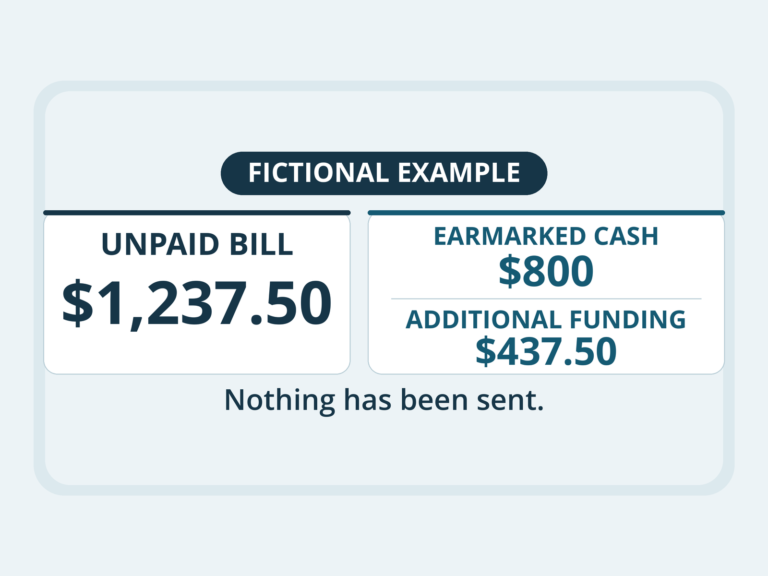
Organize one California supplemental property tax bill, its payment evidence and the cash earmarked for it. A fictional example shows why a funding gap…
Title Insurance Quotes: Compare Policies, Services and Payers
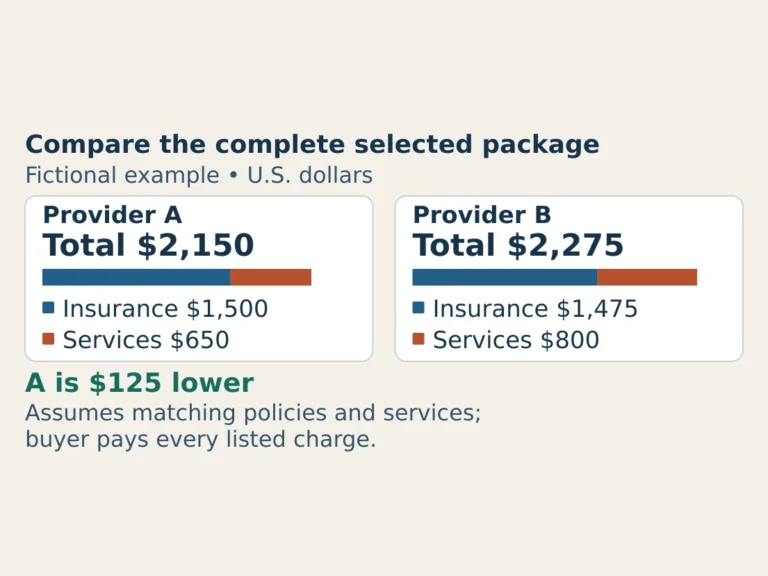
Compare fictional $2,150 and $2,275 title packages using matched coverage, complete service charges and a separate payer worksheet.

Flood Insurance Quote: Test Two Deductibles Against Your Cash Reserve
Test fictional flood quotes against a $6,000 reserve: $180 in annual savings comes with $3,000 more building deductible exposure.