Start-Up Costs and Opening-Year Deductions
Reconcile initial and monthly recovery.
Estimated reading time: 1 minute
Start-up costs are not necessarily deductible when paid, and the opening-year deduction is not always $5,000.
A fictional calendar-year U.S. sole proprietor begins operating a new service business on July 15, 2025, and continues through year-end. In January–June, they pay $54,500 for advertising, market surveys and employee training. Verified records establish these as qualifying start-up costs that would be ordinary deductible expenses in an operating business—not equipment, inventory, organizational costs, interest, taxes or research. There are no other start-up costs. Their timely 2025 return properly elects deduction and amortization, with Form 4562 attached.
The 2025 Schedule C instructions reduce the $5,000 initial allowance by costs exceeding $50,000: $5,000−$4,500=$500.
The remaining $54,500−$500=$54,000 is amortized over 180 months, beginning in July—not January when spending began. Monthly amortization is $54,000÷180=$300; July–December supplies six months, or $1,800.
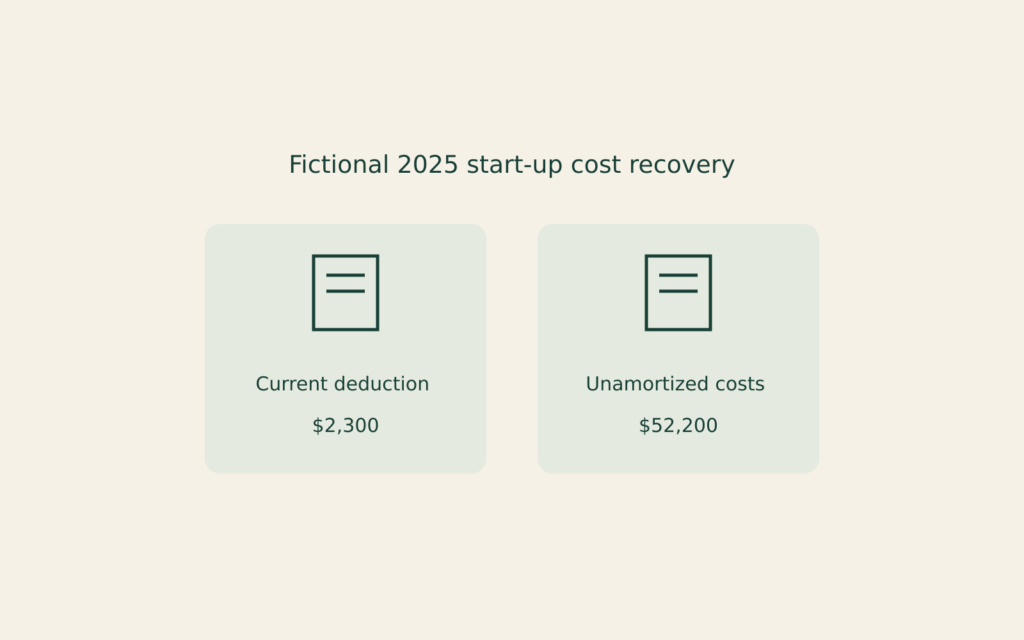
The 2025 deduction totals $500+$1,800=$2,300. Unamortized costs entering 2026 are $54,000−$1,800=$52,200. This reconciles cost recovery, not cash remaining or tax savings.
Mid-Quarter Depreciation Across Purchases
Check the entire acquisition pool.
Alternative Minimum Tax Reconciliation
Separate tentative and additional tax.
Self-Employed Health Insurance Limits
Check coverage eligibility before enrollment.