Supplier Discount or Cash Buffer? Test One Invoice Three Ways
Compare three invoice-payment choices, then test a delayed customer receipt against cash and credit buffers.

Estimated reading time: 8 minutes
A supplier discount can reduce an invoice while using cash earlier. Compare the three payment routes below, then test a delayed customer receipt against both the operating cash buffer and the remaining credit available.
A fictional business can save $600 on one invoice, but its cheapest payment choice also leaves the smallest cash cushion. This worked decision compares cash payment, a full credit-line draw and payment at the ordinary deadline. The decision uses three tests together: ending cash, the lowest operating cash balance and credit left for another need.
An early-payment discount trades a reduced invoice amount for earlier payment; the discount deadline and the normal payment deadline are separate inputs. Treasury reference.
Original example: All amounts, commercial terms, dates, reserve choices and calculations below are independently invented. The reference supports only the preceding background sentence, not this model or its assumptions. These are neither current offers nor personalized financial advice.
Supplier discount: fix the invoice, cash and borrowing terms
- Supplier: $24,000 payable on day 30, or an invented 2.5% reduction if paid on day 0. The early payment is $23,400, saving $600.
- Cash: $38,000 available initially. Operating payments of $5,000 occur on day 15 and day 35. One $25,000 customer receipt is expected on day 20.
- Chosen buffers: Keep at least $8,000 cash and $6,000 undrawn credit. These are this business’s planning choices.
- Credit: Assume an unused $30,000 line is drawable whenever needed. Drawn principal bears an invented constant 14.5% annual simple rate, using actual elapsed days divided by 365. Each draw incurs $60, paid at payoff without financing the fee.
- Settlement: Repay all borrowing when the receipt arrives; no interim payments. Round total interest once at payoff, half-up to cents. A day-0 draw repaid on day 20 has 20 interest days.
Transactions occur at each day’s start, with receipts before payments and any bridging draw before its expense. Credit capacity counts principal only. Assume no other flows, charges, balances, cash earnings, taxes or access restrictions. Compare through day 60, after every listed payment and loan payoff.
Supplier discount with a Day 20 customer receipt
1. Use cash on day 0
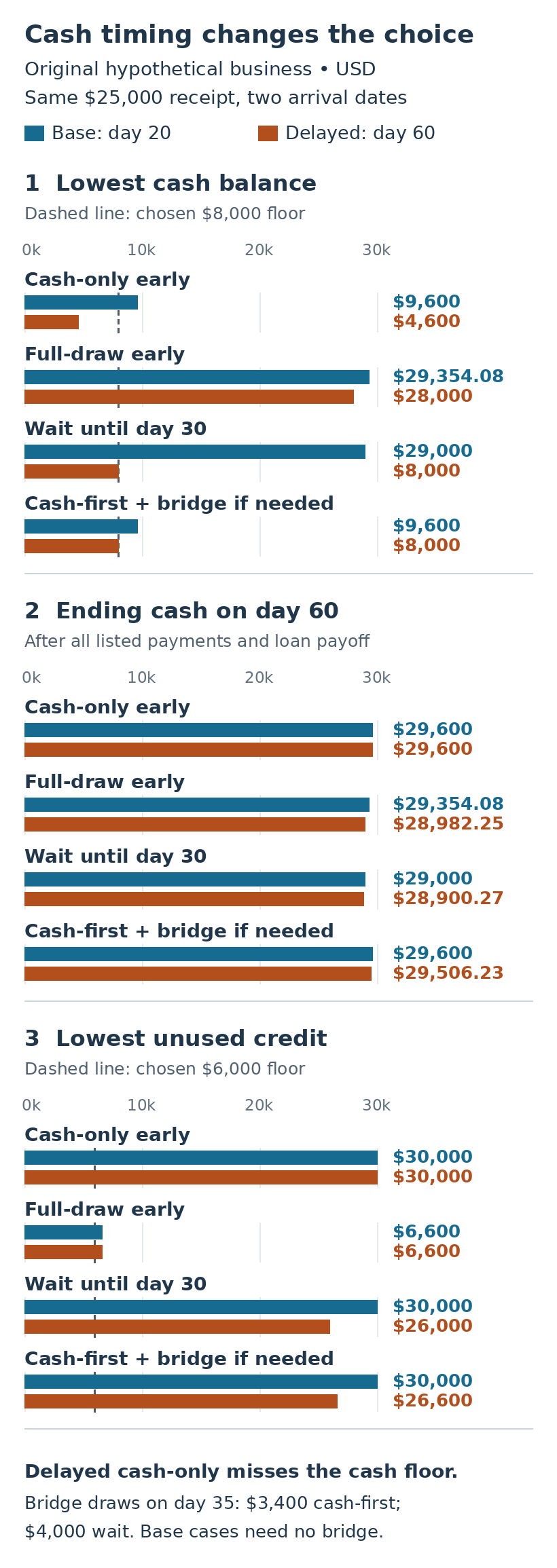
Pay $23,400, leaving $14,600. The day-15 expense reduces cash to its low of $9,600, just $1,600 above the chosen floor. After the receipt and remaining expense, ending cash is $29,600. All $30,000 of credit remains undrawn.
2. Borrow the full early payment
Draw $23,400 and immediately pay the supplier, preserving the initial $38,000 cash. Interest is $23,400 × 0.145 × 20 ÷ 365 = $185.92. Adding the $60 fee gives $245.92 financing cost and a $23,645.92 payoff.
Ending cash is $29,354.08, also this policy’s lowest cash balance. Before payoff, credit headroom is only $6,600, $600 above the selected reserve. This choice preserves more operating cash than cash-only payment, while occupying most of the line.
3. Pay $24,000 on day 30
The day-20 receipt arrives before the supplier payment. No borrowing is needed. After the day-35 expense, ending and minimum cash are $29,000; unused credit stays $30,000.
Under this schedule, cash-early finishes $600 ahead of waiting. Full-draw early finishes $354.08 ahead: $600 minus $245.92. The cash-only choice has the greatest ending cash, but its $9,600 trough deserves attention alongside that result.
Move the same receipt to day 60
Keep every other amount and date unchanged. Waiting now needs funding too, so compare both policies through their day-60 payoff.
- Cash-only early: Cash reaches $4,600 on day 35, breaching the $8,000 floor by $3,400. A later positive ending balance doesn’t make this cash-only policy feasible under the selected floor.
- Full-draw early: The $23,400 draw remains outstanding for 60 days. Interest is $557.75; with the fee, financing costs $617.75. Minimum cash is $28,000, minimum headroom is $6,600, and ending cash after payoff is $28,982.25.
- Wait: Cash is $9,000 after the day-30 supplier payment. Draw $4,000 immediately before the day-35 expense to leave $8,000. Interest for the remaining 25 days is $4,000 × 0.145 × 25 ÷ 365 = $39.73. Including the fee, financing costs $99.73. Minimum headroom is $26,000; ending cash is $28,900.27.
The full early draw’s cost exceeds the $600 invoice saving, yet its incremental financing cost over waiting is only $617.75 − $99.73 = $518.02. Its ending-cash advantage is therefore $81.98. Charging it the full $617.75 disadvantage would silently give the waiting policy free financing.
A smaller bridge changes the cash-first choice
As a separate adjustment, pay early with cash but draw $3,400 before the day-35 expense. This is no longer cash-only. Its 25-day interest is $33.77, plus the $60 fee. It finishes with $29,506.23, maintains $8,000 minimum cash and leaves $26,600 minimum headroom. It uses the initial cash cushion more heavily while avoiding the larger day-0 draw.
Check the supplier discount borrowing interest live
Use the simple-interest calculator to reproduce each constant-principal borrowing interval. Enter the principal actually drawn, 14.5% annual interest, the stated elapsed days and Actual days / 365. The agreement in this fictional example rounds total interest once at payoff; the form also retains calculation precision before displaying cents.
| Case | Principal | Days | Interest |
|---|---|---|---|
| Full early draw, receipt Day 20 | $23,400 | 20 | $185.92 |
| Full early draw, receipt Day 60 | $23,400 | 60 | $557.75 |
| Wait, then bridge Day 35 to 60 | $4,000 | 25 | $39.73 |
| Cash-first bridge Day 35 to 60 | $3,400 | 25 | $33.77 |
Keep the $60 fee outside the calculator. It’s paid at payoff without being financed, so it doesn’t increase interest-bearing principal. Add it once to each case’s interest to reproduce that case’s financing cost. Don’t add the $600 supplier discount to principal or subtract it from an interest result; the discounted invoice already determined the $23,400 early payment.
The 25-day interval begins when the bridge is drawn on Day 35 and ends on Day 60. Entering sixty days for that smaller draw would charge it for time before it existed. Conversely, the full early draw really begins on Day 0 and stays outstanding for sixty days in the delayed case.
These are alternative payment policies, not four simultaneous borrowings. Keep the selected case beside its cash timeline and credit headroom. The calculator’s principal-plus-interest amount excludes the separate fee and can’t establish whether either buffer stays intact.
For a real supplier discount decision, obtain the lender’s day-count basis, principal changes, fee timing and payoff terms. If borrowing is repaid in stages or the rate changes, a single constant-balance interval won’t reproduce the account. Split only where the actual terms justify it and retain the supporting records. Don’t treat a lower interest result as proof that the business has enough usable cash or continued access to the line.
Supplier discount break-even: include fees and the waiting loan
For the full-draw comparison, the dollar test is:
Early-payment saving − (early-policy financing cost − waiting-policy financing cost).
A positive result means more ending cash from early payment under the modeled flows. It doesn’t answer whether either buffer is adequate.
At day 60, holding waiting’s $99.73 cost fixed, the largest early draw fee that produces equal ending cash is $600 + $99.73 − $557.75 = $141.98. The assumed $60 fee leaves the $81.98 advantage.
For a receipt on day H after day 35, the early draw runs H days and waiting’s $4,000 draw runs H − 35 days. With one $60 fee in each policy, the fees cancel. Equality before cent-rounding is:
$600 = (0.145 ÷ 365) × [$23,400 × H − $4,000 × (H − 35)].
This gives about 70.64 days. With the stated rounding, early funding still saves $4.91 at day 70 but costs $2.80 more at day 71. Those comparisons end on the receipt day. They assume no additional spending after day 35; add any new commitments before using a longer delay test.
Make the supplier discount choice pass both buffer tests
The selected credit reserve permits a maximum draw of $30,000 − $6,000 = $24,000. The $23,400 full draw fits, but leaves little room above that reserve. If this business instead needed $10,000 of unused credit, the same policy would fail by $3,400, regardless of its dollar savings.
Before substituting real figures, resolve these questions:
- What amount must the supplier receive, by which date and payment method?
- What credit is actually available on each draw date, and which fees, interest rules and repayment dates apply?
- Do all three choices preserve the selected cash and credit buffers after a delayed receipt, including charges at payoff?
For this fictional business, cash-early has the best base-case ending cash; the cash-first bridge is the lowest-cost feasible delayed-receipt adjustment tested. Full early borrowing buys a larger cash cushion at the cost of interest and occupied credit. Choose only after deciding which buffer the business needs to protect.
For related working-capital decisions, review bulk inventory discount calculations and check how a business borrowing base can constrain available credit.