Variable Income and Personal-Loan Payments: Build a Timing Buffer
Map irregular pay against a personal-loan due date, test delayed income, and calculate a cash-timing gap with a practical private worksheet.

A positive monthly budget does not guarantee that cash will be available on your personal-loan payment date. With variable income, check the lowest projected balance between receipts, then test what happens if an expected payment arrives late.
This guide measures a timing gap using a fictional calendar. It does not calculate how much you qualify to borrow or prescribe a universal savings target. Keep your worksheet privately; no account numbers, tax documents or uploads are needed.
Separate the monthly result from the lowest cash point
The CFPB’s cash-flow budgeting tool tracks when money comes in and goes out, carrying available cash forward. That timing view can reveal a shortage hidden by a positive monthly total.
We use two planning labels:
- Operating floor: Cash you choose to leave untouched during the projection.
- Additional timing cushion: Extra opening cash needed, above the opening amount already entered, to keep the projection at that floor.
These are this guide’s labels, not official definitions or lender requirements. An operating floor is not a complete emergency plan. Keep money earmarked for other purposes outside available opening cash unless you deliberately change that allocation. Do not count the same dollars twice.
Use money that is available, with dates you can defend
Record the cash currently usable after known pending withdrawals and protected earmarks. Note those adjustments so they are not deducted again later. An invoice sent is not yet spendable cash. Use the amount available for these bills, rather than gross invoice revenue or a hoped-for job.
Give each expected receipt a confidence label: confirmed, estimated or uncertain. Record what supports its expected date. This is a planning distinction, not a statement about which income a lender accepts. Do not include restricted benefits as money available for a loan payment.
Enter the actual required installment and due date, allowing for the payment-processing instructions you verify with the servicer. Date everyday spending too. If a deposit and withdrawal share a date and their posting order is unknown, test withdrawals first. Even a weekly surplus can conceal a shorter gap.
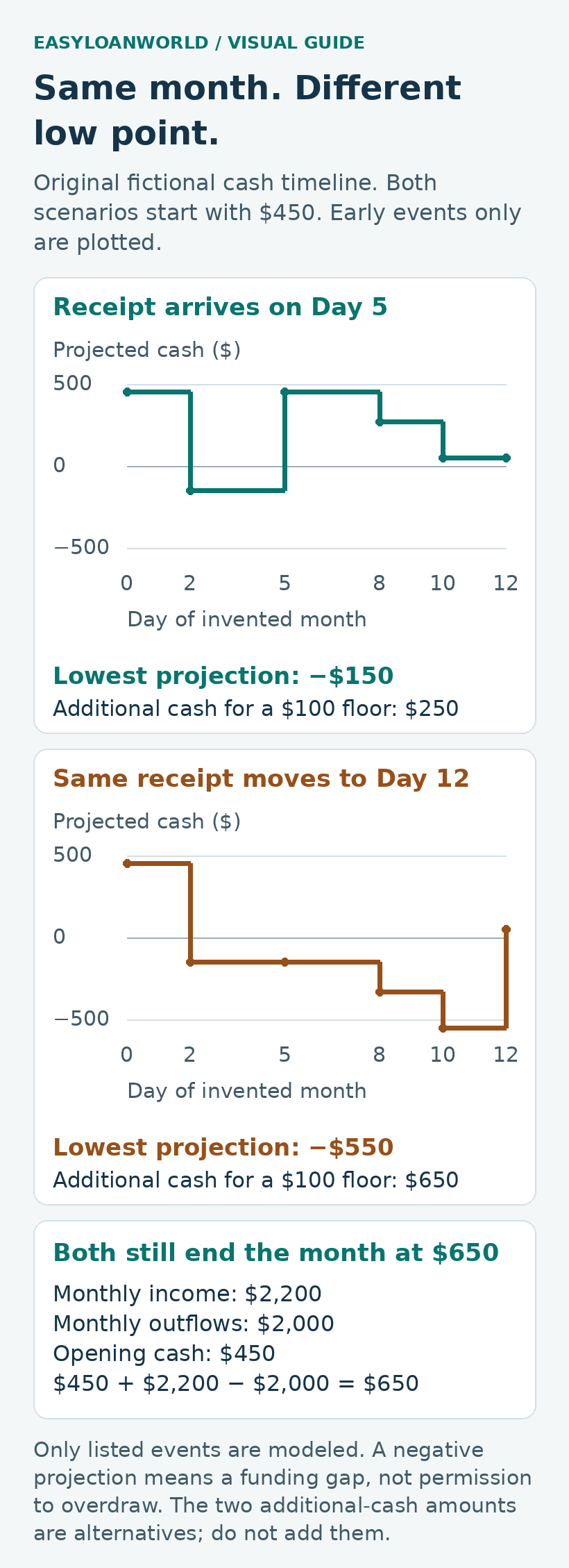
A $200 monthly surplus can still leave an early shortage
Here is an invented month with $450 of available opening cash. That figure is already adjusted for pending withdrawals and other earmarks. Only the events listed below are modeled. Income is assumed usable on its stated date; fees, deposit interest and all other transactions are excluded.
- Day 2: $600 essential bills leave. Projected balance: −$150.
- Day 5: $600 usable income arrives. Balance: $450.
- Day 8: $180 required personal-loan payment leaves. Balance: $270.
- Day 10: $220 essential spending leaves. Balance: $50.
- Day 17: $1,100 usable income arrives. Balance: $1,150.
- Day 20: $700 bills and spending leave. Balance: $450.
- Day 27: $500 usable income arrives. Balance: $950.
- Day 28: $300 bills and spending leave. Balance: $650.
Monthly income totals $2,200 and outflows total $2,000, leaving a $200 flow surplus. Ending cash is $450 + $200 = $650. The $650 is not all new savings; it includes the opening cash.
Nevertheless, the projection reaches −$150 on Day 2. A negative projection identifies an unfunded sequence. It does not mean the bank will allow an overdraft or that a payment will succeed. Resolve the shortage before relying on that payment plan.
Suppose this fictional household independently chooses a $100 operating floor. It needs $100 − (−$150) = $250 in additional opening cash. Its total opening amount would become $700. Every projected balance would rise by $250, making the lowest $100.
That extra cash bridges only the modeled timing gap. It does not establish long-term affordability or cover unknown expenses.
Delay one receipt without changing the month’s income
Now move the same $600 receipt from Day 5 to Day 12. Leave every other amount and date unchanged. Starting again with $450, the early balances become:
- Day 2, after essential bills: −$150.
- Day 8, after the loan payment: −$330.
- Day 10, after essential spending: −$550.
- Day 12, after the delayed receipt: $50.
From Day 17 onward, the original balances resume. Monthly income remains $2,200, outflows remain $2,000, and ending cash remains $650. Yet the lowest projection has fallen to −$550.
Preserving the same $100 floor now requires $650 in additional opening cash: $100 − (−$550). Total opening cash would be $1,100. The delayed case needs $400 more cushion than the first case.
The $250 and $650 cushions are alternatives; do not add them together. The delayed receipt is still $600. The $400 measures the difference between the two scenarios’ lowest balances.
Calculate the cushion without counting opening cash twice
Additional cash needed = the larger of zero or: chosen floor minus lowest projected balance.
The lowest balance must already include your opening cash. If the projection never falls below your chosen floor, this calculation gives zero additional timing cash. That result is not a guarantee against unmodeled costs or delays.
If the required cushion is not available, writing the number down does not fund it. Identify a real change before the short date: a genuinely flexible expense, an earlier verified receipt or an approved change to payment timing.
The CFPB’s cash-flow adjustment tool suggests discussing due-date changes with creditors. Ask your servicer whether a change is available and when it would take effect.
Confirm what remains due while the request is pending. Ask whether a transition changes interest, the next installment or the debit date. These are questions to resolve, not promised features. A timing adjustment does not create income or repair a recurring deficit.
Copy this private timing worksheet
- Horizon: Start and end dates; which major bill cycle and expected receipts does it cover?
- Opening cash: Usable amount; pending withdrawals already deducted; other earmarks excluded.
- Events: Date, receipt or outflow, amount, confidence, supporting evidence and projected balance after each event.
- Lowest point: Amount and date, before adding any new cushion.
- Floor: Chosen amount and reason; additional timing cash calculated.
- Delay test: Receipt moved, revised date, new lowest point and alternative cushion.
- Adjustment: Proposed change, whose agreement it needs, confirmed effective date and obligations until then.
- Checkpoint: Actual receipt received, upcoming obligations reserved and projection updated.
Extend the horizon through the next relevant bills and receipts, including a known slow season. Month-end is not a natural stopping point if the following week’s bills depend on that closing cash.
After each receipt, replace the estimate with the actual usable amount and recalculate before optional spending or extra loan payments. A high balance today may already be committed. If the cushion is repeatedly consumed without rebuilding, investigate an ongoing income-and-spending gap rather than automatically adding debt. If an installment may be missed, contact the verified servicer about the options for your account; do not assume relief or suspend required payments.
U.S. consumer education. Examples and planning labels are original illustrations. Sources checked October 19, 2026.
Featured photo: Photo by Kelly Sikkema on Unsplash. Used under the Unsplash license. Illustrative stock photograph of a blank notebook and stationery. No actual household cash-flow record is shown. Photo by Kelly Sikkema on Unsplash.

Keep Savings or Pay Extra on a Personal Loan? Compare Cash and Debt
A fictional three-payment comparison shows how extra principal changes cash, debt, and interest, then tests which expenses the remaining cash can cover.
Payday Alternative Loans: Your Options
Screen three cash needs, then compare actual offers.

Stop Loan Autopay: Separate the Debit From the Debt
Review a fictional $210 payment, trace a $420 cash outflow, and compare the supporting records before treating an unexplained difference as resolved.