Debt Snowball vs. Debt Avalanche: Choose a Payoff Order
Compare debt snowball and debt avalanche with a fictional $220 payment example, then build a practical worksheet for choosing your next extra payment.

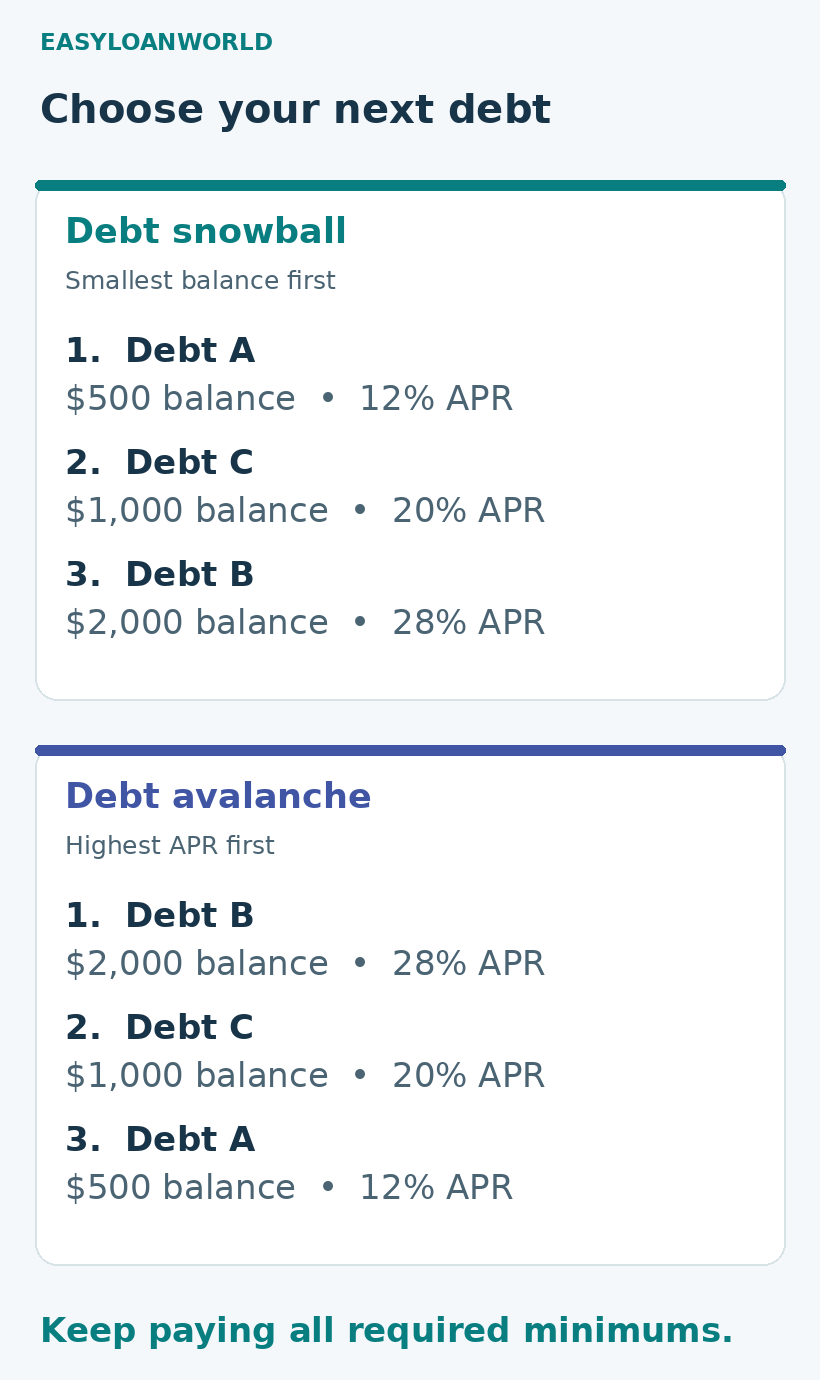
Debt snowball targets the smallest balance; debt avalanche targets the highest annual percentage rate (APR). Both require keeping up with all minimum payments.
Use this guide to choose a repayment order for ordinary unsecured debts, such as credit cards. If you cannot cover the minimums, start with the hardship section below instead.
Snowball or avalanche: what are you optimizing?
- Debt snowball: Rank balances from smallest to largest. Clearing a small account may provide a useful early milestone, but this approach can cost more interest.
- Debt avalanche: Rank APRs from highest to lowest. Prioritizing the highest APR generally reduces interest cost when other terms and payments are the same. A large first balance may take longer to clear.
Keep paying the other minimums. After a payoff, redirect the freed payment toward the next target if your budget still allows it. The CFPB worksheet calls avalanche the “highest interest rate method.” Motivation is not guaranteed.
Before choosing an order, check the budget
Do not treat every bill as an interchangeable entry in a payoff list. Rent, essential living expenses, overdue obligations and debts secured by property need separate attention. This comparison is not a reason to miss a housing or car payment to accelerate a credit card balance.
Write down the amount available for debt payments after essential expenses and a realistic allowance for irregular costs. Subtract the required payments. The remainder is your extra-payment amount. If the result is zero, there is no extra payment to allocate this month.
Also flag special terms before using a simple ranking: promotional or deferred-interest deadlines, changing rates, fees and any prepayment restrictions. These details can require a different calculation. The APR ranking here is not a universal rule for every kind of debt.
Worked example: the same $220 budget, two allocations
Every figure below is fictional and illustrative. The required payments are assumed amounts, not an issuer’s minimum-payment formula. This is a one-month allocation example, not a forecast of payoff dates or interest savings.
- Debt A: $500 balance, 12% APR, assumed $25 minimum
- Debt B: $2,000 balance, 28% APR, assumed $60 minimum
- Debt C: $1,000 balance, 20% APR, assumed $35 minimum
The minimums total $120: $25 + $60 + $35. With a $220 monthly debt-payment budget, the extra amount is $100.
Snowball allocation
The starting order is A → C → B. This month, pay $125 to A ($25 minimum plus $100 extra), $60 to B and $35 to C. Total: $220.
Avalanche allocation
The starting order is B → C → A. This month, pay $25 to A, $160 to B ($60 minimum plus $100 extra) and $35 to C. Total: $220.
The choice changes the destination of $100, not the total budget. Actual statements will determine future minimums, balances and rates. Billing timing, interest and fees also affect later results; do not extrapolate a payoff date from this snapshot.
Build a five-field debt worksheet
Use one row per account in a private notebook or spreadsheet. Record these five fields:
- Debt nickname, such as “Card A”
- Current balance
- APR, noting separately if the account has multiple rates
- Required minimum payment
- Payment due date
Add notes for promotion expiry dates and unusual terms. Account numbers are unnecessary for this planning sheet. Use current statements or the issuer’s account information for payment amounts and terms. A free credit report can help you cross-check your account inventory, but it does not replace those payment instructions.
If a credit report’s card balance differs from your current statement, see our credit-utilization record check. A reported balance and a payment due date serve different purposes; use the issuer’s due date to schedule payments.
Make a choice you can review
Ask yourself three practical questions:
- Is reducing interest cost my main priority?
- Would paying off a small balance make it easier for me to keep following the plan?
- Can I maintain my total payment budget after an account is paid off?
Write down your chosen target and the extra amount for the coming month. On each new statement, recheck rates, minimums and promotional deadlines. Revisit the budget if income or essential costs change. Keep a simple payment record so that your plan reflects payments actually made rather than amounts you intended to send.
This guide compares payments across accounts. It does not describe how an issuer allocates a payment among different APR balances within a single credit card account. Check those terms separately before assuming your extra payment will reach a particular balance.
If you cannot afford all the minimums
Contact the card issuer promptly. Before calling, prepare the amount you can afford, why the current minimum is unaffordable, how long you need help and when you expect to resume normal payments. Ask what assistance may be available and request the terms of any proposed arrangement.
If you consider credit counseling, ask about charges and the services included before signing up. The CFPB’s credit-card hardship guidance outlines these first steps. Help is not guaranteed, and a repayment-order worksheet is not a substitute for addressing a payment shortfall.
Common questions
Can I switch methods?
Yes. Recheck current balances, terms and due dates before changing your target.
What if the smallest debt also has the highest APR?
Both methods target that account first.
Does an extra payment replace another account’s minimum?
No. In the example, every account still receives its own assumed minimum. Sending more to one account does not satisfy a separate account’s payment requirement.
Will either method raise my credit score?
Neither payoff order guarantees a credit-score increase. Choose a plan around affordable payments and the debt terms, rather than a promised score outcome.
This article provides general educational information for U.S. readers, not personalized financial advice.
Sources checked October 19, 2026.
Featured photo: Photo by Jakub Żerdzicki on Unsplash. Used under the Unsplash license.

Credit-Builder Loan vs. Secured Card: A Cash-Access Checklist
Work through three fictional situations and four private questions before deciding whether a new account fits your needs.
Hotel Card Hold: Compare Two Checkout Payment Paths
Compare two fictional hotel checkout choices while keeping the original card’s capacity and the actual payment in separate records.
Overdraft Fee? Look Beyond the Online Bill Label
Compare three fictional document packets behind the same $60 ONLINE BILL entry, then identify what the records still leave unexplained.