Customer Overlaps
A business worksheet can contain every pairwise channel overlap yet still leave its unique-customer total unresolved.
Estimated reading time: 2 minutes
A business worksheet can contain every pairwise channel overlap yet still leave its unique-customer total unresolved. This fictional example shows the missing information.
Hold six reported counts fixed
Use 300 distinct people. 100 responded through A, 100 through B and 100 through C. Each pair—A/B, A/C and B/C—shares 50 people. These are inclusive pair counts: someone in all three channels belongs to every pair.
Let t be the unknown number responding through all three. The following mutually exclusive groups reproduce the six supplied counts:
| Group | People |
|---|---|
| A only | t |
| B only | t |
| C only | t |
| A/B only | 50 − t |
| A/C only | 50 − t |
| B/C only | 50 − t |
| All three | t |
| None | 150 − t |
For example, A’s total is t + (50 − t) + (50 − t) + t = 100. The inclusive A/B overlap is (50 − t) + t = 50. The other channels and pairs follow identically; all eight groups sum to 300.
Establish the exact missing range
Counts cannot be negative: the triple group requires t ≥ 0, while each pair-only group requires t ≤ 50. Conversely, every integer from 0 through 50 makes every displayed count nonnegative and preserves all six reports. Thus these are attainable alternatives, not merely loose limits.
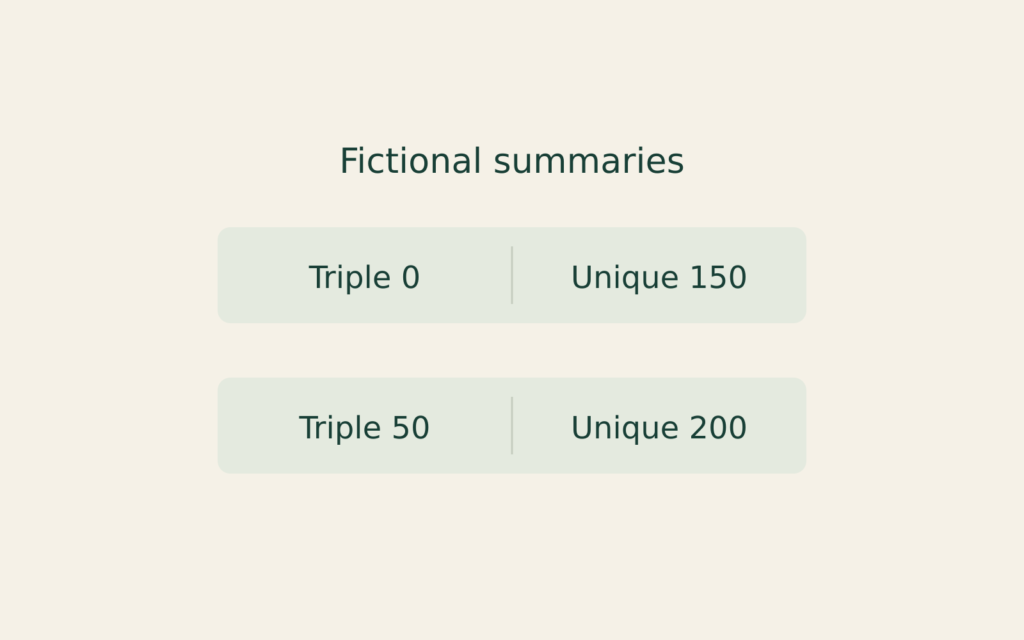
The unique responders total 300 − (150 − t) = 150 + t. At t = 0 there are 150 unique responders; at t = 50 there are 200.
Carry that uncertainty into one expense test
Now stipulate that every unique responder buys exactly once, contributes $10 after variable costs, and that $1,700 is the only remaining expense. These are deterministic teaching assumptions, not conversion estimates or a complete borrowing budget.
The remaining amount is $10 × (150 + t) − $1,700 = −$200 + $10t. It is negative for integer t from 0 through 19, zero at 20, and positive from 21 through 50. The two endpoint worlds leave −$200 and +$300 respectively.
Ask for the missing intersection
Oscar Levin’s counting text explains inclusion–exclusion: add individual set sizes, subtract pairwise intersections, then add the triple intersection. The pair counts include triple members; they are not counts of people in exactly two channels.
Equity Returns
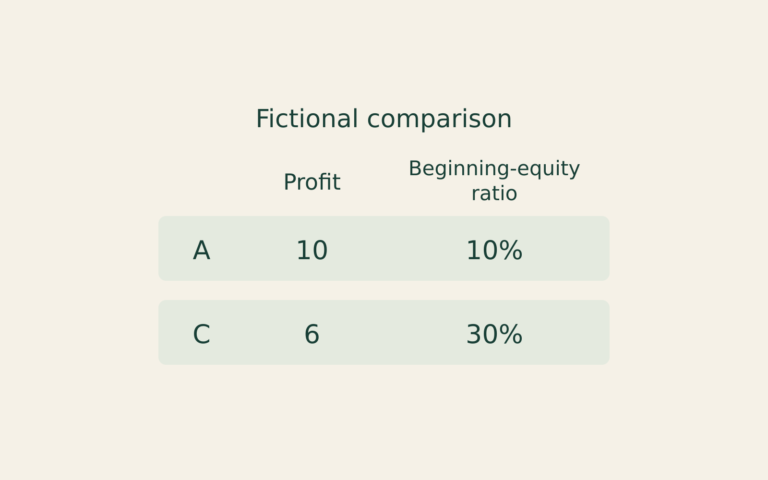
A higher profit-to-equity percentage need not mean more profit. This fictional comparison holds operations constant and then reverses the calculation.
Hedge Funding Peaks
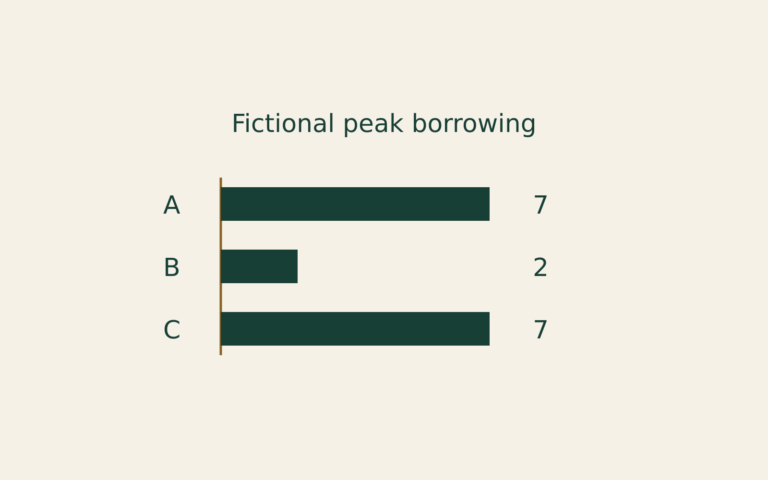
A matched terminal receipt does not specify the largest borrowing balance along the way. This fictional example connects both calculations using one price…
Inventory Margins
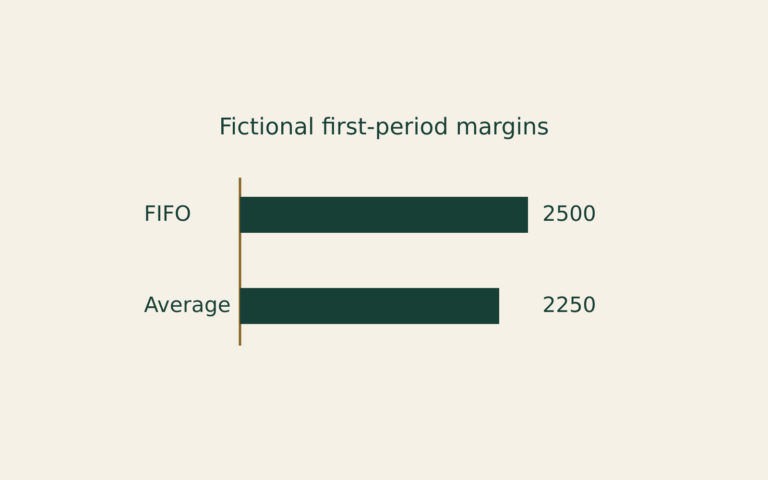
Two inventory reports can show different period margins even when purchases, sales and cash match.