Car Rebate vs. Low-Rate Financing: Compare the Full Deal
Compare a fictional rebate and promotional loan, find the full-term rebate threshold, and see why early payoff can reverse the result.

A $3,000 car rebate can beat a low-rate loan if you clear the debt early, yet lose if you make every scheduled payment. In the fictional example below, the rebate wins at months 12 and 36; promotional financing wins over all 60 months. The useful question is how much cash it takes to buy the same vehicle and clear its loan at the date you can realistically afford.
Some promotional financing requires giving up a purchase rebate. That is a possible trade-off, not a universal rule, as Navy Federal’s car-buying education explains. Identify the actual packages first. If an eligible offer combines a promotional rate and bonus cash, keep both in that offer. A purchase rebate reduces the transaction amount; it is not money you contribute from savings.
Match the purchase, not the loan principal
Start with the same vehicle, negotiated transaction components and buyer cash contribution. Then subtract each offer’s applicable incentive to find its own borrowing amount. Forcing both loans to start at the same principal would erase the rebate’s benefit before the comparison even begins.
Every amount and rate below is invented, not an advertised offer. The $33,000 transaction total already includes assumed taxes and ordinary transaction fees. Those amounts are identical in both branches; this is not a calculation under any state’s tax rules. There is no trade-in, negative equity, add-on, separate financing fee or other credit.
| Input or result | A: promotional financing | B: rebate plus higher-rate financing |
|---|---|---|
| Transaction total before this incentive | $33,000 | $33,000 |
| Rebate applied immediately | $0 | $3,000 |
| Buyer’s cash at purchase | $3,000 | $3,000 |
| Resulting loan principal | $30,000 | $27,000 |
| Fixed annual nominal interest rate | 1.9% | 6.9% |
| Illustrative APR, with no financing fees | 1.9% | 6.9% |
| Payment schedule | 60 monthly payments; first one month later | 60 monthly payments; first one month later |
| Separate financing charge beyond interest | $0 | $0 |
| Monthly payment, displayed to cents | $524.52 | $533.36 |
| Total of 60 modeled repayments | $31,471.29 | $32,001.56 |
| Interest included in those repayments | $1,471.29 | $5,001.56 |
| Buyer cash plus all modeled repayments | $34,471.29 | $35,001.56 |
The principal calculations are $33,000 − $3,000 cash = $30,000 for A, and $33,000 − $3,000 rebate − $3,000 cash = $27,000 for B. Both loans fully amortize with equal monthly periods and no late or extra payments. There are no payoff charges, incentive clawbacks or refunds in this model. Those are assumptions to check, not promises about a real contract.
Real offers need their lender-disclosed APRs and actual payment schedules. Here, the nominal rates and illustrative APRs coincide because there are no financing fees and the payment periods are regular. Do not automatically use an APR that includes fees as the monthly interest rate in an amortization formula.
Why the lower-rate loan wins over 60 months
Option B starts with $3,000 less debt, but its higher rate generates about $3,530 more interest. That additional interest overtakes the purchase incentive, leaving A about $530 cheaper over the full term. A also has a payment about $9 lower each month. Neither conclusion follows from the rate or the rebate alone; both follow from applying each rate to its own principal.
The calculation uses monthly payment = P × r ÷ [1 − (1 + r)−n], where P is the starting principal, r is the annual nominal rate divided by 12, and n is the number of payments. For A, enter P = 30,000, r = 0.019 ÷ 12 and n = 60. For B, use P = 27,000 and r = 0.069 ÷ 12 with the same n.
Totals use unrounded internal payments, not the displayed cents multiplied by 60. A lender’s cent-rounded installments and adjusted final payment may differ slightly. The exact modeled full-term difference rounds to $530.28; subtracting the two displayed totals gives $530.27. Whole-dollar comparisons avoid implying that this one-cent display difference changes the decision.
How large would the rebate need to be?
With these rates and this 60-month term, the full-term break-even rebate is approximately $3,447.40. At that rebate, B would start at about $26,552.60 and produce the same modeled monthly payment and total repayments as A. A larger rebate favors B over the full term; a smaller one favors A, provided every other input remains unchanged.
To reproduce the threshold, calculate each rate’s payment factor, f = r ÷ [1 − (1 + r)−60]. Then use break-even rebate = $30,000 × [1 − (low-rate factor ÷ higher-rate factor)]. The $30,000 is what would be financed before this rebate, after the same $3,000 buyer cash contribution.
The actual example’s $3,000 rebate is about $447 below the threshold. That is not the $530 repayment gap: an additional rebate would reduce principal and avoid interest on that principal. The threshold is a conditional comparison, not a discount the dealer owes you. Recalculate it if the transaction amount, cash contribution, either rate, term, taxes or fees change. It is also a full-term threshold, not the answer for someone paying off sooner.
Now change only the payoff date
Keep the same purchase, rates and scheduled payments, but assume the buyer clears the entire remaining balance immediately after payment 12 or 36. Total cash outlay to that point equals:
Buyer cash at purchase + installments already paid + remaining balance paid off.
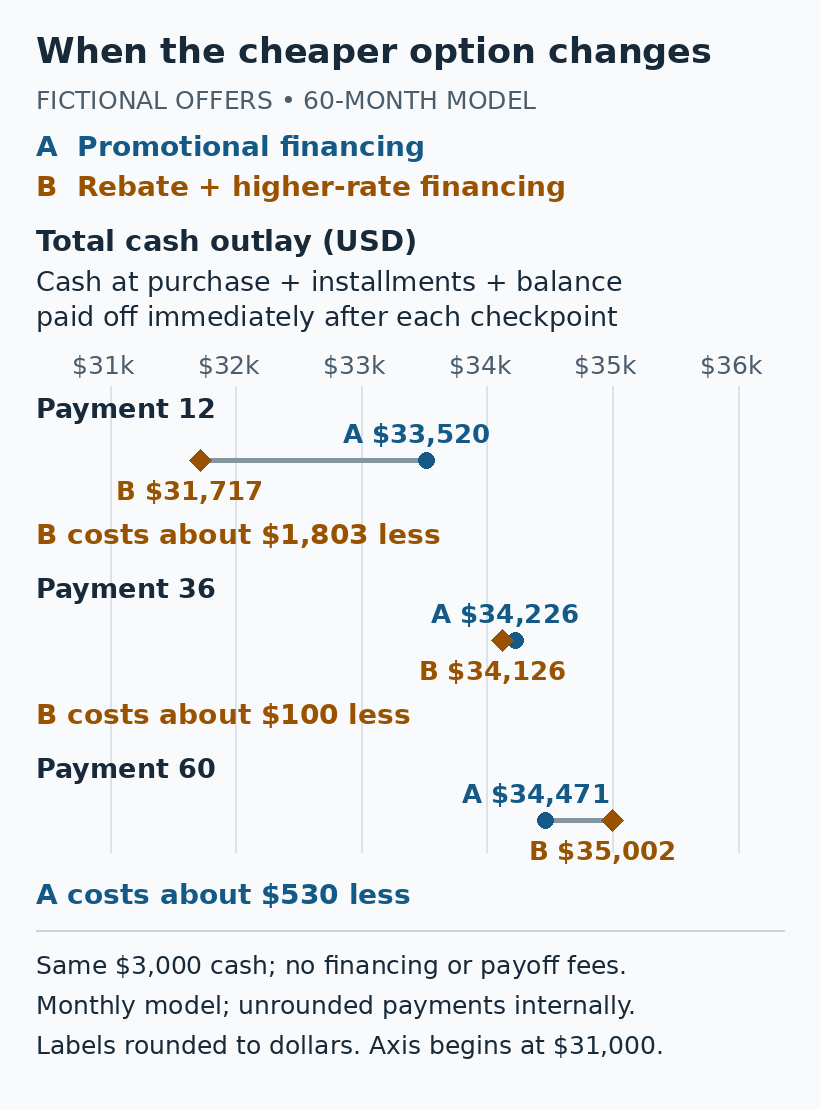
- After payment 12: A totals $33,519.89: $3,000 cash, about $6,294.26 in installments and a $24,225.63 balance. B totals $31,716.72: $3,000 cash, about $6,400.31 in installments and a $22,316.41 balance. The rebate option costs about $1,803 less.
- After payment 36: A totals $34,225.52: $3,000 cash, about $18,882.77 in installments and a $12,342.75 balance. B totals $34,125.64: $3,000 cash, about $19,200.94 in installments and a $11,924.71 balance. The rebate option still costs about $100 less.
- After payment 60: Both balances are zero. A totals $34,471.29 and B totals $35,001.56, including the original cash contribution. Promotional financing now costs about $530 less.
Each component is displayed to cents, so a displayed sum can differ from its unrounded total by a cent. To reproduce a checkpoint balance after k payments, use Bk = P(1 + r)k − m[(1 + r)k − 1] ÷ r, where m is the unrounded monthly payment. Substitute that balance into the cash-outlay formula above.
B’s monthly payment is higher even at the checkpoints where its total outlay is lower. Counting only installments would miss its smaller remaining debt. Comparing only interest would miss its lower purchase cost. Subtracting the rebate again would count the same incentive twice, and adding the $33,000 transaction total again would count financed purchase dollars twice.
The reversal happens because B’s initial principal advantage is gradually consumed by higher interest. Paying off at month 12 stops that process much earlier than paying through month 60. These checkpoints do not establish a universal break-even month for car incentives.
Which real-world differences change the answer?
- Eligibility and available terms. Compare offers you can actually obtain. The CFPB’s guidance on advertised zero-percent financing notes that qualification is generally limited to high-credit-score borrowers and that short repayment terms may be required. It does not establish your eligibility for either fictional rate here.
- Different terms or purchase contents. A 36-month offer and a 72-month offer need separate schedules and a common comparison date, with any remaining balance included. If a trade-in changes borrowing, resolve the trade-in negative-equity calculation first. If one package includes extra products, use the financed add-on cost guide to separate that change from the incentive decision. Include actual financing fees without counting financed fees twice.
- Payoff terms and interest method. The CFPB explains that contract terms and state law affect early payoff, including possible penalties. Its simple-versus-precomputed-interest explanation also matters: balance-based interest and interest calculated at the outset do not behave identically when repayment changes. A precomputed loan may involve an unearned-interest refund. Do not apply this monthly balance model unchanged to every contract; obtain the lender’s payoff calculation for the intended date.
- Taxes, incentive adjustments and payment dates. Ask for each package’s actual transaction total rather than assuming this illustration’s equal taxes and fees. Check whether the incentive terms require any repayment when financing ends early. A payoff between installment dates needs a dated payoff amount that accounts for applicable accrued interest and charges; the illustrated post-payment balance alone is insufficient.
- The cash needed to execute the plan. At month 12, B still needs more than $22,000 to clear its balance. Do not choose it on the assumption that an unapproved refinance will provide that money. If you refinance, the replacement borrowing has its own payments, interest and fees; the household debt has not disappeared. If using savings, consider what cash remains available for emergencies and other obligations.
Choose an affordable offer that survives your fallback plan
First compare the feasible packages at the payoff date you can realistically fund. Then test the full scheduled term in case early payoff does not happen. Here, choosing B for a planned month-12 payoff means accepting a roughly $530 full-term disadvantage if that plan falls through, as well as its higher monthly obligation.
These are undiscounted cash totals, not a present-value analysis or a measure of what retained savings might earn. They exclude operating expenses and vehicle resale proceeds. When cash contributions or disposal plans differ, those differences need a separate comparison rather than being silently treated as equal.
Finally, check that the monthly obligation leaves room for insurance, fuel and maintenance. A lower modeled financing cost does not make an unaffordable vehicle affordable.
Featured photo: Portafolio fotográfico automotriz / Unsplash.
College Withdrawal Bill: Reconcile the School Account
Use three school records and a fictional $1,340 example to trace each adjustment, check a changed balance and organize questions for the right office.

Student Aid Credit Balance: Separate the School Ledger From Spendable Cash
Use two fictional aid snapshots and a private payment record to organize the amounts, permissions and dates behind a college-account credit.

Solar Loan Quotes: Compare the Cash Price Before the Low Rate
Match the installation scope, reconcile a fictional $6,000 financed-price uplift, and test the later payment if a planned savings payment never arrives.