COVID EIDL Payment Assistance: What Borrowers Should Check
Review the cash-flow trade-off, unresolved SBA application-route and loan-status guidance, and questions to confirm for an existing COVID EIDL loan.
Estimated reading time: 8 minutes
COVID EIDL payment assistance may give an existing borrower breathing room, but the useful question is what happens to the business’s cash flow during the reduced-payment period and afterward. This guide explains the trade-off and questions to confirm with SBA; it isn’t a new-loan application or an eligibility decision.
Research checked: October 19, 2026. This is a source-review date, not a policy effective date.
COVID EIDL payment assistance: unresolved account questions
Application route: SBA’s COVID EIDL guidance says eligible loans can apply through the SBA Loan Portal, while retaining email instructions for loans originally above $200,000 at COVIDEIDLServicing@sba.gov. These simultaneous instructions leave the route unclear; this guide can’t establish which applies to your account.
Loan status: SBA separately says “Loan must be less than 90 days past due at the time of the request” and “Loan must be in current status”. Both conditions remain listed. Being fewer than 90 days late alone doesn’t establish eligibility.
SBA’s separate Manage your EIDL page describes the status condition as excluding Charged Off or Uncollectible loans. The pages don’t explicitly explain how their status wording relates. Ask SBA to confirm the applicable test for your account.
Confirm your account’s current instructions with SBA before transmitting documents or changing scheduled payments. Borrower-specific portal enrollment screens weren’t verified for this guide.
What the published assistance describes
According to the SBA guidance, eligible existing borrowers pay half their installment for six months, available once per five years. The business must operate; the borrower and every owner must be outside active bankruptcy; difficulties must be temporary. Existing enrollment continues through its term, then full installments resume. Interest accrues, and SBA warns of a larger maturity balloon.
An $800 installment: cash retained now
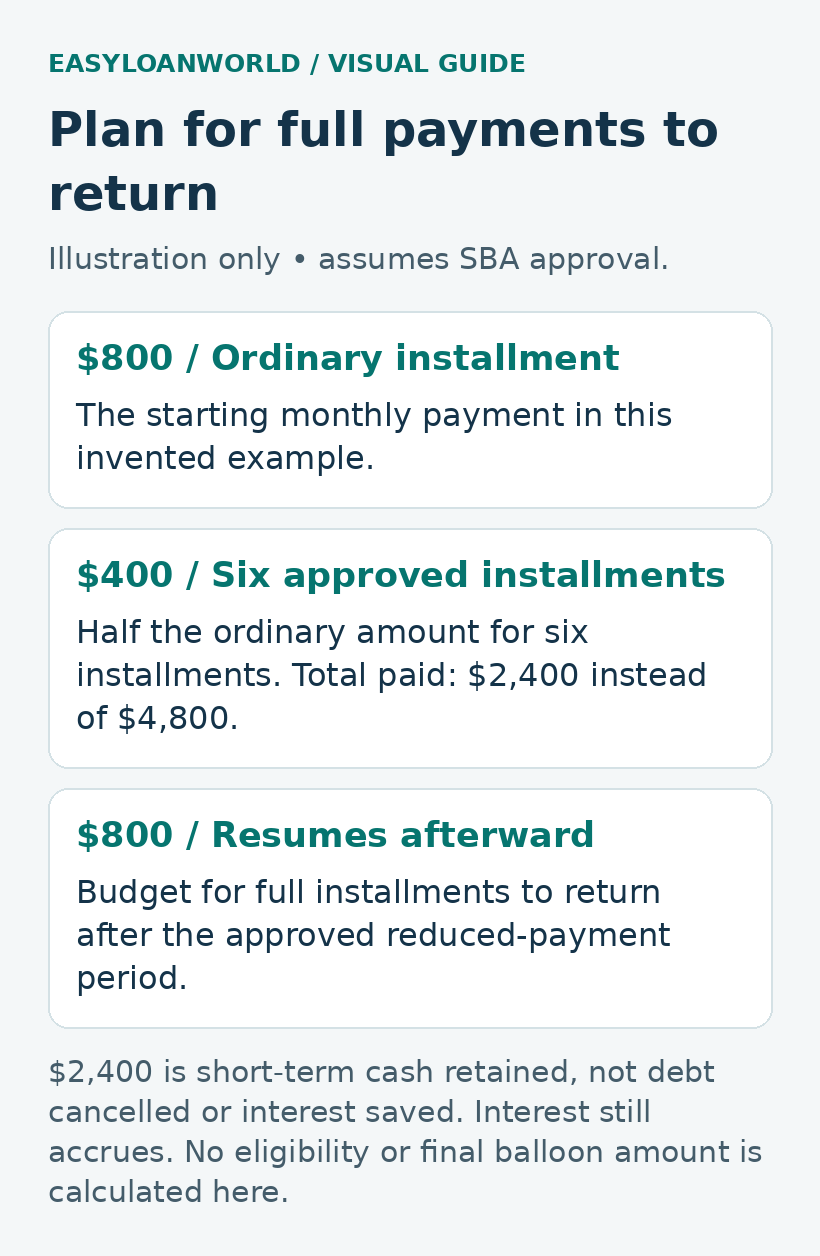
Here’s an original illustration, not a real borrower’s schedule. Assume SBA approves six installments at half an ordinary $800 installment:
- Ordinary six-month cash outflow: $800 × 6 = $4,800.
- Illustrative approved installment: $800 × 50% = $400.
- Reduced-payment cash outflow: $400 × 6 = $2,400.
- Cash retained during those six months: $4,800 − $2,400 = $2,400.
- Budget for the illustrative $800 installment to return afterward.
The $2,400 measures short-term cash retained. It doesn’t calculate interest savings, debt cancellation, or the increase in the final balloon payment. A maturity calculation needs the actual balance, interest terms, accrued interest, payment allocation, remaining schedule, and approved servicing terms. The monthly installment alone can’t supply that answer.
COVID EIDL payment assistance: budget for full payments
Use the illustration to test a plan rather than treating the reduced amount as permanent spending room. For each affected month, write down:
- Expected customer receipts and when they should arrive.
- Essential operating costs and their due dates.
- The installment confirmed for that month.
- Cash left after those outflows, including any reserve you intend to keep.
Then repeat the worksheet for the first month after the reduced-payment period. In the example, the installment increases by $400 compared with the temporary amount. Identify what change in receipts, expenses, or reserves would cover that difference. If your plan only works while payments stay reduced, that’s an important issue to discuss before relying on the arrangement.
COVID EIDL payment assistance: test operating cash before the installment
Add a separate fictional operating budget to the original $800 installment example. Suppose customer receipts minus all other operating cash uses leave $500 each month before this loan payment. Assume $2,000 of usable starting cash after other earmarks.
At an ordinary $800 installment, the monthly position is $500 minus $800, or a $300 gap. At an expressly approved $400 installment, the position is $500 minus $400, or a $100 surplus.
The monthly improvement is $400, matching the payment difference. It doesn’t mean the business generates $400 more operating earnings. Receipts and non-loan uses haven’t changed; the timing of loan cash paid has changed.
Across six identical reduced-payment months, the $100 surpluses add $600 to starting cash, producing $2,600. Without the reduction, six $300 gaps would use $1,800 and leave $200. The $2,400 difference matches the original short-term cash-retention calculation.
Both endpoints assume receipts arrive before the relevant outflows and there are no additional costs or restrictions. They don’t establish eligibility, an approved schedule or a recommended reserve for an actual business.
COVID EIDL payment assistance: test the first full-payment month
Continue only the approved-reduction branch with $2,600 cash after month six. If operating money before the installment stays $500 when the $800 payment returns, the monthly $300 gap also returns.
Eight identical later gaps would use $2,400, leaving $200. A ninth would be unfunded by $100. Temporary assistance has delayed the cash problem in this fixed example; it hasn’t changed the underlying recurring operating amount.
This is a simple cash sequence, not a loan-balance projection. Interest, payment allocation and maturity obligations remain separate questions requiring actual account data. Don’t use the reserve endpoint as a calculated balloon amount.
For an independent recovery variation, suppose confirmed operating money before the full installment rises to $750. The full-payment month still has a $50 gap. A result that worked with the temporary $400 payment doesn’t establish that the restored payment is covered.
If the confirmed amount instead becomes $900, the same $800 installment leaves $100. These are alternative operating assumptions, not forecasts or instructions to assume higher sales. Identify what actual receipts and costs support any revised amount.
COVID EIDL payment assistance: keep the twelve-month comparison complete
Under the original approved schedule, six $400 installments followed by six $800 installments total $7,200 during the first twelve months. Twelve ordinary $800 installments would total $9,600. The cash-paid difference is $2,400.
Multiplying the temporary $400 difference by twelve would wrongly claim $4,800 retained during that year. The stipulated reduction lasts six installments. Put its confirmed first and last dates on the calendar before extending any cash comparison.
Likewise, a request submitted during a month doesn’t establish which installment is reduced. Use the actual written approval and account instructions. Until the effective dates are confirmed, keep the proposed schedule conditional.
If the approved dates or amounts differ from this illustration, rebuild every affected month. A later start can change an early funding gap even if the eventual total number of reduced installments is the same.
COVID EIDL payment assistance: record what the servicing answer resolves
If SBA explains the correct application route for the account, record that answer without marking eligibility or enrollment approved. If it confirms status eligibility, keep requested payment dates and amounts separate until those are established too.
For automatic payments, obtain the actual instructions and confirm what posts. A budget showing $400 isn’t evidence that an existing $800 debit instruction changed. Conversely, don’t initiate a second payment merely because a posting isn’t yet visible without checking the account record.
Keep the ordinary schedule, approved temporary schedule, actual payment entries and return-to-full-payment plan together. Each answers a different question and can expose a discrepancy that a single “assistance active” label conceals.
The practical test is whether the business has a supported plan for the end of relief, not simply whether six smaller installments create room today. Discuss a continuing gap using actual account and business records rather than treating temporary cash retained as debt forgiveness.
A positive monthly endpoint can also hide an early gap. For an independent timing example, assume no opening usable cash, a $400 installment due on day 5 and the $500 operating cash available only on day 20. The endpoint is $100, but day 5 is unfunded by $400. This doesn’t assume an overdraft or permission to pay late; it identifies timing that the monthly total alone omitted.
Questions to get answered for your account
Keep these questions beside your budget and record SBA’s response, the date, and any written confirmation:
- How do both listed loan-status conditions apply to my account?
- Which application route and supporting documents apply to my loan?
- What installment amount and exact first and last due dates would be approved?
- What payment resumes afterward, and on which date?
- How should existing automatic payments be handled?
- What projected maturity obligation would result, and what assumptions does that projection use?
- How does any previous assistance affect the once-per-five-years condition?
Questions about a proposed schedule are different from confirmation that it has been approved. Keep the approved terms with your loan records so your budget follows the actual arrangement.
This is general education. Obtain account-specific servicing guidance from SBA and appropriate professional advice for distressed-business decisions.
Use the business-loan affordability worksheet to examine the return to regular installments without treating temporary relief as debt forgiveness.
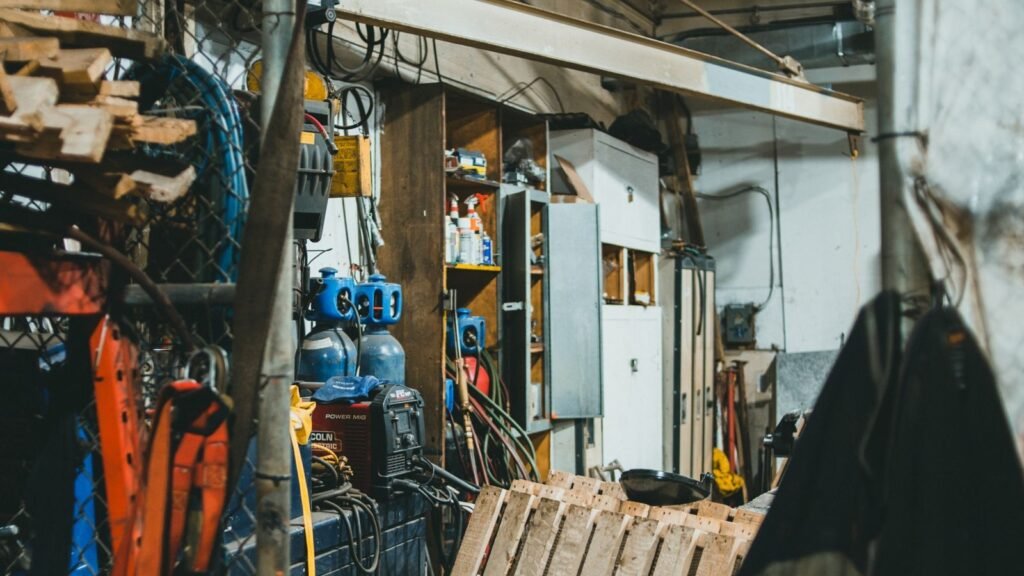
Featured photo: Photo by Jonathan Cooper on Pexels. Used under the Pexels license. Illustrative stock photograph of a workshop; not a business identified as an EIDL borrower or assistance recipient. Photo by Jonathan Cooper on Pexels.

SBA 504 Payoff: Keep Both Loan Records Separate
Separate loan identities, preliminary estimates and final payoff figures.
SBA Disaster Loan Declined: Match the Review Stage
An SBA disaster-loan decline should start two separate tasks: identify the review procedure and connect each stated reason to evidence.

SBA Building Purchase: Measure Occupied Space Before Counting Tenant Rent
Build a classified area worksheet before relying on tenant rent. See how an omitted 500 square feet changes a fictional building’s operating-use calculation.