Debt Consolidation Loan vs. Balance Transfer: Compare the Payoff Plan
Compare a consolidation loan and balance transfer using the same debt and repayment budget, including fees, promotional expiry and partial transfers.

Estimated reading time: 10 minutes
Compare a debt consolidation loan vs balance transfer using equal debt and one repayment budget. Carry any remaining promotional balance past expiry in the calculation.
The fictional example below replaces $6,000 of existing card debt and pays $300 a month toward either option. It shows the balance at promotional expiry, the cost afterward and the different budget needed to finish before that deadline. It’s an offer-comparison method, not a product ranking.
Debt consolidation loan vs balance transfer: match the debt
The CFPB explains that consolidation combines debts into a loan payment. A longer repayment period can increase overall cost.
Write down which old balances would actually be cleared. Compare net debt retired, rather than assuming equal quoted credit amounts buy the same result.
Discover’s loan FAQ explains how some lenders deduct origination charges from proceeds; Discover states that its own personal loans don’t charge origination fees. Verify your particular offer before equating principal with money available to pay creditors. The fee-bearing loan below is fictional, not a Discover offer.
The CFPB confirms that a zero-percent transfer offer can still carry a transfer fee. Include that charge in the comparison.
Eligibility also matters. For example, Chase’s transfer FAQ excludes paying cards or loans issued by Chase or its affiliates. That’s a provider-specific restriction. Ask your actual issuer which debts and amounts qualify.
Debt consolidation loan vs balance transfer: $6,000, $300 monthly
Assume either transaction fully clears exactly $6,000 at time zero. No old interest, pending purchase or charge remains. There’s no extra cash borrowed or household cash contribution.
Both options receive $300 at each month-end, beginning one month later, except for the final smaller payment. Assume all required minimums are met. The loan permits extra repayment without penalty and applies it after interest. There are no new purchases, annual fees, late payments, additional charges or discounts.
The model adds monthly interest before payment, using nominal annual rate divided by 12, with no intermediate rounding. It’s a simplified illustration, not a statement estimate or disclosed-APR calculation. Real payment dates, day counts, allocation, rounding, fee rules and variable rates can change the outcome.
Route A: fixed-rate consolidation loan
Assume a fixed 12% annual contract interest rate over 24 scheduled months, with a 4% fee deducted from principal:
- New principal: $6,250.
- Deducted fee: $250.
- Net money retiring old debt: $6,000.
- Modeled required installment: about $294.21.
The selected $300 payment is voluntary extra repayment, not the contractual minimum. At that pace, the model uses 23 payments of $300 and a final payment of about $143.80 on payment date 24.
Total repayment is about $7,043.80: $6,000 of original debt, the $250 new fee and approximately $793.80 of new interest. Cost above the debt retired is about $1,043.80. The fee is already financed; don’t add it again to total payments.
Route B: promotional balance transfer
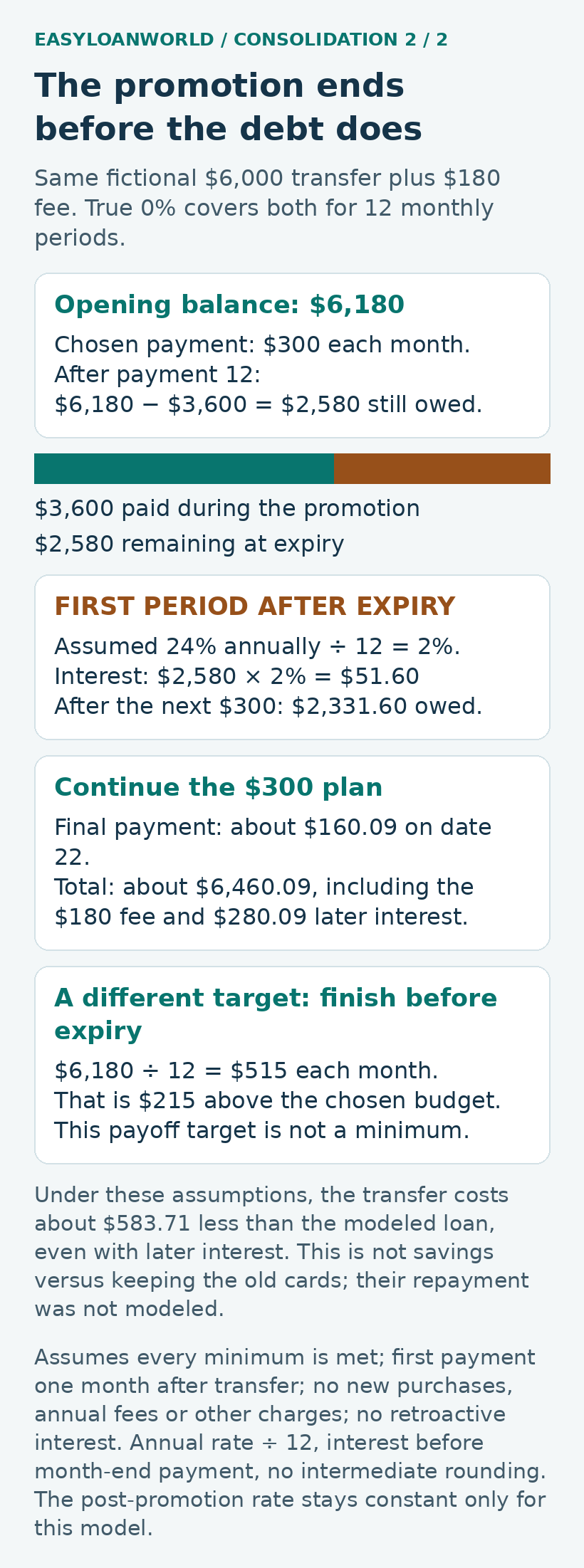
Assume a 3% fee on the $6,000 transferred amount, added to the new card. That creates a $6,180 opening balance, including the $180 fee.
In this invented offer, true 0% applies to both the transferred debt and its fee for exactly 12 monthly periods. Immediately after payment 12, a constant 24% annual rate begins, modeled as 2% monthly. No interest is added retroactively for the first 12 periods; this example isn’t a deferred-interest arrangement.
- Twelve payments of $300 remove $3,600.
- $2,580 remains when the promotion ends.
- The first post-promotion interest charge is $2,580 × 2% = $51.60.
- After the next $300 payment, the balance is $2,331.60.
Continue at $300. The full model uses 21 payments of $300, then a final payment of about $160.09 on payment date 22.
Total repayment is about $6,460.09: $6,000 of old debt, the $180 fee and about $280.09 of post-promotion interest. Cost above the debt retired is about $460.09.
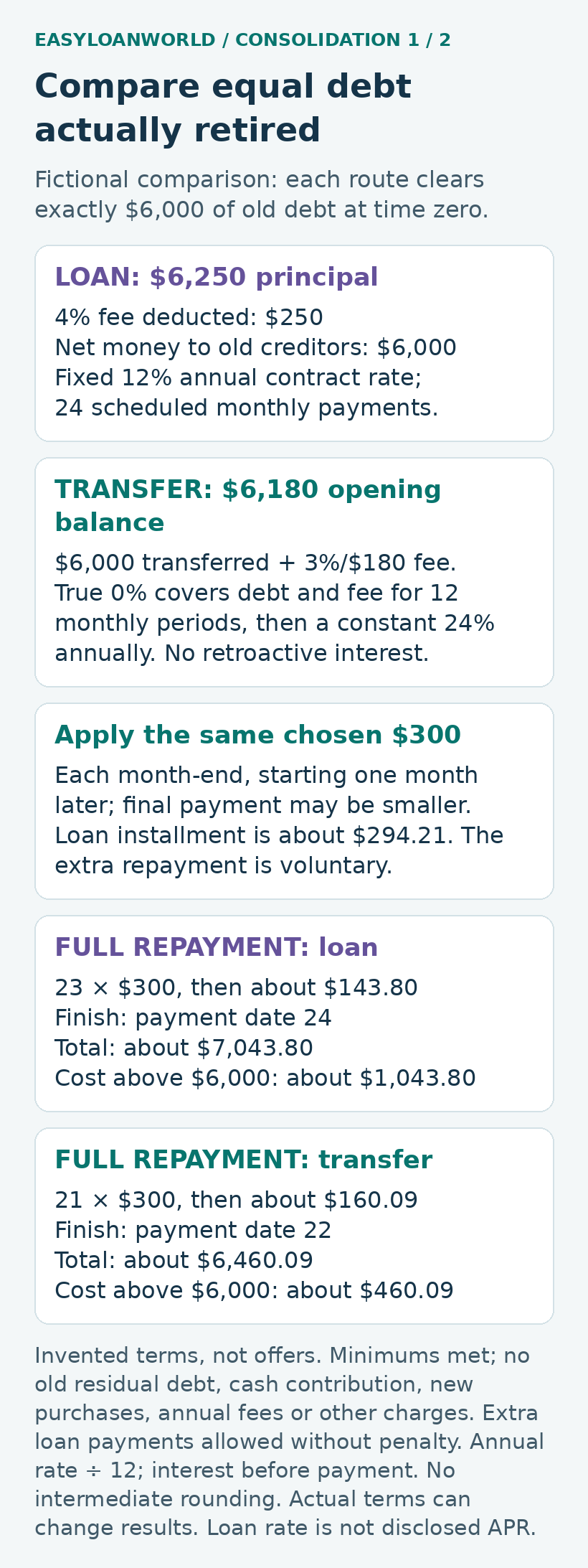
| Measure | Consolidation loan | Balance transfer |
|---|---|---|
| Old debt fully retired | $6,000 | $6,000 |
| Opening new balance including fee | $6,250 | $6,180 |
| Chosen monthly payment | $300 | $300 |
| Final payment date | Month 24 | Month 22 |
| Total repayment | $7,043.80 | $6,460.09 |
| New fee and interest combined | $1,043.80 | $460.09 |
Read both the deadline and the final result
Under these assumptions, the transfer costs about $583.71 less than the modeled loan and finishes two payment dates earlier. That isn’t a savings figure against keeping the old cards: their repayment path hasn’t been modeled. Different offers can reverse the comparison.
For a different target, clearing this transfer during the 12 zero-interest periods requires $6,180 ÷ 12 = $515 per month. That is $215 above the chosen $300 budget.
The $515 figure is a payoff target, not an assumed required minimum. Paying $300 may satisfy the invented offer’s minimum, but it can’t meet the zero-balance deadline. A realistic comparison should show that gap rather than claim the balance will disappear during the promotion.
Leaving a balance doesn’t automatically make this transfer more expensive than the loan. The example still favors it after including later interest. What matters is the remaining amount, its actual future rate and a sustainable payment path. Don’t fill the gap by assuming another promotional offer will be available.
Chase’s guide to transfer terms highlights transfer limits, completion deadlines, fee minimums, annual fees and the fee’s own interest treatment. Record the actual promotional end date and subsequent rate. New purchases can create different-rate balances and complicate payment allocation.
Debt consolidation loan vs balance transfer: calculator stages
For the loan, use the loan payment calculator with $6,250 principal, a 12% contract rate and 24 months. That reproduces the approximate $294.21 scheduled installment. It does not automatically gross up the loan for a deducted fee; $6,000 ÷ (1 − 0.04) supplies the $6,250 input. The article’s $300 voluntary-payment result uses a different repayment path from that scheduled installment.
For the transfer, calculate the promotion separately first: $6,180 − (12 × $300) = $2,580. Then enter $2,580, a 24% APR and a $300 fixed payment into the credit card payoff calculator. It estimates the remaining stage under constant-rate assumptions. Add the first 12 payment periods and their $3,600 of payments to that result when comparing the entire plan.
The card calculator doesn’t automatically switch promotional rates or model deferred interest. Recalculate with the actual expiration, subsequent rate and fee treatment. A payment date falling after expiration may not receive the promotional treatment you expected.
If only part of the debt can move
Suppose a separate hypothetical offer accepts only $4,800 of the $6,000 debt, with a 3% fee. The new card starts at $4,944, while $1,200 stays on the old account. Combined debt starts at $6,144 before further interest.
The full-transfer calculation no longer applies. Record both required payments and rates, then divide the total $300 budget across the two accounts. Sending $300 to the new card while ignoring the old account understates the cash needed.
No payoff date or total cost can be calculated for this partial example without the old rate, minimum, payment split and dates, plus the new-card terms. If combined required payments exceed $300, the proposed budget has an unresolved shortfall.
Complete a two-account, 12-month test
Now supply invented terms for that partial transfer. Keep $1,200 on the old card and $4,944 on the new card, including its $144 fee. The old balance accrues 2% per month; the entire new balance receives true 0% for exactly 12 periods. Assume a $60 old-card minimum, capped at its full amount owed, and a $100 new-card minimum throughout these periods. These fixed minimums are exercise inputs, not issuer formulas.
Payments arrive at each month-end after interest, starting one month after the completed transfer. There are no other balances, purchases, charges, missed payments or rate changes within the test. Each month uses exactly $300 across the two separate accounts. Calculations retain unrounded amounts internally; displayed cents are approximations.
- Split A: pay up to $200 to the old card and put the remainder of $300 on the new card. When the old card is cleared, send the whole $300 to the new card.
- Split B: pay $60 to the old card and $240 to the new card for all 12 months.
Both splits meet the invented minimums. For example, the first month’s old-card interest is $24. Split A leaves $1,024 on the old card and $4,844 on the new one; Split B leaves $1,164 and $4,704.
Under A, six $200 payments leave approximately $89.77 on the old card. After the next interest charge, approximately $91.57 clears it on payment date seven; the remainder of that month’s $300 goes to the new card.
Immediately after payment 12, before any post-promotion interest:
- A: old card $0; new card approximately $2,635.57; combined debt $2,635.57.
- B: old card approximately $717.16; new card $2,064; combined debt $2,781.16.
B makes the promotional balance look approximately $571.57 smaller, yet leaves approximately $145.60 more combined debt, calculated before display rounding. Both paid $3,600. A incurred about $91.57 of old-card interest; B incurred about $237.16. The difference is interest, not an additional transfer fee.
Check the reconciliation: $6,144 starting combined debt + interest − $3,600 payments = ending combined debt. The $144 fee is already inside the opening balance; do not add it again.
This compares allocation during the promotional window, not lifetime costs or the decision to transfer. Neither split clears all debt by expiry. The remaining balances still require a funded post-promotion plan using their applicable rates and minimums. It is not a rule for allocating payments between different-rate balances within one card account.
Finish the comparison before committing
- Debt retired: eligible accounts, dated payoff amounts, net proceeds and anything remaining elsewhere.
- Payment plan: required amounts, selected budget, extra-payment treatment and final payment date.
- Promotion record: completion window, expiry date, qualifying balances, fee treatment, later rate and whether it can vary. Expiry may differ from a payment due date.
- Result: balance at expiry, cost through final payoff and any missing offer term.
- Existing-debt option: calculate keeping the old accounts under a stated plan before claiming savings against them.
Submitting a transfer request doesn’t settle the source debt. Chase instructs borrowers to keep paying until the transfer has posted and paid the balance. Confirm completion before changing an existing payment plan.
The useful choice comes from a complete repayment path: equal debt retired, an achievable budget and all remaining balances accounted for.
After either route is completed, check payoffs and combined debt so the old balances and new payment setup agree with your plan.
Common questions
Does a lower monthly payment prove consolidation saves money?
No. Compare the full payments and charges needed to retire the same debt. A lower required payment may simply spread repayment over more months.
Is a balance transfer always best if I can finish during the promotion?
Compare fees, eligibility and available limits as well. The hypothetical $515 target clears this example in time, but it’s useful only if the household can actually repeat that payment.
When can I stop paying the old card?
Verify that the payoff or transfer posted, then inspect the source account for any remaining balance or interest. A request confirmation alone doesn’t show that the debt is cleared.
Sources checked October 25, 2026.
Featured photo: Photo by Mediamodifier on Unsplash. Used under the Unsplash license. Blank stationery for illustration. Photo by Mediamodifier on Unsplash.
Changing Loan Autopay: Check the Notice
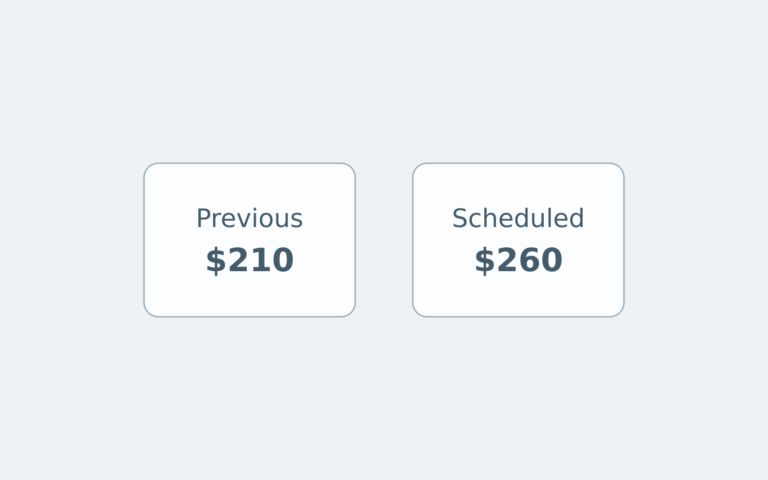
Compare the debit and notice.
Approved for a Loan, but Received a Risk-Based Pricing Notice?
Identify the document and separate report-review questions from the actual loan offer.