Debt Consolidation Aftercare: Check Payoffs, Cash Flow and Total Debt
Use a practical aftercare worksheet to verify card payoffs, organize the new loan payment, spot cash gaps and compare combined debt balances.
A consolidation loan reorganizes debt into a new repayment obligation. It does not, by itself, close a gap between household income and spending. The CFPB’s consolidation guidance stresses understanding why the debt accumulated and reviewing the budget.
After the loan is funded, focus on three checkpoints: confirm the old accounts were paid correctly, make the new payment fit actual cash flow, and track whether total debt is falling. The worksheet below is designed for an unsecured installment loan used to pay credit cards. It is an organizing tool, not a guarantee of a particular result.
First checkpoint: confirm where the money went
Keep the lender’s disbursement record alongside each card’s payment record. Do not mark a card “finished” solely because it appeared in a direct-pay instruction.
For each creditor, record:
- Account nickname and intended payoff amount.
- Amount actually sent and payment reference.
- Date the receiving account confirms receipt or credit.
- Remaining amount, pending activity or question to resolve.
- Next statement checked and any follow-up completed.
Then reconcile the whole loan: net funds available after deductions, payments sent to creditors, money you added and funds still unapplied. Treat unapplied proceeds as part of the reconciliation, rather than automatically adding them to a spending budget.
Review each old account’s next statement and any unresolved charge. Before changing an old automatic payment, check whether a debit is already pending or an amount is still due. Verify the new loan’s payment setup separately. Save confirmations so that a missing payment and a duplicate payment are easier to investigate.
Second checkpoint: verify the new payment setup
Write down the required payment, due date, payment method, paying account and any rate-discount conditions. Check that the first payment actually completes; enrollment alone is not your completion record.
With bank bill-pay, the bank sends a payment; with automatic debit, the company withdraws it. The CFPB explains this distinction and recommends retaining the authorization and monitoring amount and timing. Automatic payments need sufficient funds; a shortage can create fees.
Keep a brief payment log: due date, amount, scheduled date, completed date and confirmation. If a payment fails or differs from the agreement, contact the lender and bank as appropriate rather than assuming the other organization will correct it.
For extra payments, ask how the lender applies them and check the agreement for any fees. Verify the resulting balance and next payment requirement. Do not assume that paying early automatically changes the loan in the way you intended.
Make the cash plan work between paydays
Cash timing matters as well as monthly totals. The CFPB’s cash-flow and emergency-fund guide explains how mismatched income and expense timing can create shortages.
For the period before your next payday, fill in:
- Available money now, after allowing for pending debits: ____.
- Income expected before the next payday: ____.
- Essential bills and required debt payments due in that interval: ____.
- Other planned spending and transfers: ____.
- Amount remaining after those outflows: ____.
Check the dates, too. If cash arrives after a payment is due, ask the creditor about changing that due date.
A hypothetical budget still has only $150 left
Assume a household has the following monthly plan. All amounts are fictional, and the ordinary living-cost figure excludes every item listed after it.
- Take-home income: $3,800.
- Ordinary essential living costs: $2,950.
- New consolidation-loan payment: $400.
- Money set aside for known non-monthly costs: $200.
- Emergency-fund contribution: $100.
Remaining for optional spending: $3,800 − $2,950 − $400 − $200 − $100 = $150.
The $200 allocation could cover $1,200 of annual insurance, $600 of planned maintenance and $600 of other known annual bills: $2,400 divided by 12. Those costs are outside the $2,950 figure, so they are not counted twice.
If this household plans $350 of optional spending instead, its plan is short by $200 a month. Six identical months create a $1,200 funding gap before financing charges or additional card-payment obligations. That is a budget calculation, not a prediction of the eventual card balance.
The household needs a plan that fits available cash. If even essentials and required payments do not fit, simply labeling spending “optional” cannot fix the problem. Identify what can realistically change and seek payment assistance when needed.
An emergency reserve can help cover unplanned costs without new borrowing, but the right amount depends on circumstances. Small contributions can help. Do not schedule a savings transfer that leaves required payments unfunded; the example’s $100 is not a universal target.
Choose a deliberate role for the paid-off cards
Closing a card can reduce available credit and increase utilization, with a score effect that varies. Keeping it is not always preferable: fees, terms or avoiding unaffordable debt may favor closure. The CFPB’s card-closure guide recommends monitoring statements even on unused accounts.
Choose a control that addresses the actual reason balances might return:
- Unplanned checkout spending: Consider removing saved card details from stores or a digital wallet.
- A card kept for planned purchases: Decide which cash will pay for those purchases before using it.
- Recurring charges: Review the merchant’s subscription and payment settings directly.
- Issuer transaction controls: Ask what they block and whether recurring charges are treated differently.
Do not assume that removing a saved card or using a card lock cancels a merchant agreement. If a restriction is important to your plan, verify its limits before relying on it.
Third checkpoint: track the combined balance
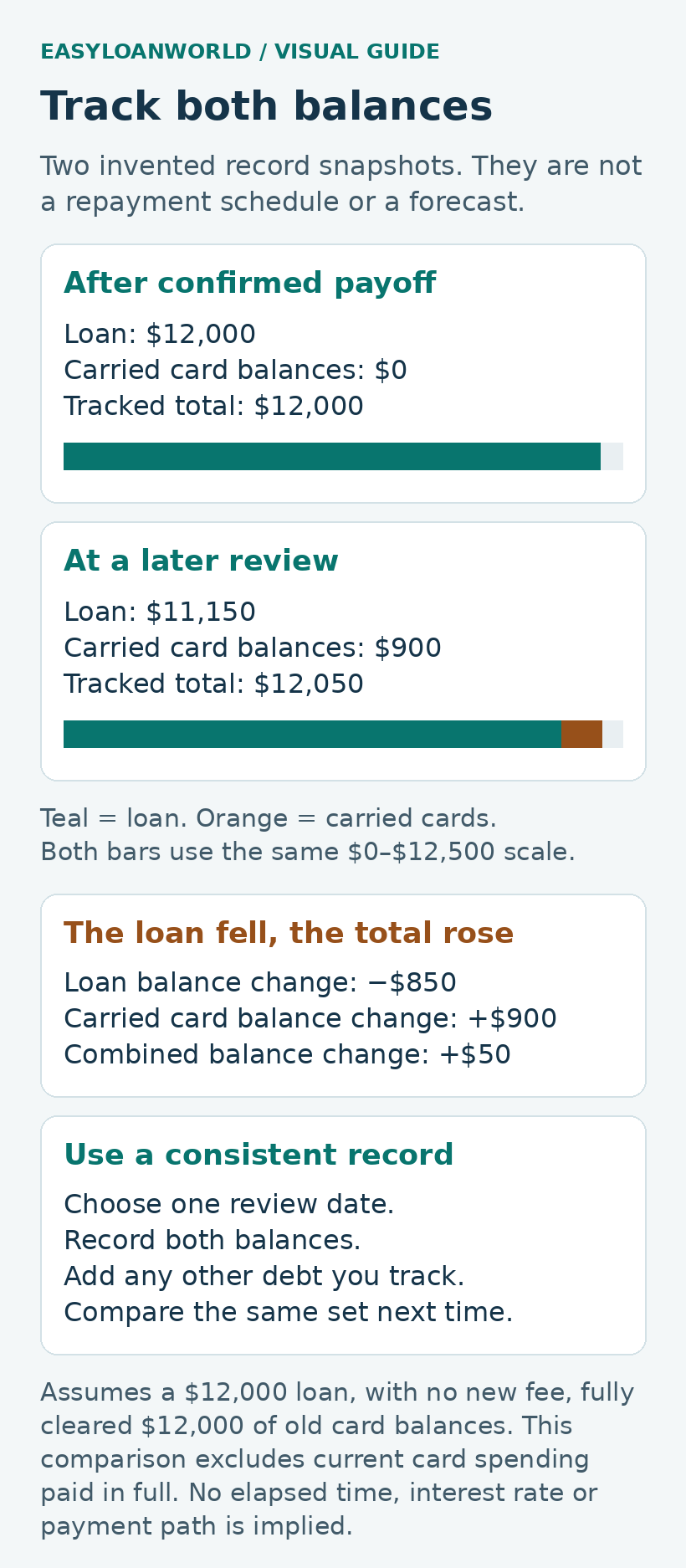
Use the same review date and definition each month. For this exercise, add the consolidation-loan balance and card balances carried rather than paid in full; add any other borrowing you choose to track consistently. Record current purchases you intend to pay in full separately, with the cash reserved for them.
Two illustrative snapshots
Assume a $12,000 loan, with no new loan fee, fully clears $12,000 of old card balances.
- After confirmed payoff: $12,000 loan + $0 carried card balances = $12,000 tracked debt.
- At a later review: $11,150 loan + $900 carried card balances = $12,050 tracked debt.
The loan fell by $850, but the combined balance rose by $50. Looking only at the loan would miss that change.
These are invented balance records, not an amortization schedule or the result of the budget example above. No elapsed period or interest rate is implied. After a confirmed payoff, do not count both the replaced debt and its replacement; before confirmation, reconcile any outstanding old balance rather than assuming it disappeared.
Use an early warning to change the plan
At each review, answer four questions: Did required payments clear? Are new purchases funded? Are known future bills included? Is there a cash gap before the next income arrives?
If an unplanned carried balance returns, identify the cause: reduced income, bill timing, an underestimated cost, an emergency or discretionary spending. Different causes need different responses; the balance alone does not tell you which happened.
If a required payment no longer fits, contact the creditor early about available changes. Some may consider a lower payment or a different due date; agreement is not guaranteed. Keep following the existing requirements unless an approved change applies.
For related questions, see our credit-card hardship guide and debt-management-plan guide. Use the review to identify the next concrete action, such as correcting a payoff, confirming a payment arrangement or rebuilding the cash plan.
U.S. consumer education. Sources checked October 19, 2026. Examples are hypothetical. This guide does not recommend a specific loan or provide personalized financial advice.
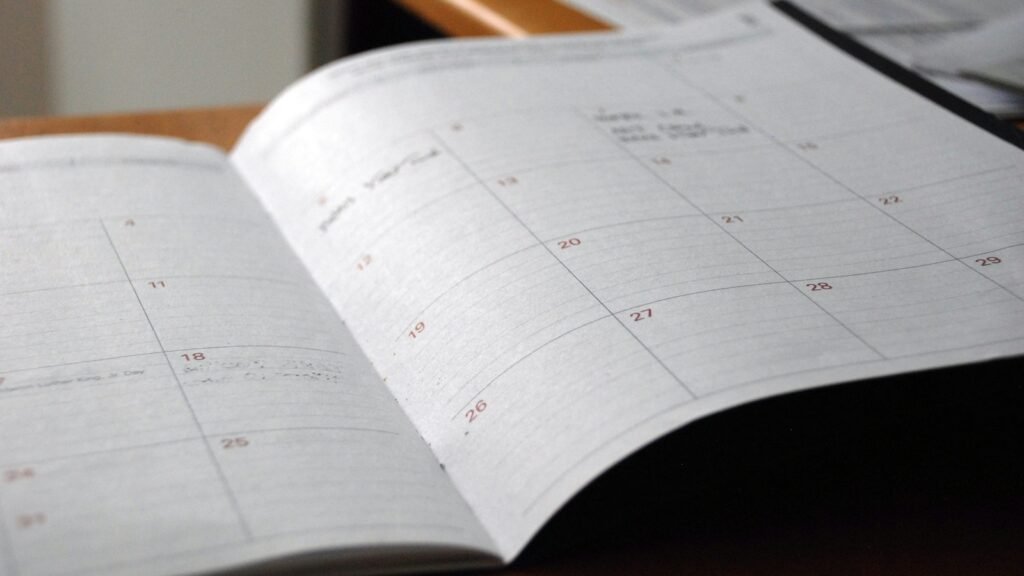
Featured photo: Photo by Eric Rothermel on Unsplash. Used under the Unsplash license. Illustrative stock photograph of a paper planner. Dates and notes pictured are not a payment schedule for this guide. Photo by Eric Rothermel on Unsplash.

Credit-Builder Loan vs. Secured Card: A Cash-Access Checklist
Work through three fictional situations and four private questions before deciding whether a new account fits your needs.
Hotel Card Hold: Compare Two Checkout Payment Paths
Compare two fictional hotel checkout choices while keeping the original card’s capacity and the actual payment in separate records.
Overdraft Fee? Look Beyond the Online Bill Label
Compare three fictional document packets behind the same $60 ONLINE BILL entry, then identify what the records still leave unexplained.