Extra Personal-Loan Payments: Check Principal, Due Dates and Interest
Check how an extra personal-loan payment affects principal, your next due date and interest. Use a payment audit and a clearly hypothetical schedule.

Estimated reading time: 8 minutes
Extra personal loan payments need a check before and after they post. Confirm how the lender will allocate the amount, then reconcile principal, the next due date and any remaining required payment.
Before making an extra personal-loan payment, confirm how much will reduce principal and what will remain due next. After the payment completes, check the allocation against those instructions. A payment confirmation, a lower principal balance and a later billing date answer different questions.
Use only cash you can spare after required payments and essential bills. This guide helps you audit one existing loan; it doesn’t decide which debt to prioritize or promise a particular saving.
Extra personal loan payments: read five fields separately
Make a private before-payment note using the account’s exact labels:
- Principal: Remaining loan principal and its as-of date.
- Interest and fees: Amounts currently accrued or due and the allocation order.
- Next obligation: Required amount and due date.
- Automatic withdrawal: Amount and date still scheduled.
- Repayment projection: Expected finish date under the payments you actually intend to make.
A later displayed due date doesn’t, by itself, tell you whether principal fell or interest stopped. Principal reduction also doesn’t establish that the next installment disappeared. Allocation and billing-date advancement are separate effects that can coexist.
Upstart’s servicing help says additional payments don’t replace the scheduled installment or postpone its due date, and are allocated to principal and interest according to the agreement.
Best Egg’s guidance says paying ahead may advance the due date, while enrolled automatic payments continue at the fixed scheduled amount.
Those examples show why you must verify your own loan’s treatment. They aren’t recommendations of either provider. Don’t apply one company’s explanation to another account.
Ask what extra personal loan payments can change
Contact the servicer through a verified channel and ask:
- Which fees and accrued interest must be satisfied before money reduces principal?
- Can I give a principal-reduction instruction, and what method is accepted for this loan?
- What will happen to the next required amount, its due date and the scheduled automatic debit?
- Does a prepayment charge or other contractual charge apply? Where is it explained?
- Where can I see the completed allocation and an updated repayment projection?
These are questions, not guaranteed account features. Writing “principal only” in a memo doesn’t override the agreement.
For example, SoFi’s payment guidance currently says principal-only payments are unavailable and describes allocation to fees, then accrued interest, then principal. That’s a provider-specific policy.
Don’t confuse interest already accrued with a charge for early repayment. Ask separately about an unexpected fee and the term said to authorize it; its appearance on a screen doesn’t resolve whether it’s correct.
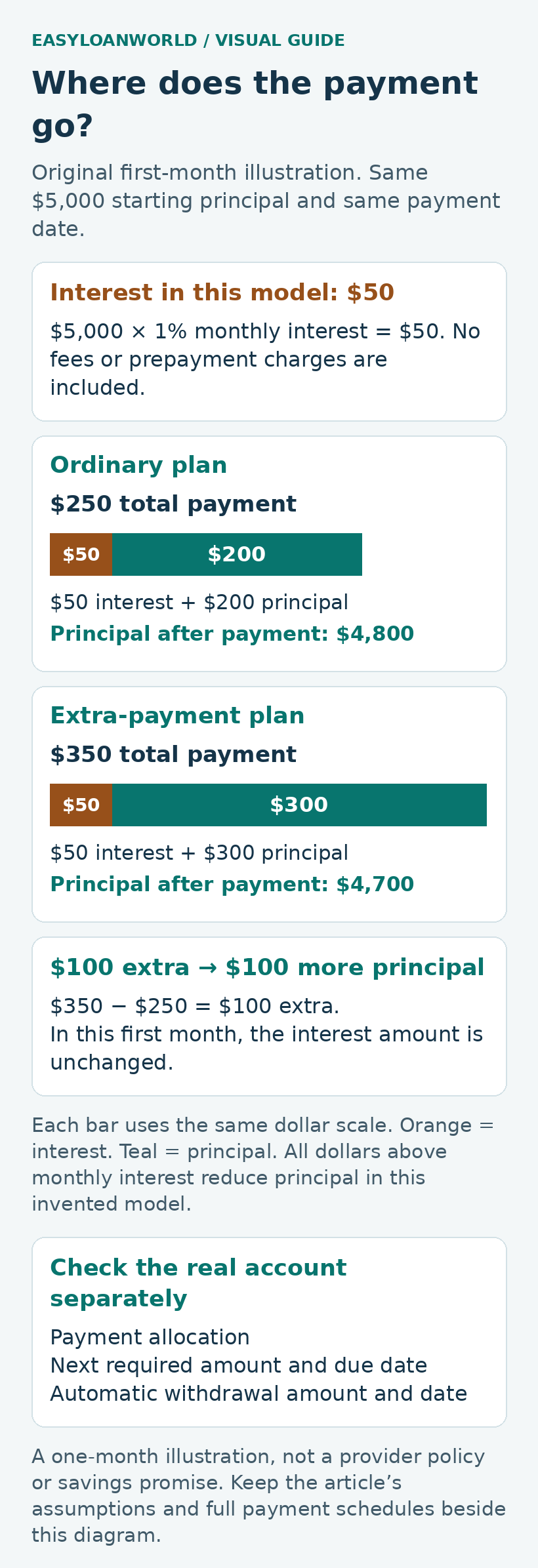
Example: $100 extra changes the principal reduction
This is a fictional monthly-period model, not a named lender’s policy, a current offer or a prediction for your account.
- Starting principal: $5,000.
- Fixed annual contract interest rate: 12%; monthly rate: 1%.
- First payment: one month later; all payments occur at month-end after monthly interest is added.
- Interest: rounded to cents each month, with half cents rounded up.
- No fees, prepayment charges, skipped payments or rate changes.
- All payment dollars above that month’s interest reduce principal.
The assumed regular installment is $250. The extra-payment plan sends $350 total each month, including $100 extra, except for a smaller final payment. No reduction in the required $250 installment or re-amortization is assumed.
First month: ordinary plan
Interest is $5,000 × 1% = $50. Of the $250 payment, $50 covers interest and $200 reduces principal. Remaining principal is $4,800.
First month: extra-payment plan
Interest is still $50 because the starting balance, rate and payment date are identical. Of the $350 total payment, $50 covers interest and $300 reduces principal. Remaining principal is $4,700.
The $350 isn’t the extra amount; $100 is. The $50 interest isn’t an early-payment penalty. Later interest must be recalculated from each plan’s changing balance.
Follow both schedules through the smaller final payment
Applying the stated monthly calculation repeatedly produces:
- $250 plan: 22 payments of $250, followed by $106.76 on monthly payment date 23. Total paid: $5,606.76, including $606.76 interest.
- $350 plan: 15 payments of $350, followed by $172.63 on monthly payment date 16. Total paid: $5,422.63, including $422.63 interest.
Within this model, the extra-payment plan costs $184.13 less interest and finishes seven monthly payment dates earlier. These are outputs of invented assumptions, not promised savings.
The second month illustrates why the schedules separate: interest is $48 on $4,800 in the ordinary plan, versus $47 on $4,700 in the extra-payment plan. The calculation continues from each new balance.
The 16-payment result assumes the $350 plan continues until its smaller final payment. A single $100 extra payment is a different scenario. If later extras stop or their timing changes, recalculate; do not keep using the finish date from the original plan.
Do not multiply 23 × $250 or 16 × $350 to obtain the totals: each would overstate the smaller last payment. Dividing an unchanged estimate of future interest by $100 also misses the changing principal balances.
Upstart’s allocation explanation describes daily simple interest, where payment timing affects accrued interest and the principal share. It excludes Relief Loans. A daily-interest account can differ from this monthly model.
OneMain’s precomputed-interest explanation provides another counterexample: early-payoff treatment can involve a rebate under the loan’s terms. Don’t use this monthly model for a precomputed-interest contract.
Use the agreement’s actual interest method and confirmed payment dates when checking your own projection. Don’t assume all personal loans are penalty-free, that a fee will be refunded or that an extra payment automatically lowers the required installment.
Extra personal loan payments: compare one extra with a continuing plan
A one-time extra payment needs its own schedule. Keep the original $5,000 balance, 12% nominal annual rate, month-end timing and cent-rounded monthly interest with half-cent ties rounded up. Pay $350 in month one, then return to $250 monthly, with a smaller last payment. No other original assumption changes.
Month one ends at $4,700, just as in the continuing-extra plan. In month two, interest is $47, but the restored $250 installment reduces principal by $203, leaving $4,497. The continuing $350 plan would instead repay $303 principal and leave $4,397. The paths separate as soon as the extra stops.
| Payment path | Finish date | Total interest |
|---|---|---|
| $250 throughout, except final payment | Month 23 | $606.76 |
| $350 once, then $250 | Month 22 | $582.45 |
| $350 each month, except final payment | Month 16 | $422.63 |
The one-time path pays $350 first, then twenty $250 installments and a final $232.45: total payments of $5,582.45. Its $24.31 modeled interest reduction is smaller than the $184.13 reduction from continuing the extra every month. The initial $100 principal reduction isn’t an additional saving to add to either interest difference.
Use this distinction when a bonus or refund funds extra personal loan payments. Record whether the amount is available once or in every future month. A projection assuming continuing extras should be revised if only the first extra is confirmed. Conversely, continuing more than planned requires a new cash-capacity check.
The calculation changes future payments, not the assumed required installment or lender’s allocation policy. For a real account, verify the credited date, interest method and actual posting before adopting either finish date. Keep enough separately budgeted cash for the next required payment; a one-time extra isn’t evidence that another installment has been satisfied.
Reconcile extra personal loan payments after posting
Keep this payment-audit card privately. EasyLoanWorld doesn’t need your loan records or account details.
- Before: Principal balance and timestamp.
- Instruction: Amount submitted, date, accepted direction and confirmation reference.
- Completion: Posted or credited date and total payment recorded.
- Allocation: Dollars recorded against fees, interest and principal.
- After: New principal and any other principal adjustment.
- Next: Required amount, due date and automatic-debit amount/date.
- Projection: Updated finish estimate and the future payments it assumes.
If no other principal adjustment occurred, opening principal minus the posted principal reduction should reconcile to closing principal. In the fictional first month, $5,000 − $300 = $4,700. Real records may require explaining other adjustments before that comparison is meaningful.
A scheduled transaction is not yet proof of completed allocation. If the result differs from what you understood, save the instruction and confirmation, identify the exact discrepancy and ask the servicer to explain it. Do not assume fraud, an error or a right to reallocation without evidence.
Keep required payments current while you investigate; do not cancel autopay merely because you paid extra. When you are actually ready to finish the loan, request a dated payoff amount and reconcile pending transactions separately.
U.S. consumer education. Contract and servicing rules vary. Sources checked October 19, 2026.
If the extra amount is intended to finish the loan, use a dated payoff quote rather than assuming the displayed balance is the final amount.
Featured photo: Photo by Kim Leary on Unsplash. Used under the Unsplash license. Illustrative stock photograph of stacked coins. The stacks don’t represent the example payment amounts or promised savings. Photo by Kim Leary on Unsplash.
Changing Loan Autopay: Check the Notice
Compare the debit and notice.
Approved for a Loan, but Received a Risk-Based Pricing Notice?
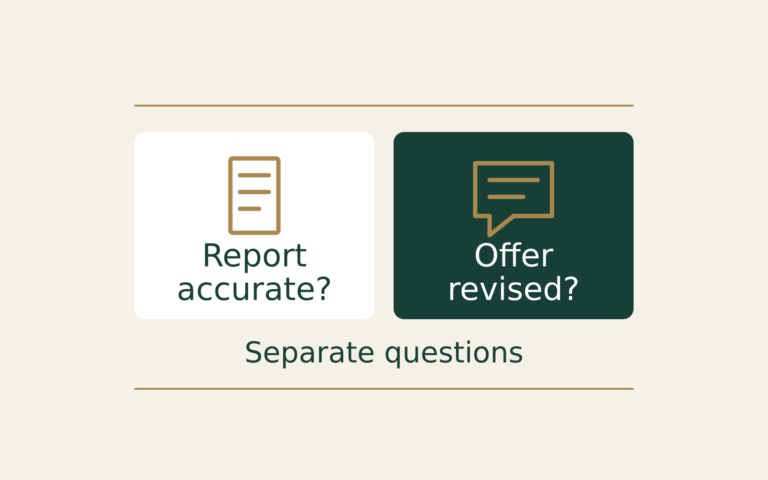
Identify the document and separate report-review questions from the actual loan offer.