Interactive planner inputs and results
Before planning: Enter income months on a consistent basis. If an unused month is prefilled with 0, clear that field and leave it blank. Enter 0 only for a month in which you truly received no income; zeros count in the average, while blank months are excluded. Use cash actually received for a cash-flow assessment; an unpaid invoice is not an accessible reserve. Compare your lowest month and upcoming bill due dates with the average before deciding how much is available to spend.
Interactive calculator unavailable: JavaScript is required to process your own inputs. The worked example, calculation assumptions and related guidance on this page remain available without JavaScript.
Worked example: income average and reserve coverage are different measures
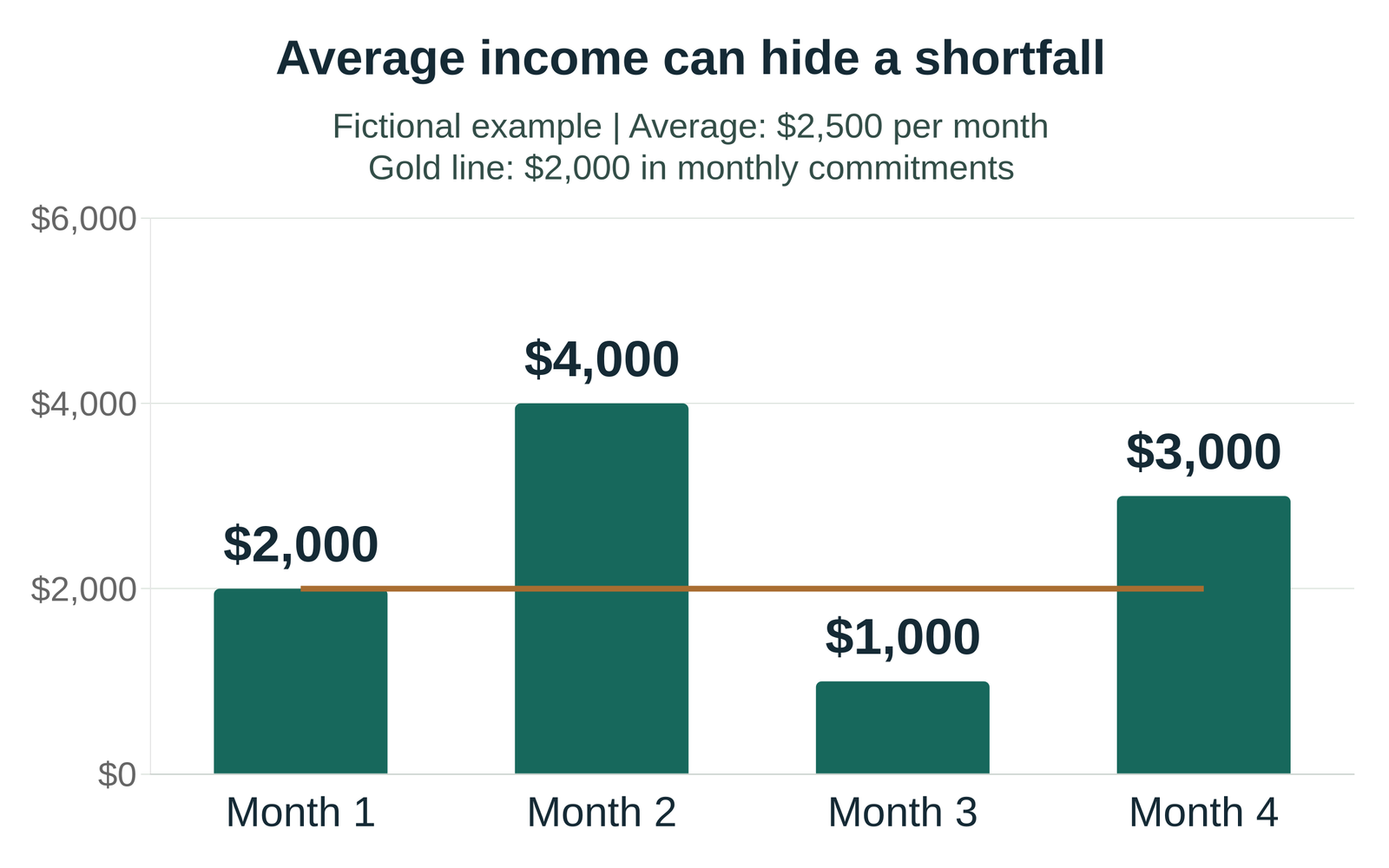
This fictional four-month dataset uses $2,000, $4,000, $1,000 and $3,000 of income. The average is $2,500/month; the low is $1,000, the high is $4,000 and the range is $3,000. If essential personal expenses are $1,300, business obligations $700 and accessible reserve $3,000, monthly commitments total $2,000 and reserve coverage is 1.5 months ($3,000 ÷ $2,000).
The average being higher than commitments does not mean a $1,000 income month can pay all $2,000 of bills. This tool describes entered months, not a prediction or guarantee of future income. Two months of data can be misleading; blank months are excluded but a month entered as $0 is included in the average. If commitments are $0, reserve coverage is undefined, not evidence of unlimited reserves.
Copy these figures into the four-week cash forecast to test actual bill due dates. See the CFPB’s income and spending worksheets for supporting money-tracking resources.
How this planner summarizes income stability
The planner uses the monthly income values you enter to summarize average monthly income, the lowest and highest reported months, the income range, your stated monthly commitments and reserve coverage. It does not display annual income or an income-minus-commitments figure. Reserve coverage is calculated only when the monthly commitments you enter are greater than $0.
This is a historical or scenario-planning view, not a forecast of future freelance income. It does not model taxes, late invoices, business expenses that vary by month, investment returns, debt interest, or changes in client demand unless you include those amounts in your own inputs.
Check your income and expense inputs
Compare the income months with your actual financial records before relying on an average. Use the same definition of income for every month. For cash planning, use money received rather than invoices sent, and exclude transfers between your own accounts from new earnings. Enter genuine zero-income months as 0 rather than skipping them; omitted months can make the average appear more stable.
Then review your monthly obligations for duplicates, check whether the reserve is genuinely accessible, and compare the average with the lowest month you entered. A separate cash-flow forecast should show when each bill falls due and when payment is realistically expected. A historical average alone cannot tell you whether the next bill can be paid on time.
From income variability to a working plan
Choose the guide that answers the question raised by your result:
Stress-test the average against your weakest month
In the worked example above, the $1,000 lowest-income month cannot cover $2,000 of commitments. The resulting $1,000 gap is the amount to test against accessible reserves and the due dates of actual bills.
If the next month genuinely has $0 receipts, the five-month average becomes $2,000 ($10,000 divided by five). If that month is outside your data period, leave its input blank instead. This stress test changes the denominator and the interpretation of the average.
Five checks before you set a regular personal transfer
- Use cash actually received, not completed project values or invoices still awaiting payment.
- Identify the number of months represented, any seasonality and whether a one-off month dominates the average.
- Record unavoidable business costs and personal essentials separately; avoid counting the same bill twice.
- Test the lowest observed month and a no-income month against the date each important bill falls due.
- Keep an emergency buffer that remains accessible; do not count an unpaid receivable as savings.
What to do next: If the weakest-month test produces a shortfall, reduce the proposed transfer or plan how confirmed receipts and existing reserves will cover the gap. Use the weekly cash-flow forecasting guide to add dates and the 13-week workbook to record a conservative scenario. This planner summarizes entered history; it does not predict future income or establish how much you can safely withdraw today.