Interactive planner inputs and results
Before using this planner: Enter expected annual income, estimated business expenses and your chosen reserve percentage. Record estimated-tax payments already sent this year separately from the current tax reserve still set aside, using the same tax year and counting each amount once. The percentage is a savings assumption, not an IRS tax-rate calculation. Check the current IRS instructions for the taxes and payment dates actually due.
Interactive calculator unavailable: JavaScript is required to process your own inputs. The worked example, calculation assumptions and related guidance on this page remain available without JavaScript.
Worked example: keep the tax reserve separate from IRS payments
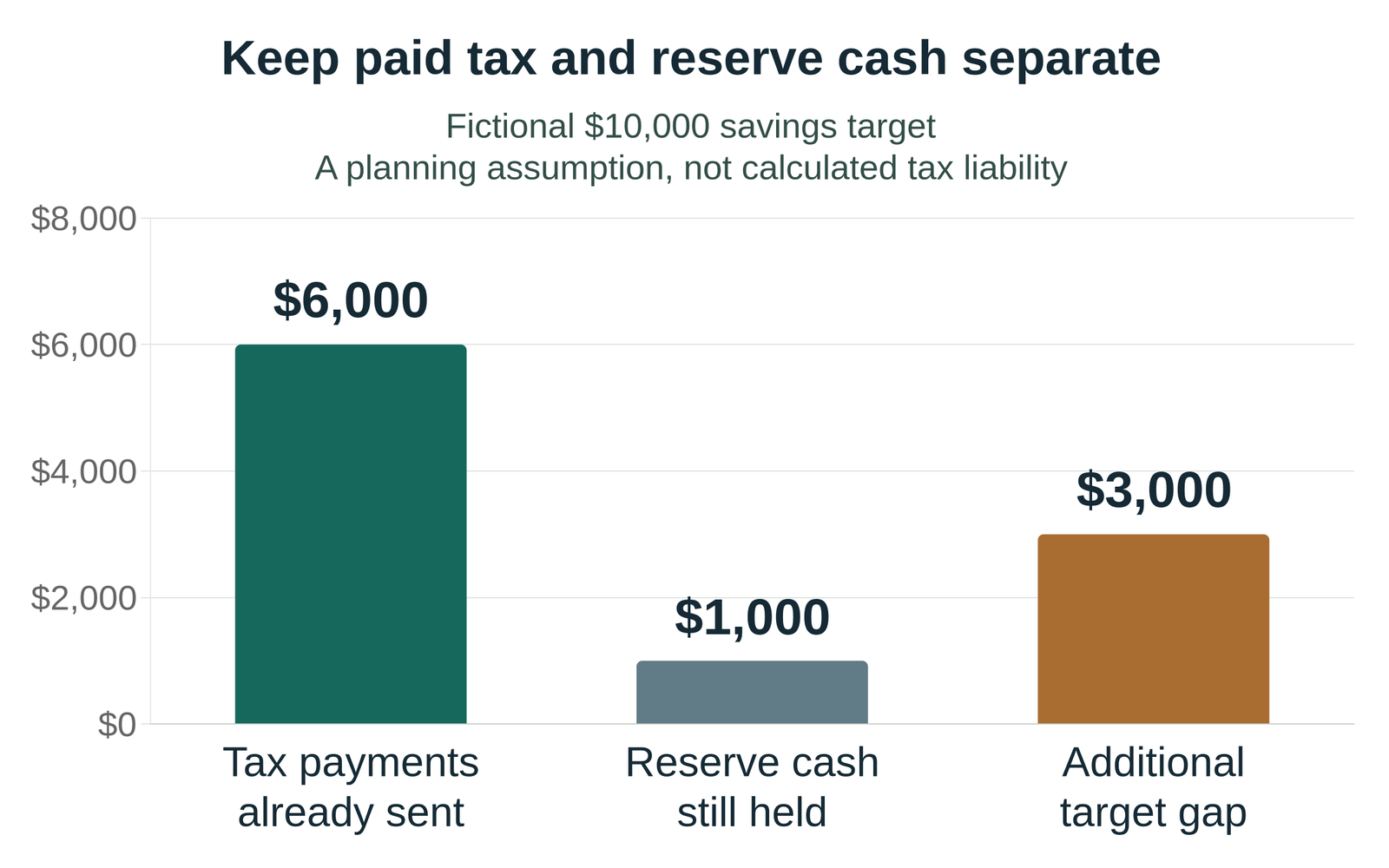
Suppose a fictional freelancer projects $50,000 of income, $10,000 in business expenses and chooses a 25% reserve assumption. The tool calculates a $10,000 target ($40,000 × 25%).
| Item | Value | Meaning |
|---|---|---|
| Planning target | $10,000 | User-selected assumption, not an IRS calculation |
| IRS payments confirmed for the year | $6,000 | Already remitted; no longer in the bank reserve |
| Cash currently held in a designated tax reserve | $1,000 | Not paid to the IRS yet |
| Difference between target and combined accounted-for amounts | $3,000 | $10,000 − $6,000 − $1,000; planning gap only |
Enter the two amounts separately: Put $6,000 in “Estimated-tax payments already sent this year” and $1,000 in “Current tax reserve still set aside.” The planner shows $3,000 more to fund the assumed annual target: $10,000 − $6,000 − $1,000. Money already sent to the IRS is no longer cash in the reserve, so do not enter it twice. This result does not determine the payment the IRS requires.
Zero is not proof of compliance: The chosen 25% could differ significantly from actual income and self-employment taxes. Verify required installments, withholding, prior-year safe harbors and payment due dates through IRS estimated-tax guidance and Publication 505.
How this planning estimate works
The annual planning target is max(0, expected income − business expenses) × your chosen reserve percentage. The additional amount to set aside is max(0, target − payments already sent − reserve still held). Use payments for the same tax year and the same taxes covered by the target. The planner keeps cash savings separate from money already paid; it does not calculate actual tax liability, required installments, safe harbors or IRS account status.
For U.S. federal estimated-tax rules, use the IRS estimated taxes guidance and IRS Publication 505. Your actual tax can depend on filing status, taxable income, deductions, credits, other income, self-employment tax, state rules, and payments already made.
Keep three separate tax numbers in your records
Use one ledger for the planning target, one for accessible reserve cash and one for payments confirmed for the same tax year. The following reconciliation shows why a lower bank reserve does not automatically mean the combined target is underfunded.
- Target: Suppose you select an illustrative 25% reserve on an $8,000 amount you have chosen as a planning basis. That produces a $2,000 savings target, not an IRS assessment.
- Cash still held: Record the $1,500 still in your tax savings separately from any payments already made.
- Tax paid: If another $600 was already sent for the same year and taxes, with successful payment confirmed, $2,100 is accounted for in total. The planner shows $0 more to reserve against the $2,000 target: max(0, $2,000 − $1,500 − $600). The bank reserve remains $1,500. Use an actual tax projection to determine the legal obligation.
Monthly reconciliation before you rely on the reserve result
- Reconcile business receipts and allowable expenses using records appropriate to your accounting and tax situation.
- Recalculate expected federal income tax and self-employment tax if annual income, credits, deductions or filing status assumptions change.
- Match every estimated-tax payment to its tax year, type and official confirmation. A scheduled bank transfer is not proof it reached the IRS.
- Review actual federal due dates, withholding, prior-year safe-harbor rules and any state obligations. Payment dates can vary by tax year and circumstances.
The definitive references are IRS estimated-tax guidance, Publication 505 and the current Form 1040-ES instructions. Use the variable-income tax walkthrough for a fuller fictional calculation. Do not interpret a positive reserve balance or a zero planner gap as evidence of tax compliance.