Interactive comparison inputs and results
Before comparing: Use the same academic year and cost assumptions for both schools. Enter each grant or scholarship once. For loans, enter net proceeds after any withheld fees, not the gross amount offered. The primary funding gap excludes potential work-study earnings; a separate row shows the remainder if those wages are earned.
Interactive calculator unavailable: JavaScript is required to process your own inputs. The worked example, calculation assumptions and related guidance on this page remain available without JavaScript.
Worked example: net price, funding gap and potential earnings
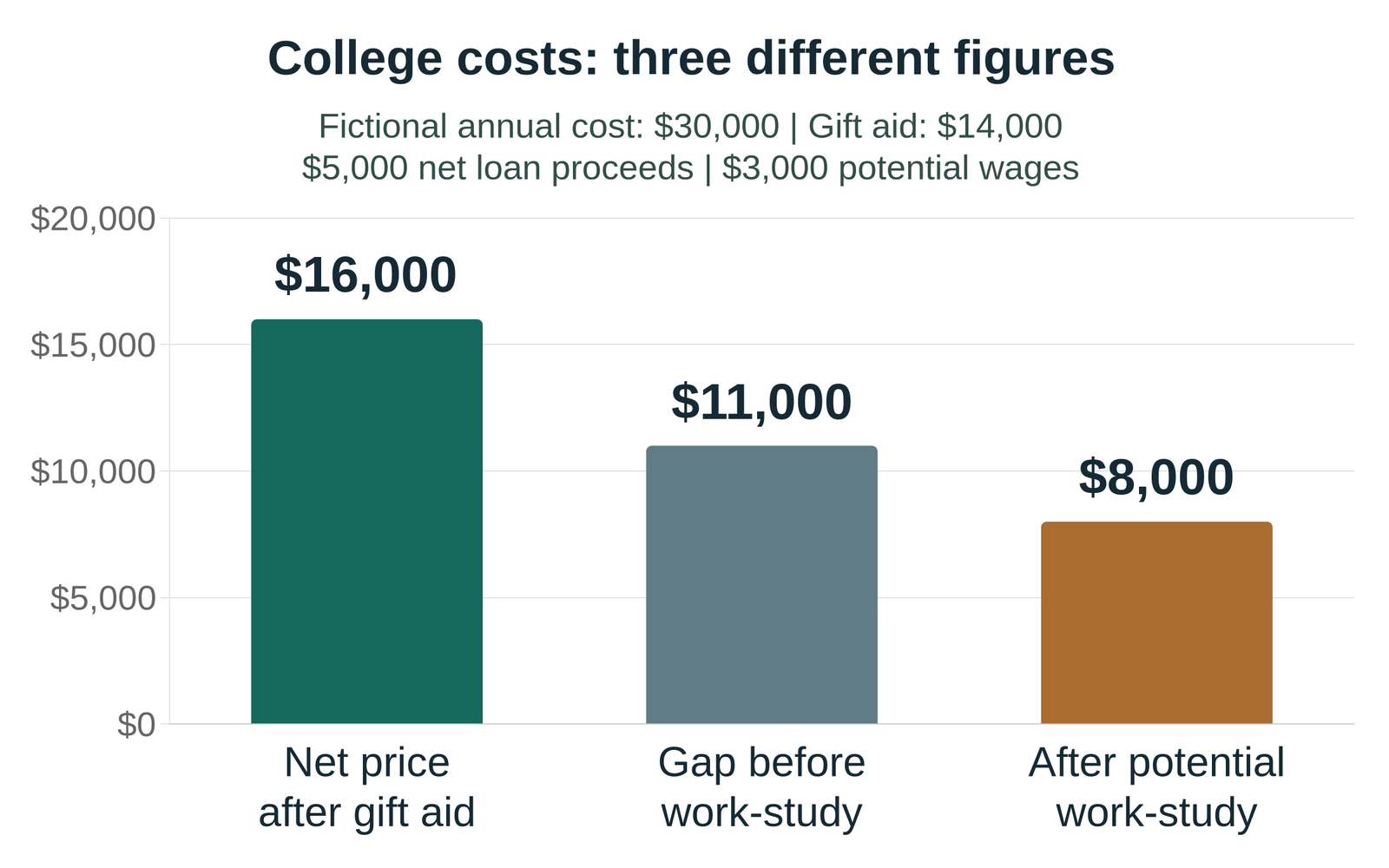
A fictional college has a $30,000 annual cost, a $12,000 grant and an additional $2,000 scholarship. The student plans to use $5,000 of net loan proceeds and may earn up to $3,000 through work-study. For this example only, the gross loan is $5,000 and the assumed withheld fee is $0, so net proceeds are also $5,000.
| Measure | Calculation | Amount |
|---|---|---|
| Net price after all grants and scholarships | $30,000 − $12,000 − $2,000 | $16,000 |
| Funding gap before work-study | $16,000 − $5,000 net loan proceeds | $11,000 |
| Potential work-study earnings | Must be earned through employment | $3,000, not upfront cash |
| Remainder after potential work-study | $11,000 − $3,000 | $8,000 |
If a loan fee is withheld: A $5,000 gross loan with an illustrative $50 fee supplies $4,950, not $5,000, toward costs. Enter $4,950 in the net-loan-proceeds field. The primary gap becomes $11,050 and the remainder after potential wages becomes $8,050. The $50 is an invented example, not a current federal loan-fee quote.
Confirm the net disbursement and its date with the school. Federal Student Aid explains that work-study requires employment and is not guaranteed.
How to read this comparison
Net price is annual cost minus both gift-aid fields. Funding gap before work-study then subtracts net loan proceeds. Remainder after potential work-study also subtracts the earnings entered. All three displayed remainders are floored at zero; a zero does not identify an overaward or guarantee that a bill is funded.
The interactive comparison does not include savings, family contributions or other confirmed funds. Use the college-aid workbook to record those separately. Neither tool models the college bill, disbursement dates, loan repayment costs or future-year eligibility.
Check funding timing and scholarship renewal
Match the money to the due date. Grants and loan proceeds can be scheduled for a different date from the college bill. Ask which amounts will actually be credited by each deadline. Potential work-study wages cannot fill an upfront gap until the work is performed and the pay is accessible.
Use the same definitions across tools. The workbook uses net loan proceeds and shows both the funding gap before work-study and the remainder after potential work-study. Its additional confirmed nonborrowed-funds column can reduce both gaps. Record earned, accessible wages once as confirmed funds and remove that amount from the potential-earnings field.
Test a later year. If the example’s $2,000 additional scholarship is not renewed while other assumed costs and grants remain unchanged, net price rises from $16,000 to $18,000. Check renewal conditions and allow for costs or eligibility to change; this is a scenario, not a prediction.
Before committing, obtain these documents
- The school’s itemized cost of attendance for the same enrollment year, housing situation and student status used in the comparison.
- Written grant and scholarship award terms, including whether an award is renewable and any grade, enrollment or income conditions.
- The federal and private loan terms actually available to this student, distinguishing debt from gift aid.
- Separate due dates for the college bill, aid disbursements and realistic work-study wages; estimated earnings are not upfront funds.
- Any required deposits and non-billed expenses such as transportation, supplies or housing that may differ between schools.
Review Federal Student Aid’s offer-evaluation guidance and confirm unclear items with each school’s financial-aid office. Use the fictional college-aid case to stress-test scholarship renewal, then record verified figures in the college comparison worksheet. This calculator does not determine eligibility or replace an actual aid letter.