Gifted Stock Basis: Three Sale Outcomes Explained
Follow three alternative sales to see when donor basis, gift-date value or the neither-gain-nor-loss result applies to the same fictional gift.
Estimated reading time: 3 minutes
Gifted investment stock can have one basis for figuring gain and another for figuring loss when its gift-date value is below the donor’s adjusted basis. In the example here, a sale between those two figures produces neither gain nor loss for this calculation.
That result is easy to miss if a worksheet stores only one “cost” figure. Keep the donor’s adjusted basis and the gift-date fair market value together, and identify which calculation the sale actually requires.
The two records the gift rule needs
IRS Publication 551, revised December 2025, explains the rule under “Property Received as a Gift” and “FMV Less Than Donor’s Adjusted Basis.” In that situation, the donor’s adjusted basis supplies the starting basis for gain; gift-date fair market value supplies the starting basis for loss. Required later adjustments still matter.
The publication also explains the middle case: if the gain-basis calculation produces a loss, but the loss-basis calculation produces a gain, neither result applies. This is not permission to choose whichever basis produces the preferred answer.
One gift, three alternative sales
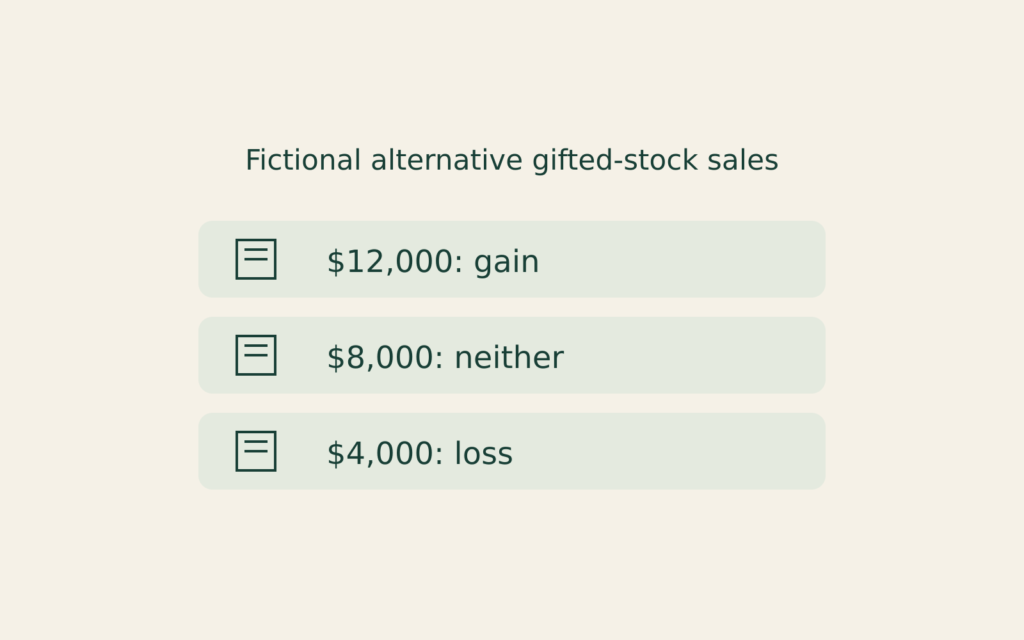
Assume an individual receives ordinary investment stock as an outright gift from a nonspouse in 2025. Records establish the donor’s adjusted basis as $10,000 and gift-date fair market value as $6,000. No gift tax, retirement account, trust, selling costs, other transactions or basis adjustments apply. Each sale below is an alternative sale of the same hypothetical holding to an unrelated buyer.
| Sale proceeds | Relevant comparison | Result in this example |
|---|---|---|
| $12,000 | $12,000 − $10,000 gain basis | $2,000 gain |
| $4,000 | $4,000 − $6,000 loss basis | $2,000 loss |
| $8,000 | Between $6,000 and $10,000 | Neither gain nor loss |
For the $8,000 sale, using $10,000 gives a $2,000 loss. Using $6,000 gives a $2,000 gain. The dual-basis rule does not let either of those results stand in these facts.
“Neither” does not mean no cash changed hands
The middle sale still produces $8,000 of proceeds. “Neither gain nor loss” describes the result of the specified tax-basis comparison. It does not erase the proceeds or describe every economic comparison someone might make with the donor’s original investment or the value at the gift date.
The example also does not determine an allowable net capital-loss deduction or tax owed. Those questions require facts beyond these three isolated sale comparisons.
Records to gather before applying the example
- The donor’s adjusted basis: identify the holding transferred and the basis immediately before the gift.
- Gift-date value: keep evidence for the fair market value and the relevant date.
- Transfer circumstances: establish whether gift tax or a different transfer arrangement requires rules outside this example.
- Later history: keep any transactions or adjustments affecting the holding before its sale.
- The actual disposal: reconcile the shares sold and proceeds, and address selling costs rather than silently assuming they are zero.
A gift and an inheritance are different starting questions. If the shares arrived from an estate, use our inherited stock valuation example instead of assuming the gift rule applies. For a later share split, see the stock split and partial-sale basis guide.
These are fictional, scoped examples of the December 2025 publication’s rules, not a basis determination for a particular taxpayer.


Roth Conversion and Account Clocks
Separate five-year tests.

ABLE Distributions Across Month-End
Separate retained purposes.