Inherited Stock Basis: Why the Valuation Date Matters
Separate original cost, the applicable estate valuation, delivery-date value and sale proceeds before calculating the gain in this inherited-stock example.
Estimated reading time: 3 minutes
Inherited stock does not always receive a higher basis. The applicable estate valuation can be below the decedent’s cost, and the value when the shares reach the beneficiary is not automatically the basis.
Start by labeling each dated amount. The purchase record, estate valuation, later delivery value and sale proceeds answer different questions. Substituting one for another can change the apparent result before any tax rate is considered.
Which valuation does the source describe?
Under “Inherited Property,” IRS Publication 551, revised December 2025, describes several possible basis rules. These include date-of-death fair market value and, when applicable, an alternate valuation chosen for the estate. It also explains estate-basis consistency requirements and exceptions.
The worked example below has already resolved those questions: the applicable date-of-death value is also the finally determined estate-tax value required under the consistency rules. No alternate valuation applies. Do not use this assumption to decide the valuation for another estate.
Worked example: four figures, one stated basis
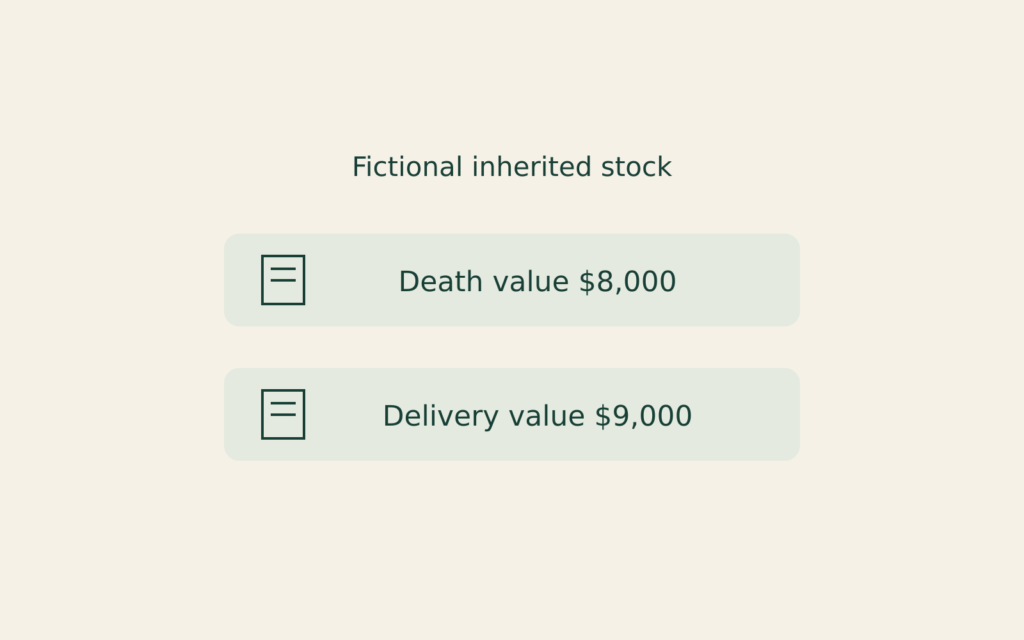
Assume an individual inherits ordinary investment stock in 2025 from its sole owner, outside any retirement account or trust. The decedent paid $12,000. The applicable date-of-death fair market value is $8,000. Neither the recipient nor their spouse gave the stock to the decedent.
When the stock is delivered later, its market value is $9,000. The recipient subsequently sells it for $10,000, with no selling costs or intervening basis adjustments.
| Record or event | Amount | Role in this example |
|---|---|---|
| Decedent’s original cost | $12,000 | Historical cost; not the recipient’s stated basis |
| Applicable date-of-death valuation | $8,000 | The recipient’s basis under the resolved facts |
| Later delivery-date market value | $9,000 | A later market observation, not a replacement basis |
| Subsequent sale proceeds | $10,000 | The amount compared with basis |
The gain is $10,000 − $8,000 = $2,000. Neither the $12,000 original cost nor the $9,000 delivery value replaces the established $8,000 basis in this case.
Why “step-up” can be an incomplete label
The original cost here exceeds the applicable valuation. Describing every inherited holding as receiving an increase in basis would therefore misdescribe this example. Use the applicable valuation and transfer facts, not the direction implied by a familiar phrase.
The $2,000 gain is not the tax owed. No tax rate or full return is supplied, and the example assumes away selling costs and later adjustments.
Checks before using a real inherited-stock figure
- Confirm how the shares were received. This example concerns an inheritance, not an ordinary lifetime gift, trust distribution or retirement-account holding.
- Identify the applicable valuation. Establish the date and any estate valuation or consistency requirement before selecting a number.
- Match the valuation to the shares. Keep the estate and transfer records with the particular holding.
- Carry forward later changes. Do not assume the basis stays unchanged if the holding’s later history requires adjustments.
- Separate sale proceeds from valuation records. A brokerage or transfer statement’s later market value has a date and purpose of its own.
For the contrasting lifetime-transfer case, read gifted stock’s gain and loss bases. For the effect of a later split on a holding, see stock split and partial-sale basis.
The numbers are illustrative. The applicable source and an estate’s actual facts must establish its valuation; this page does not establish another estate’s basis or tax result.


Roth Conversion and Account Clocks
Separate five-year tests.

ABLE Distributions Across Month-End
Separate retained purposes.