Loan Denial Notice: What to Check Before Applying Again
Read a personal-loan denial notice, separate lender reasons from score factors, and track report requests and evidence before applying again.

Estimated reading time: 9 minutes
After receiving a personal-loan denial notice, save the complete document and identify what the lender actually decided. Then match each stated issue to the record that can answer it. A new application isn’t a substitute for understanding an unresolved question.
This checklist is for U.S. consumer personal-loan applications. Keep your notes privately; don’t send denial notices, credit reports, identification documents or account details to EasyLoanWorld.
Loan denial notice: identify the action and application
Keep every page, the envelope or delivery record, and relevant application messages. Check the lender, product and application reference before acting, especially if you recently made several requests.
A notice of incompleteness specifies missing information and a response period. Don’t assume that request is a denial; read the action and deadline carefully. Regulation B addresses these notices separately.
Make a short notice inventory:
- Lender, product and date you applied.
- Action described, notice date and date received.
- Private application reference, without copying sensitive identifiers into a shared document.
- Reasons supplied or instructions for obtaining them.
- Reporting company and report or score date, if shown.
- Outstanding question and the next step you need to take.
If something is missing or unreadable, ask the lender for the complete information. Don’t fill a gap by guessing what a generic phrase means for your application.
Separate the decision, score information and report instructions
For consumer credit denials, Regulation B generally requires specific principal reasons or notice of how to request them. Credit-score factors don’t replace the lender’s actual denial reasons.
When a decision relies wholly or partly on a consumer report, federal law requires reporting-company contact information and an explanation that the company did not make the decision and can’t supply the lender’s specific reasons. Disclosure of a numerical credit score is conditional on a score actually being used in the adverse action.
Read the document in three passes. Mark the lender’s reasons first. Next, identify any score section. Finally, locate report-request and dispute instructions. Put a question mark beside anything you can’t confidently place.
The practical question is: “Which organization has the record I need to understand this issue?” Keep that question separate from “Will someone approve me?” The first helps you gather evidence; the second can’t be answered by this checklist.
Loan denial notice: track the two request routes
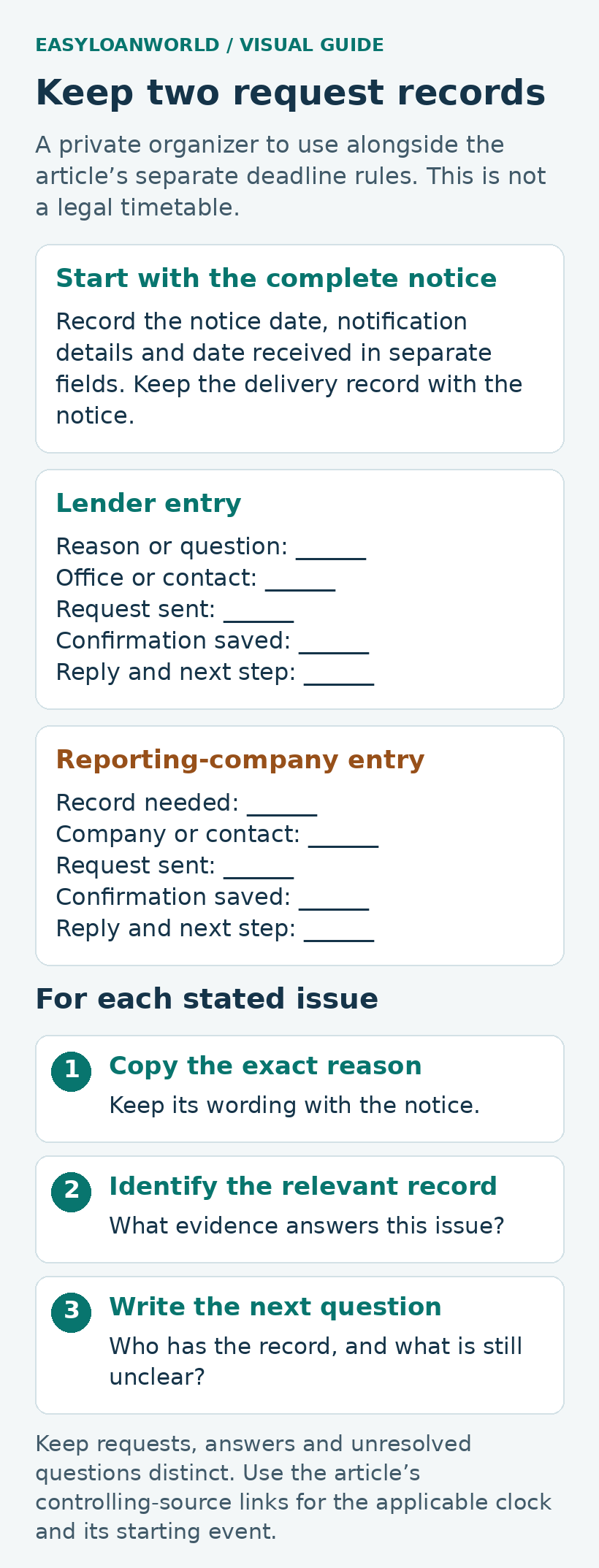
| Question | Reasons from the lender | Qualifying free report |
|---|---|---|
| Who receives the request? | The lender’s identified person or office, when the notice offers reasons on request | The consumer reporting company named in the report-based denial notice |
| What starts the request clock? | The creditor’s notification: delivery or mailing, or the applicable oral communication | Your receipt of the notice |
| What is the request window? | Within 60 days of that notification | No later than 60 days after receipt |
| What does it obtain? | The specific reasons, which the lender must provide within 30 days of the timely request | The qualifying free consumer report; this is not the lender’s decision explanation |
| What record should I keep? | Notification evidence, request date, recipient, confirmation and response | Notice-receipt evidence, request date, company, confirmation and report received |
Don’t assume the two 60-day periods end on the same date. Keep evidence of both notification and receipt, act promptly and follow the applicable notice instructions. Neither row is a general deadline for every dispute or a promise of reconsideration.
Request the reasons from the lender
If the notice offers reasons on request, request them within 60 days of the creditor’s notification; the lender must provide them within 30 days of your request. Notification occurs when the notice is delivered or mailed, or when the decision is communicated orally. It isn’t necessarily when you read a mailed notice. See section 1002.9(a)(2)(ii) and its interpretation.
Use the identified person or office and retain your request confirmation. Act promptly rather than planning around the final day. Record: request sent, recipient, confirmation reference, response received and remaining question.
You can ask: “Please identify the specific reasons for this application decision and how I can obtain them in writing. If an application detail was entered incorrectly, which office should review it?” Follow the notice’s request instructions; this suggested wording isn’t a mandatory form.
Request the qualifying free report from the reporting company
For a report-based denial, request the qualifying free report from the reporting company named in the notice no later than 60 days after receiving the notice. This receipt-based rule appears in 15 U.S.C. 1681j(b). It isn’t a general deadline for disputing all reporting errors.
Keep a separate entry for that request: company, notice received, request sent, confirmation and report received. Preserve both notice and receipt dates rather than treating them as interchangeable.
Ordering a report doesn’t itself ask the lender to reconsider. Asking the lender for reasons doesn’t itself obtain the reporting company’s file. Neither request is a promise that an application issue will be resolved within the request window.
Loan denial notice: match each reason to evidence
Give each stated reason its own four-line note:
- The exact reason as provided.
- The record that supports it or makes you question it.
- The organization with the relevant record.
- The question asked, reply received and remaining next step.
If a credit-report entry may be wrong
Follow the CFPB’s official dispute instructions. Filing a dispute doesn’t establish that the entry is wrong or guarantee removal.
If the application or verification record may be wrong
Compare the submitted answer with the underlying record. Ask the lender how to correct or clarify it and whether the original application can still be reviewed. Keep the original submission and any correction distinguishable. Never alter evidence to produce a preferred answer.
If the information is accurate
Consider what can realistically change and whether borrowing still fits your situation. Don’t label accurate information an error simply because the decision was disappointing. An explanation can help you make a better next decision without producing an immediate route to approval.
A fictional example: two reasons need two checks
Imagine an applicant receives two reasons: monthly obligations are high relative to documented income, and one stated income source couldn’t be verified. These are invented facts, not a lender’s universal approval standard.
The applicant’s evidence plan has two parts. First, ask which obligation and income figures were used and compare them with the records. Second, locate the requested evidence for the unverified income source and ask what further review the lender permits.
If the figures are accurate, the next decision is about the borrowing need and budget. Resolving the verification question wouldn’t by itself establish that the other reason disappeared. Changing a score alone wouldn’t answer both questions either.
Close each loan denial notice question with evidence
Extend the fictional two-reason example into a follow-up record. Suppose the applicant asks about both the obligation calculation and the missing income verification. A reply confirming receipt of documents closes neither issue by itself. Record what the reply actually says and which question it answers.
For the obligation reason, an entry might read: “Lender confirmed the listed monthly obligations; I checked the same amounts against current records; no factual difference identified.” For verification, the entry might read: “Requested document supplied; receipt confirmed; review outcome not yet received.” These are invented statuses, not instructions for what any lender must accept.
The two entries lead to different next steps. The first directs attention to whether the proposed payment and borrowing need fit the budget. The second remains an open evidence question until the lender explains its review. Neither supports writing “denial fixed” or treating an application as approved.
Use four status labels in your private loan denial notice tracker: not requested, requested, response received and question resolved. A response can arrive while the question remains unresolved. Add a short explanation whenever you mark an issue resolved, such as the corrected figure, the source confirming it or the lender’s written explanation that no correction was made.
Keep request dates separate from any reminder date you choose for yourself. A personal reminder isn’t a new legal deadline, and a follow-up message doesn’t automatically extend a request period or reopen an application. Preserve the original notice instructions while seeking clarification.
Before any fresh application, make a one-paragraph change note: what is now different, which evidence supports that change and which reasons remain unchanged. If the answer is only “I hope another lender says yes,” the record hasn’t yet supplied a concrete reason to expect a different result. You can still reconsider the borrowing need without treating a new application as the next required step.
Decide what you need to know before reapplying
- What has specifically changed, and what evidence shows it?
- Is a factual dispute or verification question still unresolved?
- Does this lender allow reconsideration or require a new application?
- What is its stated reapplication policy?
- Would another request involve a new credit inquiry or fresh documentation?
- Does the remaining borrowing need and payment still fit your budget?
Get the lender’s actual answers instead of assuming a standard waiting period or applying repeatedly without new information.
If you suspect unfair treatment or need help understanding a report-based denial, consult the CFPB’s denial guidance and complaint resources. A complaint isn’t a guarantee of reconsideration, approval or compensation.
General U.S. consumer education, not individual legal advice. Request rules and supporting guidance rechecked October 25, 2026.
If a stated reason points to inaccurate reporting, use the credit-report dispute tracker to describe the exact entry and supporting evidence.
Featured photo: Photo by Cht Gsml on Unsplash. Used under the Unsplash license. Illustrative stock photograph of blank envelopes. These aren’t actual lender notices or credit records. Photo by Cht Gsml on Unsplash.
Changing Loan Autopay: Check the Notice
Compare the debit and notice.
Approved for a Loan, but Received a Risk-Based Pricing Notice?
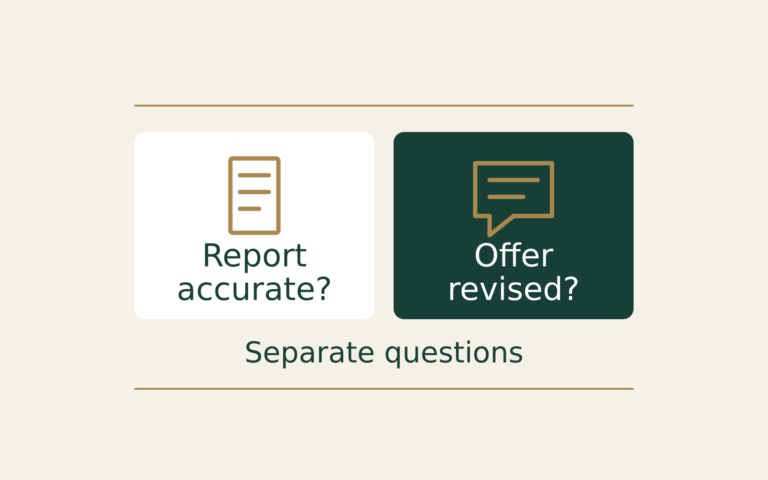
Identify the document and separate report-review questions from the actual loan offer.