Seller-Financed Purchase Problem? Check the Holder Notice
A fictional appliance purchase leaves the legal outcome unresolved.

Estimated reading time: 8 minutes
The FTC Holder Rule comparison starts with the purchase contract and its notice. Trace the seller complaint and any assignment before deciding which questions to raise.
A seller-financed purchase can involve a creditor other than the store after the contract is assigned. The FTC Holder Rule requires a notice preserving claims and defenses against holders in covered consumer-credit transactions. Its definitions concern personal, family or household purchases and exclude a creditor acting as a credit-card issuer in that transaction.
The FTC’s May 2012 opinion explains the limit: the rule preserves existing claims; it doesn’t create a claim just because a purchase disappoints you. Depending on the underlying law and facts, a preserved claim can support a defense against payment or an affirmative claim seeking money back.
FTC Holder Rule: follow one fictional purchase
Assume a retailer finances a washing machine for household use under a covered installment contract containing the Holder Notice. A confirmed assignment record identifies Finance Company F as the contract’s new holder. The machine allegedly fails on delivery. The buyer has photographs, a repair ticket and the seller’s written refusal to repair it. No court or adviser has decided whether those facts establish a legal claim.
Three links to check
First, match the credit contract to the seller, purchased item and Holder Notice. Then match the assignment record to that same contract and current holder. A billing company’s name alone doesn’t resolve the ownership question.
Next, connect the complaint to the seller’s promised performance: the order, warranty terms, delivery evidence, repair history and responses. These records help evaluate the underlying claim; possessing them doesn’t guarantee that the seller or holder is legally liable.
In this file, the purchase and transfer links are supplied, but the merits remain open. Label those conclusions separately. Replacing “claim not yet evaluated” with “refund approved” would add a result the example never established.
Keep the remedy question separate
The notice limits monetary recovery based on it to amounts paid under the contract. That’s a ceiling on that recovery route, not a promise to refund every payment. The FTC’s January 2022 statement explains that separate-law rights aren’t eliminated; an independent legal basis can matter for other remedies, costs or attorney fees. Don’t treat the notice’s limit as a universal cap on every possible claim.
A payment defense and a claim for money back are different requests. Get qualified consumer-law advice about the actual claim and payment obligations before withholding payments or treating the debt as canceled. This guide doesn’t decide either question.
If the notice or transfer link is missing, seek help identifying the applicable contract and transaction. A missing document isn’t, by itself, a legal answer about coverage.
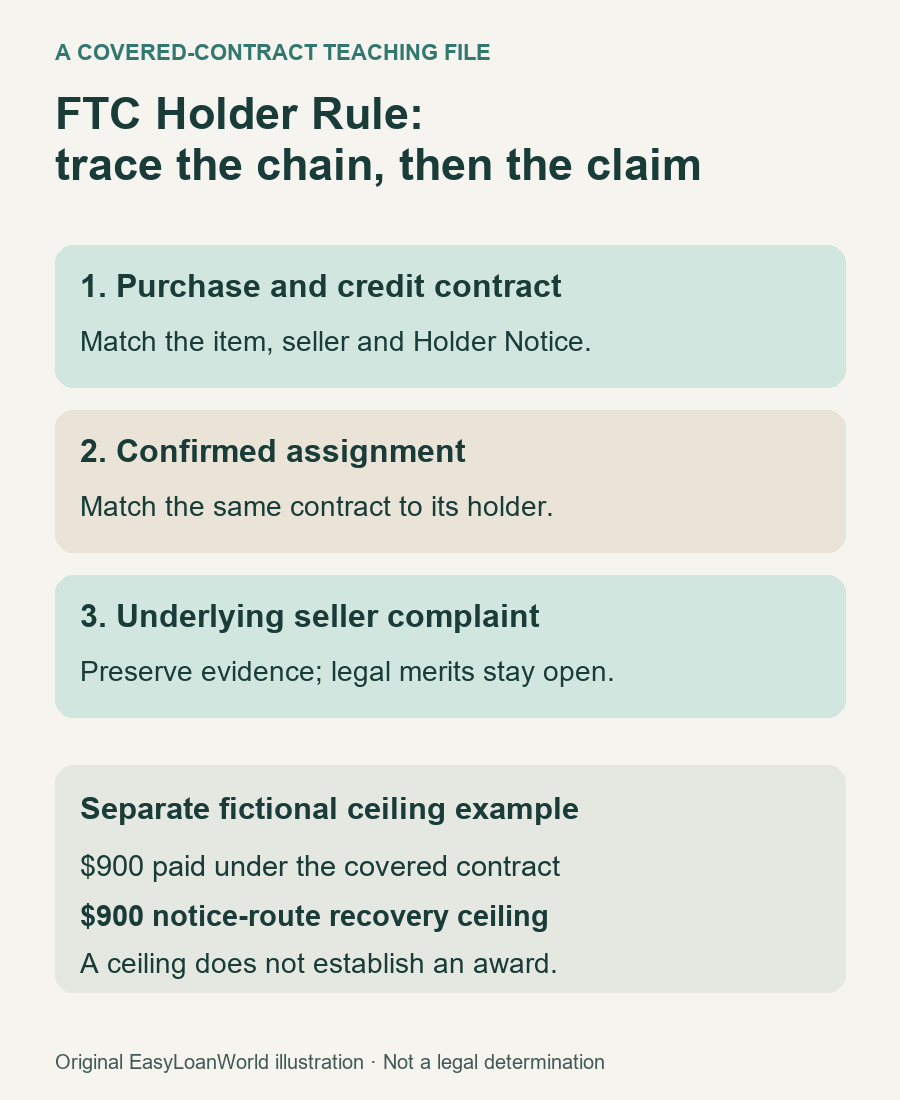
FTC Holder Rule: build the transaction chain
Use three separate links: the purchase, the credit contract and the assignment. The first identifies the item and seller promise. The second connects the financing and notice to that purchase. The third identifies the current holder.
In the washing-machine example, match the order and delivery record to the financed item. Then match the contract reference to the assignment record naming Finance Company F. Don’t rely on a familiar logo or similar account nickname alone.
A payment processor or billing contact may be another participant. A name on a bill should be investigated against the contract records before being treated as proof of ownership.
The fictional example supplies the assignment link. If a real file lacks it, mark the holder identity unresolved and seek clarification. Don’t manufacture a transfer history to make the chain look complete.
Keep the product complaint factual
The assertion that the machine failed on delivery is an allegation in this teaching file. Organize what the buyer observed, what the repair ticket says and what the seller actually promised or refused.
A photograph, repair ticket and refusal may be relevant evidence, but the article doesn’t decide whether they establish a breach or another legal claim. The underlying law and complete circumstances require review.
For a neutral note, identify the observed problem, date, supporting item and unanswered question. Avoid replacing the repair professional’s wording with a stronger technical conclusion or attributing a promise that’s absent from the contract.
Preserve the seller’s response in its original form. A summary can help index the file, but it shouldn’t replace the source or omit conditions that affect what was actually offered.
FTC Holder Rule: distinguish a ceiling from an award
For a separate fictional arithmetic illustration, suppose records confirm $900 paid under a covered contract. The notice’s amounts-paid ceiling for recovery based on that route would be $900.
That ceiling isn’t a finding that $900 must be returned. The illustration hasn’t established an underlying claim, remedy, liability or award. A maximum and an amount actually recoverable answer different questions.
If another independent file instead shows $1,200 paid, the corresponding amounts-paid ceiling would be $1,200. Changing the input changes the ceiling; it doesn’t cure missing evidence of the claim.
Don’t replace amounts paid with the purchase price or unpaid balance simply because those are larger figures. Identify the actual payment record relevant to the notice, and obtain advice on any unclear legal treatment.
The separate-law point described above also remains important. This narrow ceiling illustration doesn’t determine the availability or limits of another independent remedy, costs or attorney fees.
Separate money already paid from money still requested
For an independent ledger example, assume a buyer has paid $900 and a current bill requests $1,500 more. Those two numbers are different records. Adding them gives $2,400 of combined paid-and-requested amounts, not $2,400 already paid.
Similarly, subtracting $900 from $1,500 doesn’t determine a settlement or remaining legally enforceable obligation. It merely calculates a difference between two labels.
Keep the payment history, billed balance and requested remedy in separate fields. A legal adviser can then assess the actual contract and claim without first disentangling numbers combined in the worksheet.
This article doesn’t instruct a buyer to withhold the requested payment. Seek qualified consumer-law advice about the actual obligations and available process before taking that action.
Write the question before choosing a remedy label
A defense to payment and a request for money back are different legal aims. Identify what the buyer wants reviewed, while leaving the available remedy to the applicable facts and law.
For the fictional file, a useful opening question is whether the documented seller conduct supports an underlying claim and how the covered contract’s notice affects the holder. That’s more precise than declaring the debt canceled.
If the buyer wants reimbursement of a particular payment, identify the date, amount and supporting record. Don’t label every cost connected with the purchase an amount paid under the credit contract without checking.
A demand for the full purchase price, added costs and fees requires its own legal basis. The notice’s presence alone doesn’t establish all requested components.
Keep the covered-transaction question visible
The guide’s scope is a covered consumer-credit transaction, not every disappointing purchase or every card transaction. Retain the purchase purpose, financing documents and notice when seeking advice.
If the payment involved a credit-card issuer acting in that role, don’t automatically apply the seller-financing example. The original guide identifies that exclusion and links a different billing-error discussion for separate review.
A missing notice or uncertain contract doesn’t settle the legal coverage question by itself. Ask the appropriate adviser to assess the actual transaction rather than treating the worksheet’s missing entry as a legal verdict.
Likewise, the fictional household washing machine shouldn’t be silently converted into business equipment while retaining every consumer-credit assumption. A change in transaction purpose requires a fresh scope check.
Preserve the response and what it actually resolves
If the holder or seller acknowledges the complaint, record receipt separately from investigation and outcome. Acknowledgement doesn’t establish liability, an agreed refund or cancellation of the financing.
If an offer arrives, preserve its actual terms and ask qualified counsel about its effect before treating it as a complete remedy. A proposed amount and an accepted resolution are different stages.
Keep each response connected to the contract and complaint it addresses. A household may have several transactions with the same seller or finance company; a response about one shouldn’t close all others.
The completed FTC Holder Rule file should show the purchase chain, notice, assignment, factual complaint, payment record and unresolved legal questions. Its purpose is to support accurate review without inventing a claim or promised recovery.
For a final check, have another reader identify the seller, contract, holder, allegation and unresolved merits without assuming a refund. If the reader can’t distinguish a supported link from a legal conclusion, clarify the index before using it in a substantive discussion.
Sources: Holder Rule; FTC 2012 opinion; FTC 2022 statement.
For a separate dealership-contract change, see comparing changed dealer financing documents. For a credit-card billing problem, use the credit card billing-error guide; don’t assume the same route applies to both transactions.

Parent Pays Student Loan Interest: Who Deducts?
Separate payment and obligation.

Returned Loan Debit: Two Fees?
Trace the payment and fees.

Rehabilitation Payment Too High?
Check an alternative request.