Shorter vs. Longer Personal Loan Terms: Choose a Repayment Timeline
Compare repayment timelines with an original $10,000 example and a worksheet for checking required payments, extra-payment rules and your payoff date.
Estimated reading time: 9 minutes
Personal loan terms · U.S. personal loan education • Sources checked October 25, 2026
A shorter personal loan term usually trades a higher required payment for an earlier finish. When principal, fixed interest rate and fees are equal, a shorter fully amortizing schedule also costs less interest. A longer term lowers the required payment but keeps the commitment on your calendar longer. Actual offers may change the rate and charges along with the term, so compare the written schedules rather than assuming that one term is always better.
The useful question is: Which repayment timeline can I maintain, including months when I make no extra payment? Start with an affordable payment limit already worked out from your household finances. This guide helps you choose the timeline, rather than calculate that limit again.
Personal loan terms: what changes with the timeline?
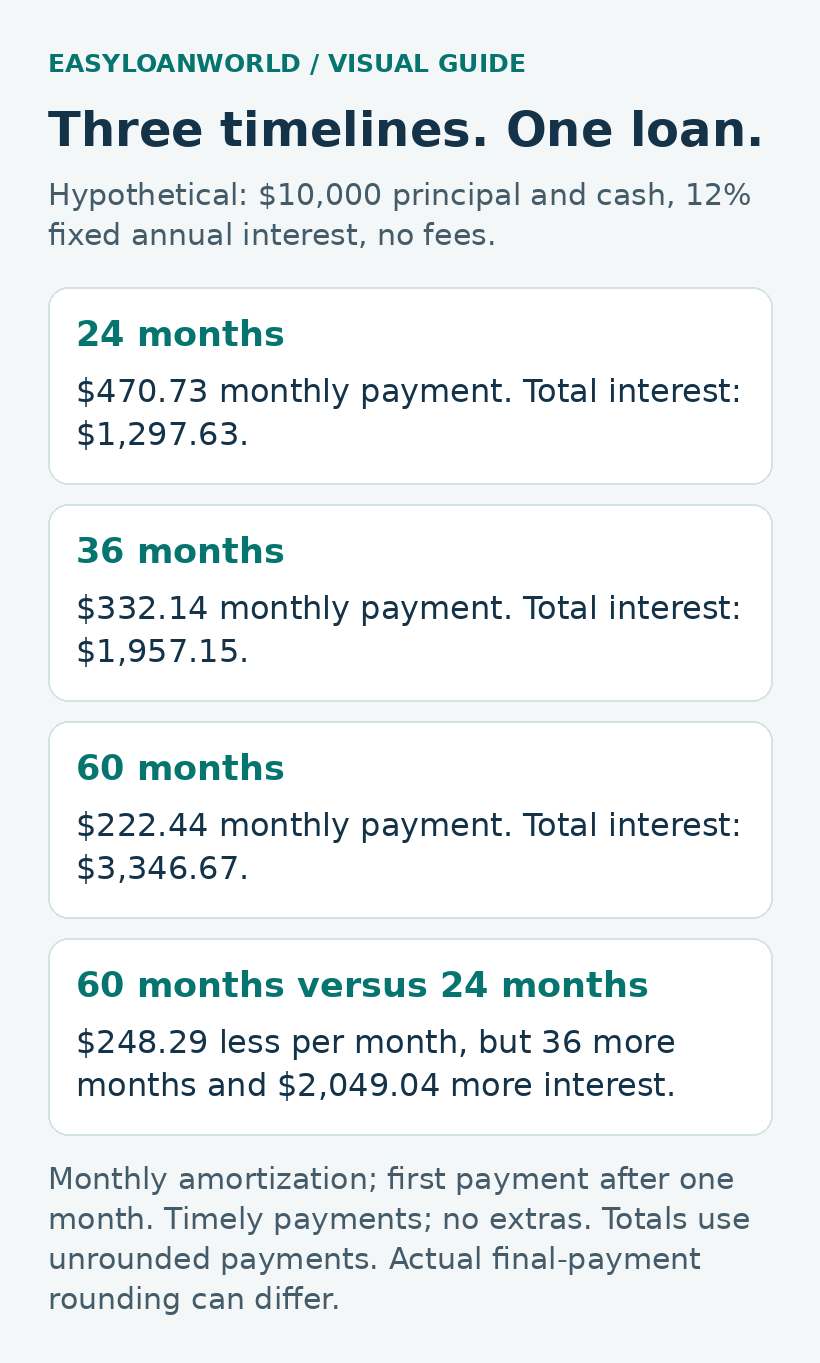
Here’s an original hypothetical comparison, not an available loan offer. Each option provides $10,000 of usable cash and has $10,000 principal, a fixed 12% annual contract interest rate, monthly amortization and no fees or optional products. The first installment is due one month after funding. All payments arrive on time.
| Repayment term | Monthly payment | Total scheduled payments | Total interest |
|---|---|---|---|
| 24 months | $470.73 | $11,297.63 | $1,297.63 |
| 36 months | $332.14 | $11,957.15 | $1,957.15 |
| 60 months | $222.44 | $13,346.67 | $3,346.67 |
Choosing 60 instead of 24 months reduces the displayed monthly requirement by about $248.29. It also adds 36 scheduled months and approximately $2,049.04 in interest. Those are three different consequences. The smaller payment does not make the extra interest disappear; the lower interest total does not prove that $470.73 fits your finances.
Calculation note: monthly rate r = 0.12 ÷ 12, and n is the number of monthly payments. Payment = principal × r ÷ [1 − (1 + r)−n]. Totals use unrounded payments, so multiplying the displayed rounded payment by the term won’t reproduce every total exactly. Actual accrual dates and final-payment rounding may differ. The model uses contract interest, not a fee-inclusive APR.
Reproduce the comparison with your actual offer
Open the loan payment calculator and enter $10,000 principal, 12% annual contract interest and 24 months. Repeat for 36 and 60 months, keeping principal and rate unchanged. The exercise shows the effect of the term alone.
For a real comparison, replace every input with the particular offer’s figures. The calculator uses gross loan principal and a fixed contract interest rate. It doesn’t reconstruct a fee-inclusive APR or automatically deduct an origination charge from proceeds. If a lender deducts $400 from a $10,000 note, only $9,600 is available to spend; compare that usable amount with what you actually need.
Record the calculator’s scheduled payment and interest estimate beside the lender’s disclosed payment and total of payments. A difference is a question to resolve, not permission to substitute the more attractive figure. Dates, financed fees, payment frequency or interest calculation can explain why a real contract differs from a monthly model.
Personal loan terms: compare the balance at month 24
The lifetime-cost table answers what each schedule costs if completed as agreed. A second checkpoint shows how much debt remains at the same future date. Use the loan payment calculator below with $10,000 principal and 12% annual interest. Run 24, 36 and 60 months separately, changing only the term, then open the calculation table and find payment 24.
| Original term | Remaining principal | Scheduled payments left |
|---|---|---|
| 24 months | $0.00 | 0 |
| 36 months | $3,738.30 | 12 |
| 60 months | $6,697.25 | 36 |
These personal loan terms use the same no-fee assumptions as the first table: fixed monthly amortization, on-time payments and no extra principal. The model carries precision internally and rounds the displayed amounts. Small differences can arise when a lender rounds every scheduled installment or accrues interest by actual days.
A lower amount paid during the first two years doesn’t establish a lower total cost when a substantial balance remains. Read the remaining principal beside the monthly payment and the original lifetime interest figure. Don’t label that balance “future interest”: it’s unpaid principal, while future interest would arise as the remaining schedule runs.
If you expect to sell an asset, change jobs or repay early around month 24, ask for a dated payoff quote when the time comes. The table’s balance is a planning checkpoint, not a payoff demand. Accrued interest, payment posting dates and contract charges can make the lender’s actual amount different. Comparing personal loan terms this way makes the length of the remaining commitment visible.
Put the last payment on a real calendar
Write the first and final scheduled payment dates beside each offer. Then mark known changes between them: an expected move, the end of a temporary work assignment, a planned reduction in hours, or another commitment that starts later. You’re checking the duration of the obligation, not predicting every future expense.
Use two columns in your notes: “already arranged” and “possible.” A signed change in working hours belongs in the first column. A hoped-for promotion belongs in the second. Don’t make an otherwise unworkable schedule depend on an uncertain raise, bonus, refinance or asset sale.
Try finishing this sentence for each option: “If I pay only the required amount, this loan ends in ___, and the main change I must plan around before then is ___.” A blank answer is a reason to inspect the timeline more closely, not a reason to assume nothing will change.
Can you take a longer term and pay extra?
Extra payments depend on your agreement. For covered loans, federal disclosures address schedules, total payments and prepayment terms. Read the agreement and CFPB Regulation Z §1026.18(g), (h) and (k).
Before counting on extra payments, send the lender a specific question: “If I pay more than the required installment, how is that amount applied, and what do I need to do to have the extra amount reduce principal?” Ask whether a payment also advances the next due date; principal reduction and a changed due date aren’t necessarily mutually exclusive.
Request confirmation of the interest calculation method, any early-payment charge, whether your required installment stays the same, and how to obtain a dated payoff amount. Ask what happens to an automatic payment when you make a separate extra payment. Keep the response with your loan documents.
For your own comparison, write two plans: the required schedule and your hoped-for faster schedule. Make the decision viable under the required schedule first. Treat the faster version as an optional outcome that needs both available money and workable contract terms.
What if the extra payments stop?
Suppose the example’s $222.44 required payment fits, and you hope to pay about $332.14 most months. Under the same interest assumptions and appropriate principal allocation, sustained larger payments would repay the balance faster. But a future month with only the required payment still follows the longer contract’s obligation.
Write the required amount into the essential budget and the extra amount into a separate voluntary line. If income falls, recheck what remains due and avoid assuming that previous overpayments cancel the next installment. If the longer term is affordable only because you expect to refinance it later, the original decision still has an unresolved problem.
A four-step decision worksheet
Copy these prompts onto a separate page for each actual offer. Use “unanswered” instead of guessing. Record the document or written lender response that supplies each answer.
1. Copy the schedule
- Creditor and quote date: ___
- Usable cash received and note principal: ___
- Interest rate; fixed or variable; fees; disclosed APR: ___
- Number of installments; first due date; final scheduled due date: ___
- Required installment; disclosed total of payments; separate upfront cash: ___
2. Test the required commitment
- Does this installment pass my previously prepared affordability test? ___
- What known changes occur before the last payment? ___
- Is the plan workable without speculative income or another loan? ___
3. Inspect flexibility
- Where are the early-payment and interest-method clauses? ___
- How are excess payments allocated, and must I give instructions? ___
- What stays due after I overpay, and how do I request final payoff? ___
- Unresolved question, answer source and date checked: ___
4. Record the choice
Write why your chosen timeline works, what additional cost you accept if choosing a longer schedule, and a date to review your plan. More than one offer may pass. Neither may pass. If none works without another borrowing assumption, reduce the amount needed or reconsider the expense plan before committing.
Questions readers often ask
Is the shortest term always best?
No. In the example it has the lowest interest total, but that doesn’t make its higher installment manageable. Choose among schedules you can sustain.
Does a longer term always have a higher rate?
Don’t assume that. Compare the actual quoted rates and schedules. This example holds the rate constant to isolate the effect of time.
Can I shorten the term after signing?
Ask whether extra payments can bring forward payoff under your agreement. Changing the contractual schedule itself is a separate question for the lender.
Does early payoff refund the origination fee?
Don’t include a refund in your plan without checking the agreement, applicable law and lender’s written payoff explanation.
This is general U.S. educational information, not individualized financial or legal advice. The hypothetical comparison doesn’t predict your eligibility or available terms.
If a longer term is paired with extra payments, verify how the lender applies extra principal before counting on an earlier finish.
Featured photo: Photo by cottonbro studio on Pexels. Used under the Pexels license. Illustrative stock photograph of scheduling tools; not an actual loan repayment schedule.
Changing Loan Autopay: Check the Notice
Compare the debit and notice.
Approved for a Loan, but Received a Risk-Based Pricing Notice?
Identify the document and separate report-review questions from the actual loan offer.