Credit Card Payment Worksheet: Two Goals, Four Amounts
Practice reading a fictional credit-card packet, change only the goal, then check your selections and arithmetic against the answer key.

Estimated reading time: 8 minutes
This credit card payment worksheet asks you to match a goal to a supplied field. Keep the fictional snapshot fixed while comparing the two choices.
Credit card payment worksheet: choose the goal
This short exercise asks you to read a supplied packet, select a field and then change just one thing: the goal. Write your two answers before opening the key. You’re comparing alternative decisions at one moment, not making two payments in sequence. Use the linked FAQ while you work, and note the passage supporting each choice.
Scope: Chase Pay Over Time after purchase. Fixed monthly fees replace plan interest. Figures are invented, not account terms.
Exclude balance transfers, other plans, overdue amounts and unresolved discrepancies; consult your agreement and Chase for those accounts. Payments can’t target balances; allocation follows your agreement. Carrying balances may prevent avoiding purchase interest.
The fictional packet
FICTIONAL EXERCISE. Not an account statement or payment instruction.
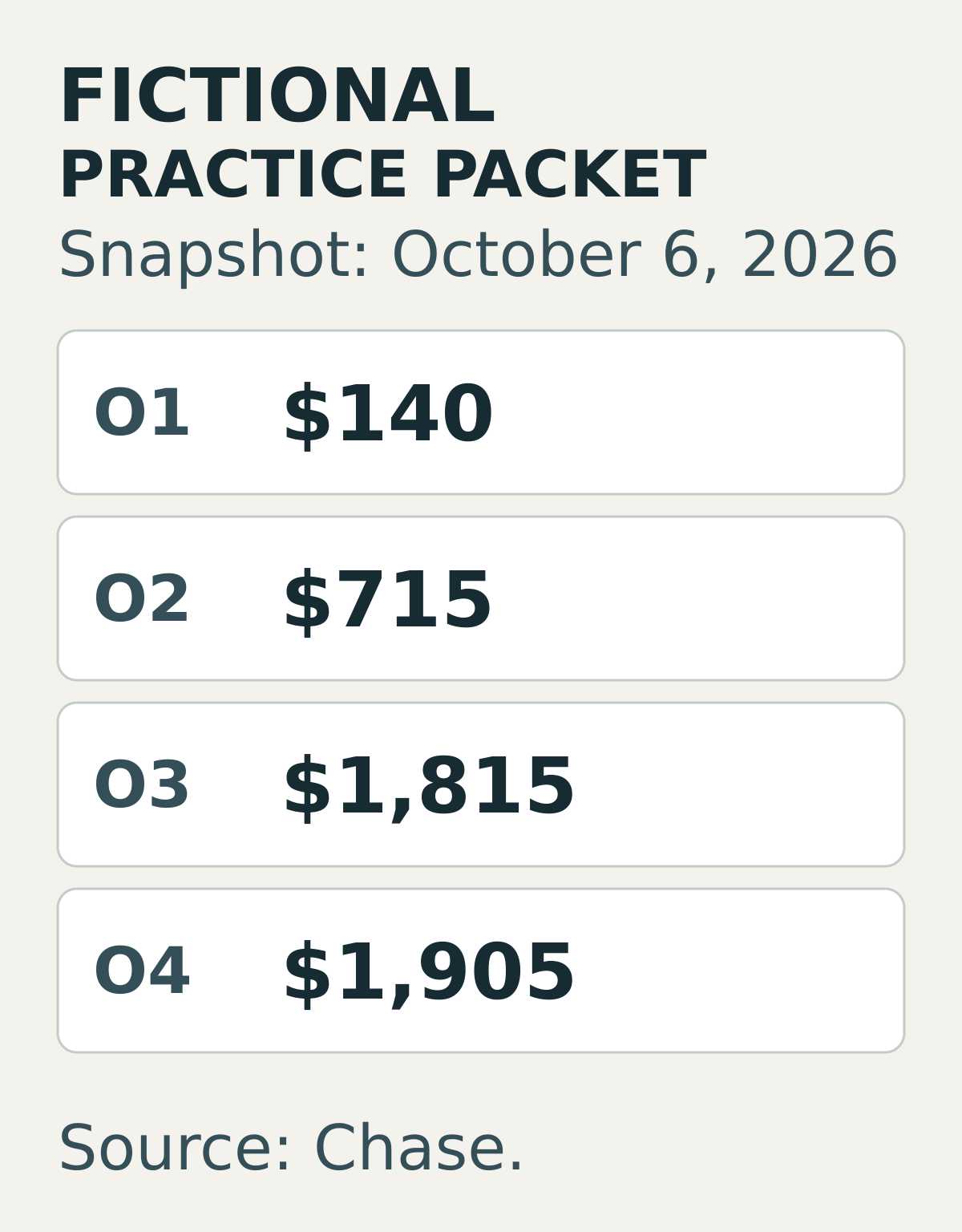
Snapshot: October 6, 2026. Closing date: October 1, 2026. Due date: October 26, 2026. The later purchase posted October 5. Apart from that purchase, no payment or other activity occurred between closing and this snapshot. The unpaid principal below is still outstanding at the snapshot.
The plan already appears on the statement. Early payoff has no penalty or future plan fees; reinstatement is impossible. Assume payment by the due date, without prior unpaid purchases.
Unpaid plan principal: $1,200; scheduled principal: $100; assumed fee: $15; other billed purchases: $600; later purchase: $90.
All four fields are supplied records for this exercise. Don’t calculate a replacement for any of them.
| ID | Field | Amount |
|---|---|---|
| O1 | Minimum payment due | $140 |
| O2 | Interest saving balance | $715 |
| O3 | Statement balance | $1,815 |
| O4 | Current balance | $1,905 |
Your worksheet
Choose the smallest match.
- A: Avoid interest on billed purchases without finishing the plan early. Write the field ID and its amount.
- Keep every date and record unchanged. Change only the goal: B: Finish the plan early. Write the new field ID and amount.
- Subtract the smaller selected amount from the larger. Describe exactly what your answer measures.
- Before applying your answer outside this exercise, name the records you would check and one condition that would make you stop.
Open the answer key
A → O2. B → O3. Interpretation: Chase’s FAQ.
The difference is $1,100. That’s the difference between the two selected cash outflows in this packet, not a calculated lifetime saving. The packet supplies no future-fee schedule for such a calculation.
For the final question, a strong response names the statement, dated account activity, plan record and agreement. Check that their dates and amounts describe the same moment. If they conflict, leave the exercise answer on the worksheet and resolve the real record first.
Score yourself on three things: selecting the matching fields, keeping the snapshot fixed and recognizing when the packet is insufficient. Getting the subtraction right alone doesn’t complete the task.
Credit card payment worksheet: explain all four choices
After selecting the two answers, explain why each other field doesn’t match the stated goal. This is a reading task before it’s a subtraction task. The exercise supplies the fields; the linked FAQ explains their purposes under the stated conditions.
O1 is the supplied minimum payment due. Selecting the smallest dollar amount on the page isn’t the same as selecting the smallest amount that matches Goal A. The goal includes avoiding interest on billed purchases while leaving the plan on schedule.
O2 matches that goal in this packet. O3 matches the separate early-plan-payoff goal because the plan already appears on the statement. O4 also includes the later purchase and exceeds the selected O3 amount.
The task asks for the smallest matching field. It doesn’t say every larger payment would have no effect. Keep that distinction in your explanation rather than treating every unselected amount as inherently invalid.
Credit card payment worksheet: the later $90 purchase
The statement closed October 1. The later purchase posted October 5, and the snapshot is October 6. Under the no-other-activity assumption, the supplied current balance exceeds the statement balance by exactly $90.
The comparison is $1,905 − $1,815 = $90. That reconciles the later purchase with the two supplied fields. It does not change the statement’s closing date or make the later purchase part of the already closed billing period.
Don’t choose O4 solely because “current” sounds more complete. Ask whether the field matches the stated goal in the supplied situation. Completeness of a dated balance and suitability for a particular goal are different issues.
If a new transaction posted after October 6, the original snapshot would still be an exercise record, not a current account statement. A real decision would need fresh account information rather than an edited guess at one field.
Credit card payment worksheet: reconcile the selected difference
The two selected amounts differ by $1,815 − $715 = $1,100. That is consistent with the difference between $1,200 of unpaid plan principal and the $100 scheduled principal portion in the packet.
This consistency check doesn’t authorize reconstructing replacement issuer fields for other accounts. All four amounts here remain supplied records. A different plan, payment history or agreement could require a different account-specific explanation.
The $100 scheduled principal is part of the $1,200 unpaid principal at the snapshot, not an additional debt to add on top. Confusing a scheduled portion with a separate balance would double count that portion.
Similarly, the assumed $15 fee is already represented in the supplied packet amounts. Don’t add it again to the selected cash outflow. Reconcile the selected field before introducing any separate hypothetical charge.
Compare the immediate bank-cash effect
For a new isolated cash example, assume $2,200 is available in checking before either alternative payment. There are $500 of other bills still unpaid, no further income and no other movements during the comparison.
With the $715 selected for Goal A, checking would fall to $1,485. Reserving the other $500 leaves $985. With the $1,815 selected for Goal B, checking would fall to $385, which is $115 less than the other bills.
The difference between those remaining-cash results is the same $1,100 difference between the selected outflows. It doesn’t establish which goal a household should choose or whether the plan is affordable.
Don’t add the $90 later purchase as another immediate checking withdrawal in this invented record. It’s a card purchase already included in the current card balance; the cash exercise includes only the chosen payment and the stated other bills.
If using a checking snapshot taken after the chosen payment, subtracting that payment again would be another double count. Label both the balance timestamp and which movements are already included.
Don’t turn a cash difference into lifetime savings
The packet supplies an assumed current fee but no complete future-fee schedule. Multiplying $15 by a guessed number of remaining months would create an unsupported lifetime comparison.
Likewise, the $1,100 larger immediate outflow isn’t a $1,100 cost of early payoff or a $1,100 saving from keeping the plan. It measures the difference between the two selected payment amounts at this snapshot.
Chase’s FAQ describes future plan fees and early payoff, but an actual dollar comparison needs the relevant plan record and terms. Keep the general product explanation separate from a calculation requiring account-specific inputs.
The worksheet also doesn’t calculate interest on any balance left afterward. Its exclusions and supplied assumptions should travel with the answer whenever the exercise is shared.
Identify when the packet is insufficient
If an account has a balance transfer, another plan, overdue amount or unresolved record conflict, stop applying this narrow answer and check the actual agreement and issuer information. Those are excluded conditions, not small details to ignore.
If the plan hasn’t yet appeared on a statement, the packet’s explicit statement-posting assumption also fails. Don’t import the O3 answer into that different situation without the relevant current guidance and account record.
For a completed response, write the goal, selected field, supplied amount, snapshot date and supporting FAQ passage. Then state one missing or conflicting fact that would prevent applying it to a real account.
A strong credit card payment worksheet answer explains the choices and limits as well as the arithmetic. It should show that the reader knows what the $1,100 measures and why the four fields shouldn’t be treated as interchangeable.
For a credit card payment worksheet review, have another reader explain why the $90 later purchase changes O4 but not the already closed statement. Then ask what the $1,100 difference measures. If either answer describes a future fee saving or two sequential payments, return to the snapshot and goal definitions before using the subtraction.
Keep the practice focused
For broader reading, see our minimum-payment guide and grace-period guide. Return here to practice the two-goal comparison.
Related reading
For a related question, read Same Principal Left, Different Card Interest: A Daily-Balance Exercise.


