Finance the Machine or Keep Outsourcing? Find the Required Monthly Volume
Compare equipment payments with avoidable outsourcing costs, then test usable capacity and dated startup cash in a fictional six-month example.
In the fictional example below, financing a machine matches outsourcing’s monthly cash outflow at 100 acceptable units. Making more than 100 improves the monthly comparison: 101 whole units saves $18, while 140 saves $720. But the purchase still runs short of cash during startup, even though every month-end balance is positive.
Use three separate checks before buying: the volume needed to cover additional cash payments, the capacity to deliver that volume, and the money available on each payment date. This is incremental cash coverage against outsourcing, not accounting-profit break-even, ROI or proof that a loan is affordable.
Start with spending you can actually avoid
SBA’s business-planning guidance distinguishes fixed from variable costs and initial outlays from recurring spending. Here, those distinctions support a comparison between two ways of fulfilling the same orders.
Compare equivalent acceptable output, delivery timing and customer prices. An outsourced unit must genuinely disappear from the supplier bill when you make it yourself. Minimum purchases, nonrefundable prepaid capacity or cancellation charges can prevent that saving. Producing unsold stock is not a substitute for customer orders.
Every amount and volume in this guide is invented for illustration. None represents an equipment quote, lending offer, demand forecast or industry capacity benchmark.
- Outsource: $30 per acceptable unit, with no minimum commitment, volume discount, extra freight or retained vendor fee.
- Produce in-house: $12 per unit, comprising $7 materials and consumables, $4 incremental paid production labor and $1 variable power. Replace these with your own fully burdened costs; do not silently value owner time at zero.
- Additional fixed operating cash: $600 monthly, comprising a $200 service contract, $250 extra space and insurance, and $150 fixed software and utilities. These are actual bills paid that month.
- Scheduled loan installment: $1,200 monthly during the example.
Common selling and administration costs cancel from this comparison, but still require funding in the whole-business cash plan. A new paid operator shift creates an additional cost step; recalculate rather than extending the original assumptions unchanged.
Calculate the monthly volume threshold
Each unit moved in-house avoids $30 of outsourcing but adds $12 of production cash: an $18 saving before fixed bills and debt service.
Monthly cash advantage = units × ($30 − $12) − $600 − $1,200 = $18 × units − $1,800.
Coverage volume = ($600 + $1,200) ÷ ($30 − $12) = 100 units.
| Acceptable units | Outsource cash paid | In-house cash paid, including loan | In-house cash advantage |
|---|---|---|---|
| 80 | $2,400 | $2,760 | −$360 |
| 100 | $3,000 | $3,000 | $0 |
| 101 | $3,030 | $3,012 | $18 |
| 140 | $4,200 | $3,480 | $720 |
At exactly 100 units the alternatives tie. The threshold does not show whether either option can pay all the business’s bills. Customer revenue and collection dates are identical here, so they cancel from the comparison; they do not disappear from the bank account.
If variable in-house cash rises to $15, the threshold becomes $1,800 ÷ $15 = 120 units. Separately, raising fixed operating cash to $900 while keeping variable cash at $12 gives $2,100 ÷ $18 = 116.67 units, or 117 whole units to cover the payments. If outsourcing costs no more per unit than in-house variable cash, additional volume cannot cover these positive fixed payments through unit savings.
Check usable capacity, including a bad month
Suppose nominal monthly capacity is 200 unit equivalents, but setup, changeovers and planned maintenance leave 80% usable: 160 acceptable units. No additional rejects are assumed. The 100-unit coverage point uses 62.5% of this effective capacity; 140 units uses 87.5%. These are results of the example, not recommended utilization targets.
Now let downtime reduce capacity to 90 units while 140 orders still need fulfillment. Make 90 and outsource 50 at the same $30 unit price:
90 × $12 + 50 × $30 + $600 + $1,200 = $4,380.
Outsourcing all 140 would cost $4,200. The purchase path is now $180 worse, despite sufficient orders. Fixed bills and debt payments continue. A separately payable $600 repair outside the service contract would make the disadvantage $780; do not add it again if the contract already covers it.
Test good-unit throughput with the actual staffing and job mix. If scrap or rework exists, revise both usable output and relevant production costs without counting the same loss twice.
Test startup cash on the dates it moves
SBA’s equipment guidance highlights upfront cash and maintenance responsibilities. Check the service scope and financing schedule before treating the installment as the full cost.
The invented machine costs $42,000: $6,000 down and $36,000 financed directly to the vendor. Setup costs another $1,000 on day 0. Other acquisition charges are assumed zero and the machine is ready immediately. Replace those assumptions with actual freight, installation, tax, training and connection costs; see the equipment upfront-cash and delivery checklist.
Each alternative starts with $10,000. Buying leaves $3,000 after the $7,000 initial outlay; outsourcing retains $10,000. Vendor-directed loan proceeds are not spare operating cash.
Test a six-month ramp of 40, 60, 80, 100, 120 and 140 units made, sold and accepted. Customers pay $60 per unit on day 5 of the following month. There are no opening receivables or supplier credit. Pay all current-month production inputs and fixed operating bills on day 1, and the loan installment on day 28. No common overhead, taxes, owner distributions or other transactions are included. This is a project-only calendar, not a complete funding recommendation.
| Month | Units sold | Customer cash received | Lowest in-house cash | Closing in-house cash | Closing outsource cash |
|---|---|---|---|---|---|
| 1 | 40 | $0 | $720 | $720 | $8,800 |
| 2 | 60 | $2,400 | −$600 | $600 | $9,400 |
| 3 | 80 | $3,600 | −$960 | $1,440 | $10,600 |
| 4 | 100 | $4,800 | −$360 | $3,240 | $12,400 |
| 5 | 120 | $6,000 | $1,200 | $6,000 | $14,800 |
| 6 | 140 | $7,200 | $3,720 | $9,720 | $17,800 |
The first shortage is $600 on month 2, day 1. The deepest is $960 on month 3, day 1, before receipts arrive on day 5. Negative figures are unfunded projections, not permission to overdraw. An additional $960 available before the first shortfall prevents negative balances under these exact dates. To preserve a separately chosen $2,000 minimum, the required addition is $2,960 instead. These are alternative funding targets, not two gaps to add together. Use the dated working-capital cash-gap method for a full-business calendar.
Month 6 saves $720 on that month’s production, yet closing purchase cash remains $8,080 below outsourcing: $9,720 versus $17,800. That difference includes the initial $7,000 and earlier monthly disadvantages. Month-6 sales of $8,400 are still receivables until month 7. This six-month scenario establishes no payback date.
Keep cash savings, remaining debt and asset value separate
The SEC’s cash-flow explainer distinguishes cash payments from noncash depreciation. Principal repayment uses cash and reduces debt; it is not an operating expense. Interest is already inside the installment. Do not add it again, or add depreciation to this direct-cash comparison that already includes purchase funding and repayment. This guide does not calculate accounting profit or tax deductions.
For the debt balance to be reproducible, the fictional contract uses $36,000 principal at a nominal 12% annual interest rate divided by 12 monthly: 35 monthly $1,200 installments and a smaller final payment in month 36. Monthly-period installments debit on day 28 in the calendar. There are no fees, balloon, prepayments or penalties. The first installment contains $360 interest and $840 principal; the remaining principal after month 6 is $30,832.31, using unrounded calculations. Lender rounding may change cents.
At month 6, the machine is retained and $30,832.31 remains owed. Cash savings alone do not measure economic return. No resale proceeds are assumed or credited to cash. For the distinct loan-versus-lease decision, see the equipment cost and ownership comparison.
Before you commit, replace the assumptions
- Obtain a matched supplier quote and identify which outsourcing payments genuinely stop.
- Cost materials, paid labor, service coverage and any extra shift; test an uncovered repair.
- Verify usable good-unit capacity and a fallback for missed production.
- Support volumes with order evidence and record actual collection dates.
- Reconcile upfront cash and the lender schedule, then test the lowest dated balance with all business costs included.
A purchase passes this example’s monthly cash test only above 100 equivalent units. It still needs deliverable capacity and funded payment dates. If either is missing, revise the purchase plan or keep outsourcing while you resolve the gap.
SBA Surety Bonds vs. Working-Capital Loans: Four Contractor Scenarios
Follow Riverton Build through four fictional alternatives at one pre-start review. Identify what remains unresolved and prepare a focused next conversation.
Export Payment Documents: A Two-Packet Review
A worked export-packet review follows an unresolved instruction proposal, an incomplete selected inventory and an unknown carrier arrangement, without inventing the missing evidence.
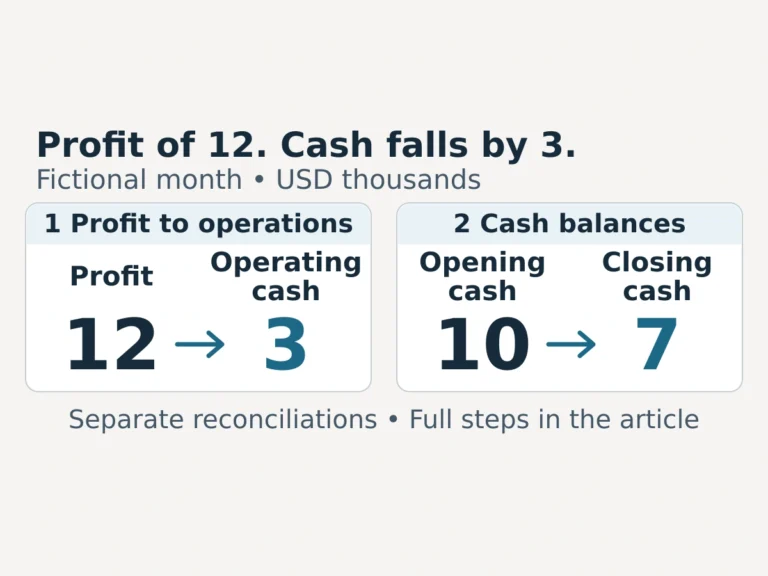
Profitable Business, Falling Cash: Reconcile the Difference
An invented one-month example reconciles net income, customer receipts, supplier payments, equipment, debt and an owner distribution to the closing cash balance.