Business Loan Paydown: Does the Interest-Rate Swap Still Match?
Two hypothetical rates expose a mismatch after principal repayment.

Estimated reading time: 8 minutes
A business loan paydown needs a separate review of any interest-rate swap. Compare the remaining loan balance with the hedge and the terms of both contracts.
A loan paydown and a swap change are separate questions. PNC explains that the swap is a separate contract; its lender materials distinguish loan prepayment terms from swap termination provisions. Check both contracts rather than assuming one transaction automatically changes the other.
In a pay-fixed, receive-floating swap, payments use a reference amount called the notional. That amount need not equal the outstanding loan.
Business loan paydown: an intentionally unmatched example
Assume a $750,000 loan charging benchmark plus 2%, and a separate $1,000,000 swap paying 4% while receiving that same benchmark.
The loan started at $1,000,000. A $250,000 principal repayment occurred before the illustrated period. For this example only, the swap contract remains unchanged. This is a stipulated contract outcome, not a rule for every loan or swap.
All rates below are invented annual rates. Both contracts use the same benchmark fixing and reset date, one 90-day period and a 360-day denominator. Amounts stay constant throughout that period. There are no floors, caps, fees, compounding or payment delays in the model; both counterparties perform as promised.
Each flow equals its calculation amount × annual rate × 90/360.
| Benchmark | 3% | 6% |
|---|---|---|
| Loan interest paid | $9,375 | $15,000 |
| Swap fixed paid | $10,000 | $10,000 |
| Swap floating received | $7,500 | $15,000 |
| Paid minus received | $11,875 | $10,000 |
Audit the 3% column: $750,000 × 5% × 0.25 = $9,375; $1,000,000 × 4% × 0.25 = $10,000; $1,000,000 × 3% × 0.25 = $7,500. Then $9,375 + $10,000 − $7,500 = $11,875. The 6% column changes only the benchmark input.
The swap exceeds the loan by $250,000. Here, higher benchmark rates increase receipts more than loan interest, so combined outflow falls. The package is no longer fully fixed.
The two alternatives differ by $1,875. They are sensitivity tests, not a forecast or a reason to prefer one arrangement. The table excludes the earlier $250,000 principal repayment and all other business cash movements.
The last row is arithmetic, not a right to net separate contracts. It isn’t APR, total borrowing cost or a swap termination valuation.
Business loan paydown: isolate the mismatched amount
The original swap notional exceeds the loan principal by $250,000. Separate the $1,000,000 swap into a mathematical $750,000 matched portion and a $250,000 excess portion. This is an analytical split, not a contract amendment.
On the matched portion, the loan’s benchmark charge and swap’s benchmark receipt cancel in the model. The remaining annual rate components are the 2% loan spread and 4% fixed swap payment on $750,000.
For 90/360 of a year, that matched portion produces $750,000 × 6% × 0.25 = $11,250. It is independent of the benchmark only under the example’s identical fixing, timing and other simplifying assumptions.
The excess portion pays 4% and receives the benchmark on $250,000. At a 3% benchmark, its net outflow is $625 for the period. Adding that to $11,250 reproduces $11,875.
At a 6% benchmark, the excess portion has a $1,250 net receipt. Subtracting that receipt from $11,250 reproduces the original $10,000 combined outflow.
Business loan paydown: derive the sensitivity
Write loan principal as L, swap notional as N and benchmark as b. With the fixed example spread and swap rate, the annualized arithmetic is L × (b + 0.02) + N × 0.04 − N × b.
Collecting terms gives L × 0.02 + N × 0.04 + (L − N) × b. Multiply the full expression by 0.25 for the stipulated 90/360 period.
Here L − N is negative $250,000. A one-percentage-point increase in the benchmark therefore changes the period outflow by negative $625: −$250,000 × 0.01 × 0.25.
The three-point rise from 3% to 6% reduces the modeled outflow by $1,875. This is exposure caused by the mismatch, not an interest saving guaranteed for the life of either contract.
The formula explains the direction of the table. It doesn’t value the swap or decide whether an unmatched position is appropriate for a particular business.
Test a lower benchmark as well
Keep the $750,000 loan and $1,000,000 notional fixed. At a fictional 2% benchmark, loan interest is $7,500, the fixed swap amount is $10,000 and the floating receipt is $5,000.
The combined arithmetic outflow is $12,500. At a fictional zero benchmark, it becomes $3,750 + $10,000 − zero = $13,750. Neither test adds a floor or changes the original model’s exclusions.
These alternatives show why looking only at the higher benchmark could be misleading. In this over-notional example, a lower benchmark increases the combined outflow. That’s the other side of the sensitivity.
Don’t assign probabilities to these invented rates or describe the smallest tested outflow as a forecast. They are conditional calculations with the same principal, notional and period.
Compare a matched notional without assuming it’s available
For an independent benchmark comparison, assume a different swap notional of $750,000 with the same 4% fixed rate. Keep the loan at $750,000, spread at 2% and all other model assumptions unchanged.
At 3%, loan interest of $9,375 plus $7,500 fixed paid minus $5,625 floating received equals $11,250. At 6%, $15,000 + $7,500 − $11,250 also equals $11,250.
This mathematical alternative isn’t a quoted amendment to the existing swap. Changing a real notional or contract can involve terms and costs outside the periodic-flow comparison.
The matched calculation also doesn’t mean an actual loan-and-swap package is risk-free. The model expressly omits differences in timing, basis, floors, counterparty performance and other contractual features that require separate review.
Test the opposite mismatch
For another independent alternative, assume the same $750,000 loan but only $500,000 of swap notional. At a 3% benchmark, the period’s amounts are $9,375 loan interest, $5,000 fixed paid and $3,750 floating received.
The combined outflow is $10,625. At 6%, the amounts are $15,000, $5,000 and $7,500, producing $12,500. Now the three-point benchmark increase raises outflow by $1,875.
The direction reverses because L − N is positive $250,000. The unhedged loan portion retains positive benchmark exposure in this simplified model.
Comparing the two mismatches helps explain the arithmetic; it isn’t advice to change an existing derivative. Each alternative assumes a different notional and excludes any transition or termination payment.
Keep principal repayment outside the interest row
The original $250,000 paydown happened before the illustrated 90-day period. Adding it to the period’s interest-and-swap total would mix a prior principal cash movement with the stated flow comparison.
A complete business cash forecast should include actual principal payments at their dates, but label them separately. The table’s last row isn’t the total cash requirement for the business or even every loan-related outflow.
Likewise, an amendment quote or termination valuation isn’t another periodic fixed-rate payment. Record its actual amount, direction, effective date and conditions separately when comparing a concrete proposal.
Don’t estimate that value by multiplying the $1,875 sensitivity by a guessed number of periods. Future rates, timing, discounting and contract terms aren’t supplied by the table.
Reconcile schedules before considering action
Bring the actual remaining loan schedule and swap notional schedule to the lender, counterparty and independent advisers. Confirm benchmarks, reset dates, day counts and any constraints or charges on a proposed change.
If the loan amortizes further, this constant-balance illustration no longer describes every later period. Recalculate each relevant period from its actual principal and notional assumptions rather than repeating the original result.
A business loan paydown review should explain the remaining exposure and contractual options before comparing any action. Correct periodic arithmetic is a useful diagnostic, but it doesn’t supply an executable quote, a termination value or a recommendation.
For a business loan paydown comparison, retain the direction of every flow: loan paid, fixed swap paid and floating swap received. Reversing the receipt sign would change the result even with correct rates and balances. A second reader should be able to reproduce the final row from those three signed amounts and the stated period.
Resolve the contract questions first
Ask the lender and swap counterparty to confirm the post-paydown principal and notional schedules, whether any amendment or termination is required, and the applicable terms. Request a dated quote for any proposed swap change alongside the loan’s prepayment costs. PNC warns early termination may produce a material payment either to or from the borrower; the table doesn’t estimate it.
Have qualified independent advisers review the documents and consequences before acting. This is an existing-business-borrower illustration, not a recommendation to enter, retain or terminate a derivative.
Sources: PNC overview; PNC lender sheet; CFTC definitions.
For the broader debt comparison, review business debt refinancing costs and term changes and day-count conventions in business loan quotes. Keep the swap’s obligations separate from the loan quote and payment schedule.
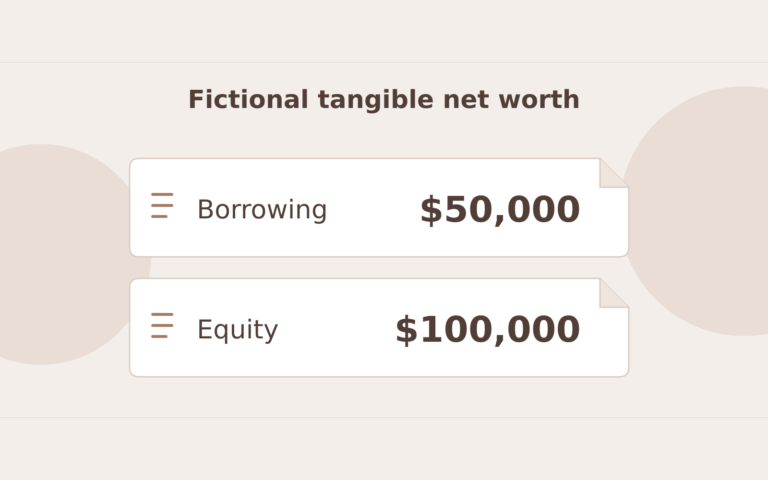
Business Cash and Tangible Net Worth
Compare equal cash injections, different obligations.
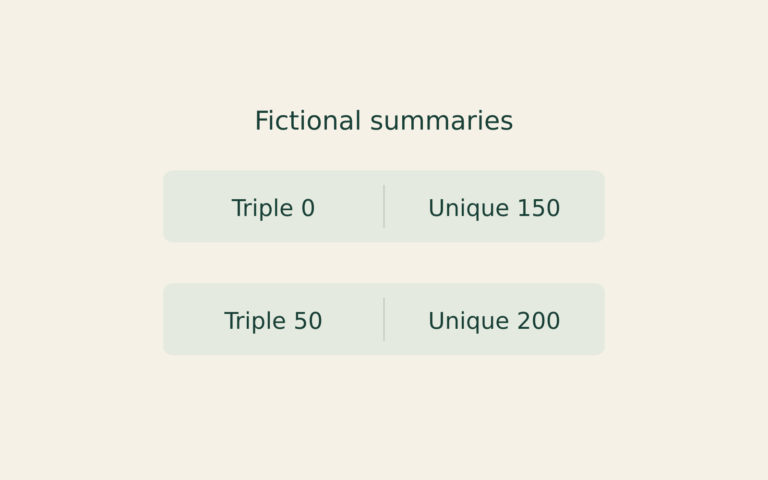
Customer Overlaps
A business worksheet can contain every pairwise channel overlap yet still leave its unique-customer total unresolved.
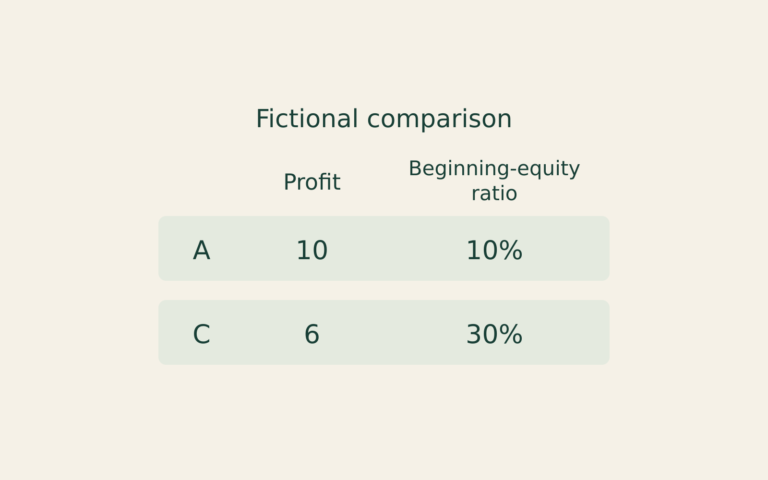
Equity Returns
A higher profit-to-equity percentage need not mean more profit. This fictional comparison holds operations constant and then reverses the calculation.