Business Loan Rate Floors: Index Minimum or Combined Minimum?
Compare two fictional floor clauses, then check a daily-floor calculation before estimating interest savings.

Estimated reading time: 5 minutes
A business loan quote that says “3% floor” is incomplete for comparison purposes. Does that minimum apply to the reference index before the lender adds its margin, or to the combined interest rate? Write the two calculations separately before estimating what falling rates would save.
This guide uses invented contract terms to isolate that difference. It isn’t a rate forecast, a loan offer, or a statement that either structure is available to your business.
Identify which number has the minimum
An index floor and a margin can create a higher effective minimum. In Federal Reserve reporting Q&A Y140000869, a contract with a zero base-rate floor and a 2.5% margin has an effective floor of 2.5%. This is an illustration in bank-reporting guidance, not a requirement that your loan use those terms.
A minimum can instead be expressed for the interest rate payable. BRT Apartments’ September 17, 2026 filing reports a facility amendment to three-month term SOFR plus 2.10 percentage points, with a 5% minimum interest rate payable. That company-specific disclosure illustrates the distinction; it isn’t a small-business product recommendation or evidence of typical pricing.
Two invented quotes with the same headline floor
For the worksheet, assume two hypothetical interest-only loans. Each has $120,000 outstanding throughout one 30-day interest period, a 360-day denominator, a fixed two-percentage-point margin, and a stated 3% floor. There are no fees, caps, principal payments, compounding, default charges or other adjustments. The selected index stays constant within each scenario and applies immediately for that entire period.
- Quote A — index minimum: use the greater of the index and 3%, then add two percentage points.
- Quote B — combined-rate minimum: add two percentage points to the index, then use the greater of that sum and 3%.
These are deliberately different assumed instructions, not competing interpretations of a real document. “Combined rate” here means index plus margin after the stipulated floor calculation; it doesn’t mean APR or a rate incorporating fees.
| Index | A: index floor | B: combined floor |
|---|---|---|
| 5% | 7%; $700 | 7%; $700 |
| 3% | 5%; $500 | 5%; $500 |
| 2% | 5%; $500 | 4%; $400 |
| 0% | 5%; $500 | 3%; $300 |
For every cell, interest equals $120,000 × the annual rate as a decimal × 30 ÷ 360. At the 2% index, A uses 3% + 2% = 5%, producing $500. B uses the larger of 2% + 2% and 3%, producing 4% and $400.
The $100 difference is interest for this one stipulated period, not lifetime savings. Neither loan reduces the $120,000 principal during the example. A complete repayment budget must separately include when that principal is due.
Find where further index declines stop helping
For A, the index reaches its minimum input at 3%. Any lower index leaves the worksheet’s annual rate at 5%. For B, the combined calculation reaches 3% when the index is 1%: 1% + 2% = 3%. Below 1%, B remains at 3%.
This gives two different thresholds even though both hypothetical quotes display a 3% floor. At the initial 5% index, both cost $700 for the period, so checking only that starting scenario would hide the difference.
Now imagine a business budget that assumes the index falls from 3% to 2%. It would overstate savings by $100 if it assigned B’s $400 interest to A. Nothing is wrong with multiplication in that mistaken budget; the wrong contract formula was selected first.
Don’t move a daily floor to the end of a period
Timing also matters. The ARRC’s SOFR in-arrears conventions recommend daily application of floors for the covered syndicated-business-loan structures, rather than applying them only at period end. The document expressly describes voluntary recommendations that may not fit every business-loan market. Check the agreement rather than imposing that convention on a different loan.
For a separate invented variation of A, stipulate daily simple interest, the same unchanged principal and denominator, and a daily index of 4% for 15 days followed by 2% for 15 days. Apply A’s index floor each day. The first block uses 6%; the second uses 5%.
Interest is $120,000 × 6% × 15/360 + $120,000 × 5% × 15/360 = $300 + $250 = $550. This is a synthetic two-block exercise, not a calendar of actual SOFR fixings.
A shortcut that first averages the indices gets 3%, then adds the 2% margin and calculates $500 for 30 days. It understates this explicitly daily-floor model by $50. The shortcut loses the extra charge on the days when the 2% index was replaced by 3%.
Ask for a reproducible calculation
For your own review, assemble a short question sheet rather than choosing a formula from a headline:
- Which clause defines the index, margin and floor, including amendments?
- What exactly is floored: the index, an adjusted index, or the combined rate?
- Which observation dates, reset dates and calculation periods apply?
- Can the lender show one below-floor example using your actual balance and dates?
- Which principal payments and charges must be budgeted outside that interest result?
If the written terms and a lender’s example disagree, request an explanation identifying the controlling provision before relying on the lower figure. Ask a qualified adviser to review unclear contract language. This worksheet provides arithmetic, not a legal interpretation of your agreement.
Keep other comparison questions separate: use the business-loan day-count worksheet for time conventions and the credit-line ledger guide for changing balances and fees. A correct floor calculation is one input to a borrowing decision, not the whole decision.
Educational examples for U.S. business borrowers. Sources checked October 29, 2026; all worksheet rates and balances are fictional.
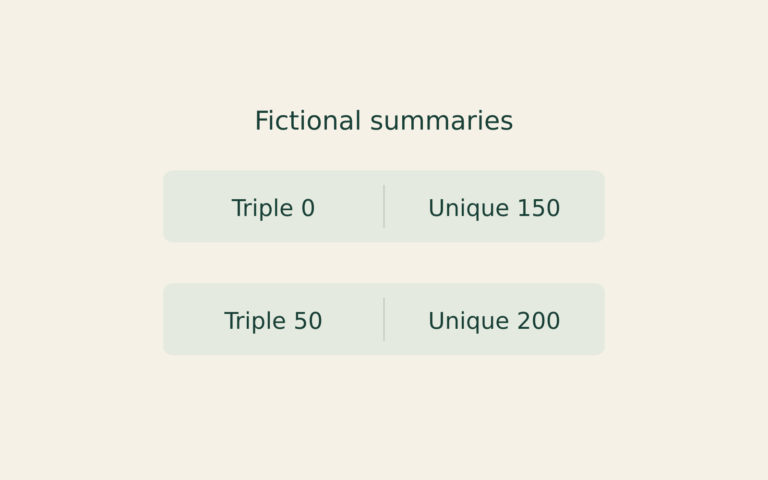
Customer Overlaps
A business worksheet can contain every pairwise channel overlap yet still leave its unique-customer total unresolved.
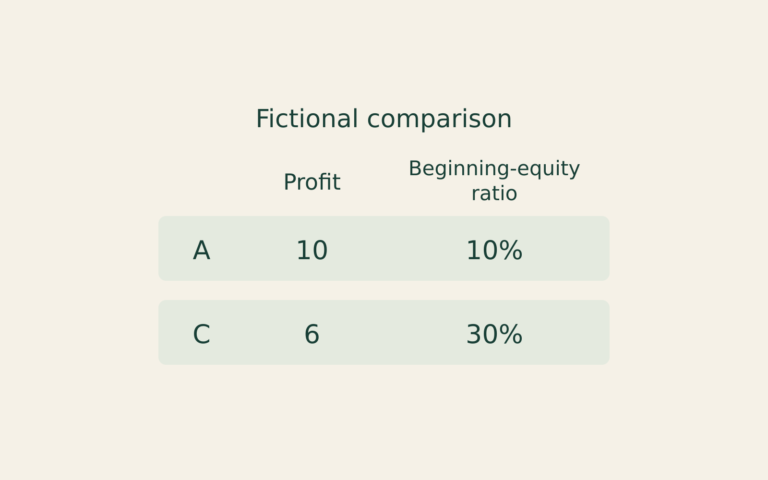
Equity Returns
A higher profit-to-equity percentage need not mean more profit. This fictional comparison holds operations constant and then reverses the calculation.
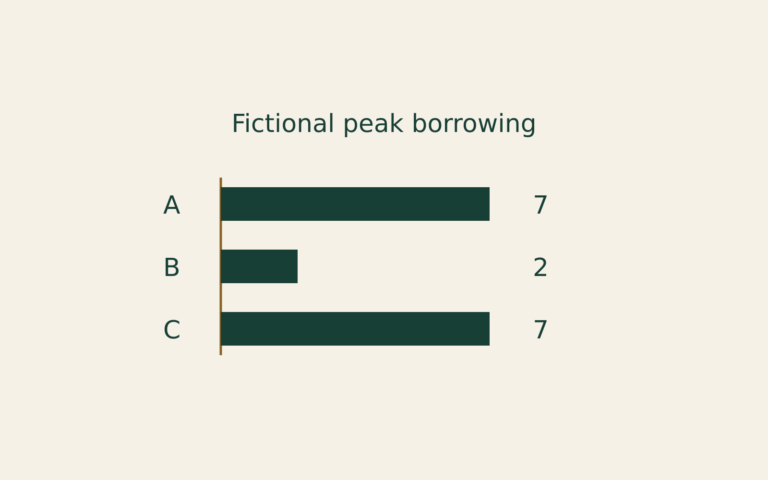
Hedge Funding Peaks
A matched terminal receipt does not specify the largest borrowing balance along the way. This fictional example connects both calculations using one price…